Flexure/Bend: How Is It Tested, What are the Standards and Why Is It Necessary


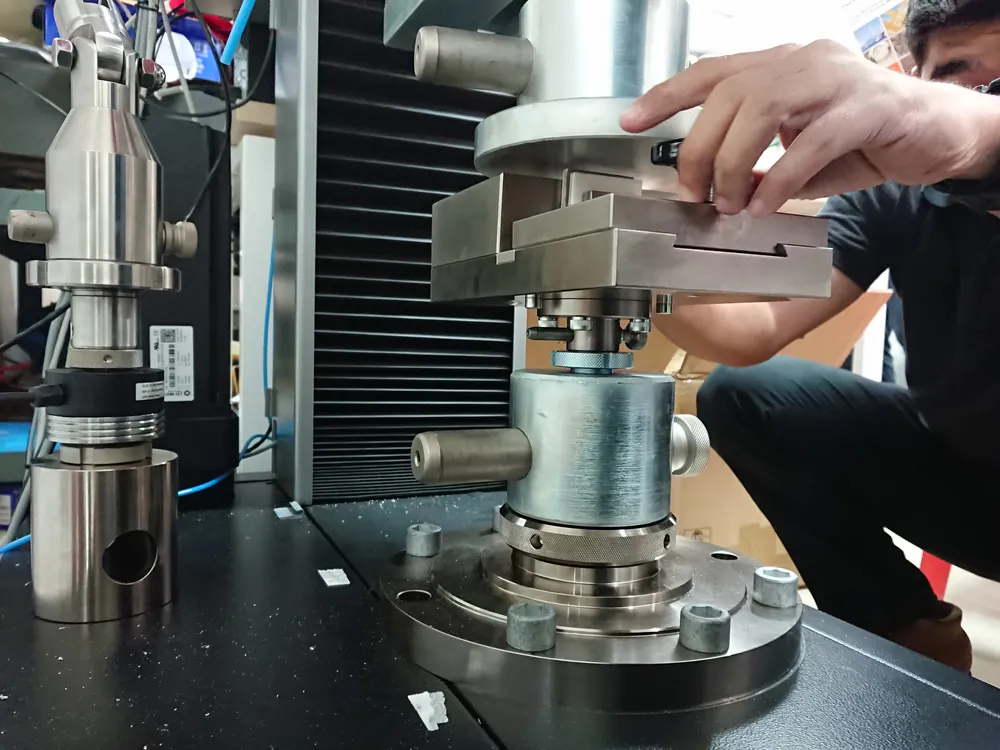
Whether designing a bridge, making aircraft components, or working on a smaller project, you’ll need to know and understand the flexural properties of the material to make sure it can live through whatever stresses you intend to put it under. Flexure (or bend) testing is the way to do this. Read on to find out exactly what it is, how it works, and how to do it.
What is Flexure/Bend?
Flexure/bend testing is a straightforward and dependable mechanical testing method used to evaluate the behavior of a material when it’s subjected to bending forces. It can be done on a variety of different materials, including:
- Metal (steel, aluminum, copper, alloys)
- Plastic (thermoplastics, thermosetting plastics)
- Composites (combination of different materials like fibers and resins)
- Brittle materials (ceramics, ceramic composites)
- Wood (plywood, particleboard, and other wood-based materials)
- Paper (cardboard and similar)
This test provides information on the material’s mechanical properties, namely flexural strength, flexural modulus, bending stiffness, surface behavior, and response to bending stress. Knowing these helps in the material selection process as you can compare the performance of different materials under bending loads to choose the most suitable one for your particular project. In addition, it provides essential data for research and development purposes in the study and improvement of materials, the development of new products, optimizing designs, and enhancing structural integrity.
It’s worth noting, however, that the size and thickness of the samples tested can influence the results (i.e., it can be hard to get uniform stress distribution on thin samples). For useful data, you’ll need to test on a piece representative of the intended application. There are also various standards to adhere to (which we’ll cover a little further down), and choosing the appropriate one for a specific material or application can sometimes be quite the challenge.
How Does the Flexure/Bend Test Work?
During flexure/bend testing, a sample or specimen is placed on supports. A force is applied to the center or at specific points on the specimen. This force causes the specimen to bend or flex, and the resulting deflection or strain is measured.
A flexure/bend test is performed using a universal testing machine. These machines are designed to assess the ductility, bend strength, fracture strength, and resistance to fracture of materials. A bend test is specifically designed to evaluate the crack resistance of ductile materials. During a bend test, forces are applied to the sample in a manner that induces deformation, emphasizing any flaws or cracks present in the material. This allows for the assessment of the material's ductility. These tests are typically conducted on ductile metals and metal products.
What Are Flexure/Bend Test Standards?
Some of the most common standards that apply to flexure tests can be found in the table below.
Standards for Flexure Bend
Flexure/Bend Test Applications
Flexure or bend testing is a go-to method across industries like engineering, construction, aerospace, and manufacturing. It helps professionals understand how materials behave under load, ensuring they can handle real-world stresses. For engineers, it’s particularly important so they can design strong, reliable structures like bridges and beams. Manufacturers use it to verify product quality and compliance with industry standards. In aerospace, where materials face extreme forces, flexure testing helps ensure the safety and performance of aircraft components. Many industries even require this test to meet regulations, making it a must for assessing material durability and reliability.
Why Is Flexure/Bend Testing Necessary?
Flexure tests offer a dependable and straightforward testing approach. They provide valuable insights into the stress-strain characteristics of material within low specimen strain. Flexure/bend testing helps to assess mechanical properties and behavior under bending loads. Flexure testing is crucial for quality assurance purposes to help ensure that only high-quality and reliable components are used in various applications. Additionally, flexure/bend testing is often required for regulatory compliance. Many industries have specific standards and regulations that mandate such testing to ensure that materials and products meet safety, quality, and performance requirements.
What Do You Need for Flexure/Bend Testing?
There are several essential components and items of equipment needed to perform flexure/bend testing. The key requirements are:
- Test Specimen: This is the material sample that will undergo bending or flexural loading during the test. The specimen is typically in the form of a rectangular or cylindrical shape, depending on the testing standard and the material being tested.
- Testing Machine: A universal testing machine or a specialized flexure/bend testing machine is required. This machine applies the bending load to the specimen and measures the corresponding response. It consists of load cells, grips, or supports for specimen fixation and control software to regulate the test parameters.
- Loading Configuration: Depending on the testing standard and the desired test type (e.g., three-point bend or four-point bend), the testing machine should be equipped with an appropriate loading configuration. This configuration includes supports or anvils for specimen placement and loading fixtures for applying the bending force.
- Measurement Devices: Strain gauges, extensometers, or displacement transducers are used to measure the deflection or displacement of the specimen during the bending test.
What Are the Benefits of Flexure/Bend Testing?
Flexure/bend testing offers several benefits in material testing and analysis, including:
- Allows for the evaluation of various material properties such as flexural strength, flexural modulus, bending stiffness, and flexural resistance.
- Offers a closer examination of the material's surface behavior, providing insights into how it responds to bending stresses.
- Aids in material selection by comparing the performance of different materials under bending loads.
- Provides essential data for research and development purposes to study and improve materials, develop new products, optimize designs, and enhance structural integrity.
What Are the Challenges of Flexure/Bend Testing?
Flexure/bend testing, while valuable, also presents some challenges that need to be considered. These are listed below:
- The size and thickness of the samples used in flexure/bend testing can influence the results. For thin samples, ensuring uniform stress distribution across the specimen width can be challenging. Additionally, the sample size should be representative of the intended application to provide meaningful data.
- There are various standards available for flexure/bend testing, and choosing the appropriate standard for a specific material or application can be challenging.
What Are the Types of Flexure/Bend Testing?
There are three main types of flexure tests based on the number of support points involved. The below table provides all the necessary differentiating characteristics of each test, and further down, you’ll be able to see images with examples for each type.

Flexure Bend Test Types
Flexure/Bend Test Examples
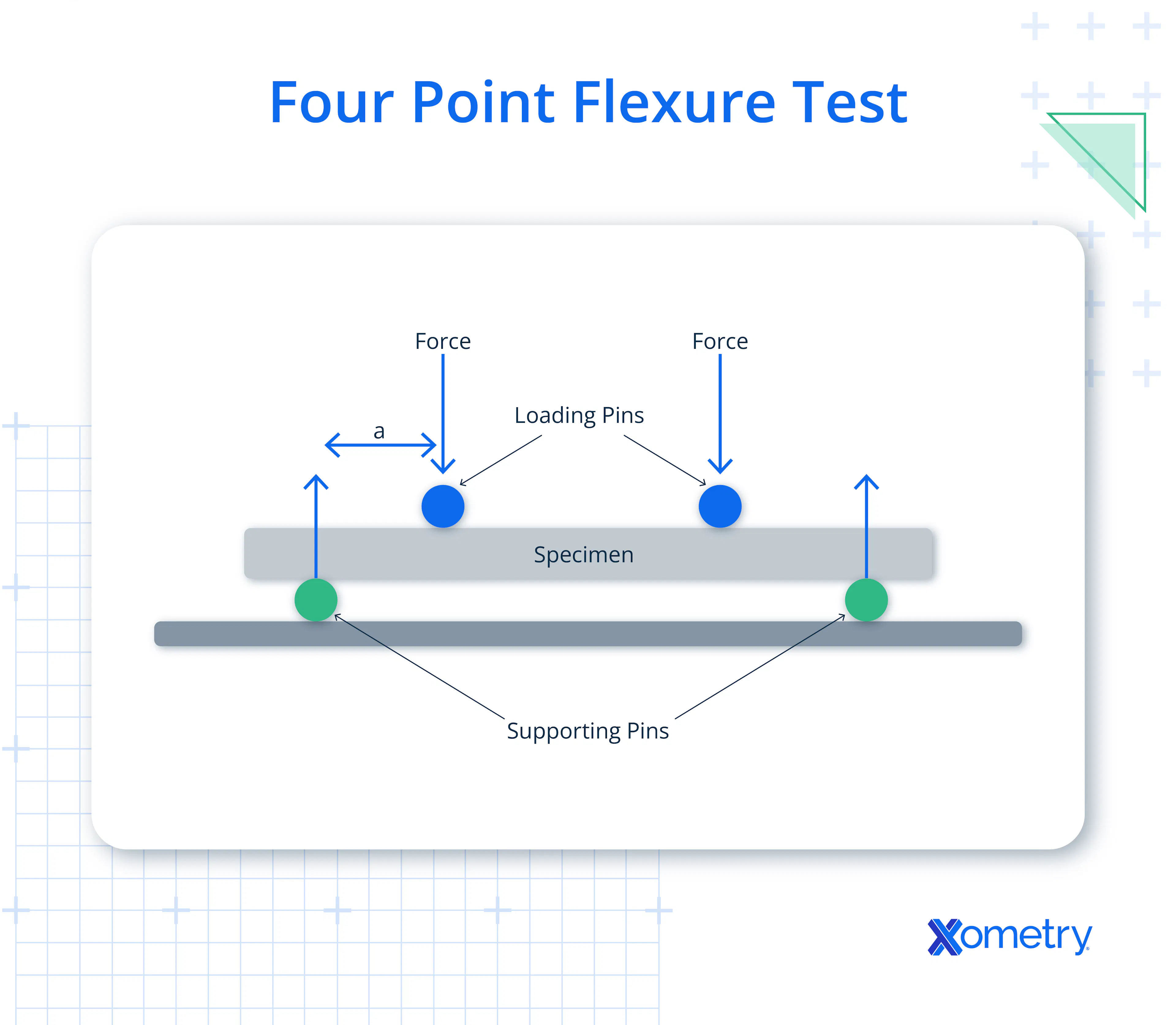

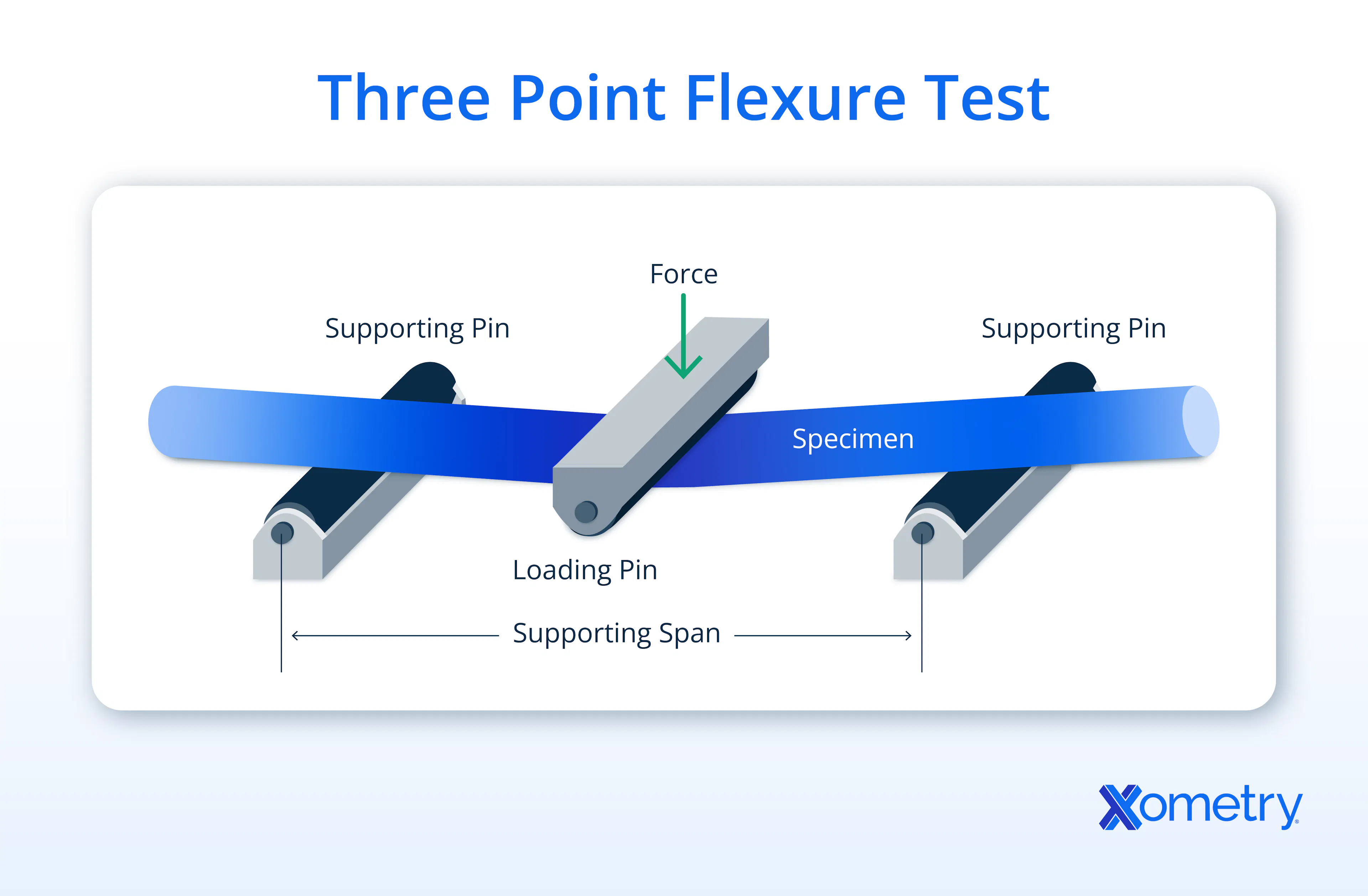
What Equipment is Needed for Flexure/Bend Testing?
To perform a flexure/bend test, you’ll need the material sample being tested, which is usually rectangular or cylindrical, and a universal testing machine (UTM), which is a specialized flexure testing device that applies the load and measures the response. In addition, fixtures, supports, and anvils to hold the specimen in place (based on the test type) are needed, as well as measurement devices, like strain gauges, extensometers, or displacement sensors to track deflection and stress distribution.
What is the Process of Flexure/Bend Testing?
Once you’ve got all the necessary equipment, here are the steps in the flexure/bend testing process:
- Cut and prep your sample, and inspect it for defects.
- Place the material on the supports and calibrate the machine according to the chosen testing standard (ASTM, ISO, etc.).
- Set the machine to apply the force at the designated point(s), which will cause the sample to bend.
- Measure track deflection, stress, and strain as the force increases.
- Keep going until the sample reaches its breaking point or its maximum deflection limit.
"Flexure tests are simple and cost-effective for evaluating a material's bending behavior, but require meticulous alignment and specimen preparation to mitigate stress concentrations and ensure accurate results. Standardized procedures and careful data interpretation are crucial for reliable analysis."
What Materials Can Be Subjected to Flexure/Bend Test?
A wide range of materials can be subjected to flexure/bend testing. Some of the common materials include:
- Metals: Various types of metals, including steel, aluminum, copper, and alloys, can be tested for their flexural properties.
- Plastics: Different types of plastics, such as thermoplastics and thermosetting plastics, can undergo flexure testing to evaluate their bending behavior and strength.
- Composites: Composite materials, which consist of a combination of different materials like fibers and resins, are often tested using flexure/bend tests to assess their mechanical properties.
- Ceramics: Brittle materials like ceramics and ceramic composites can be subjected to flexure testing to determine their resistance to bending forces and evaluate their structural performance.
- Wood: Wood and wood-based materials, including plywood and particleboard, can be tested for their flexural strength and stiffness.
- Paper and Cardboard: Flexure tests are also performed on paper, cardboard, and other similar materials to assess their bending properties, stiffness, and resistance to deformation.
Note that the suitability of a specific material for flexure/bend testing depends on its mechanical characteristics and the specific testing standards or requirements applicable to that material.
How is Flexure/Bend Be Measured?
A flexure test is primarily conducted to determine the flexural modulus and flexural strength of a material. The flexural modulus is derived from the slope of the stress versus strain deflection curve. Flexural strength, on the other hand, refers to the maximum stress experienced by the outermost fiber on the tension or compression side of the specimen. Both parameters provide valuable insights into the material's ability to withstand bending or flexural forces.
How Important Is the Flexure/Bend Test for Engineering?
Engineers rely on tests such as bend tests to give them a better understanding of material behavior under loads. It helps engineers assess the structural integrity of materials and components. Engineers can determine their ability to withstand applied loads and deformations by subjecting them to bending forces. This information is crucial in designing and analyzing structures such as: beams, columns, bridges, and other load-bearing elements.
How Important Is the Flexure/Bend Test for Manufacturing?
Manufacturers rely on the results of flexure testing to ensure the quality of their products and meet industry standards. They can evaluate their strength, flexibility, and resistance to deformation or failure by subjecting materials or components to bending forces. Flexure tests are a reliable method to verify if the materials or products can perform as intended.
How Important Is the Flexure/Bend Test for Aerospace Industry?
The flexure/bend test is essential for ensuring the reliability, safety, and performance of materials and structures used in aircraft and spacecraft. Aerospace structures, such as wings, fuselages, and landing gear, are subjected to a variety of bending loads during flight and landing. The flexure/bend test allows engineers to evaluate the structural integrity of materials and components under these bending forces. It helps identify potential failure modes, deformations, and the ability of the structure to withstand expected loads, ensuring the overall safety and performance of aerospace systems.
Is the Flexure/Bend Test Required for Engineering?
Yes, in many engineering fields, flexure/bend testing is necessary and highly recommended. The requirement for flexure/bend testing in engineering depends on the specific application, industry, and regulatory standards involved. For example, industries such as aerospace, automotive, construction, and consumer goods, have established standards and regulations that specify the testing methods and requirements for materials and components. In many cases, these standards include flexure/bend testing as a mandatory or recommended test procedure.
Flexure/bend testing provides valuable insights into the mechanical behavior and performance of materials and structures under bending loads. It helps engineers understand the flexural strength, stiffness, ductility, fatigue resistance, and other properties that are critical for assessing the suitability of materials and designing structures to withstand bending forces.
Frequently Asked Questions on Flexure/Bend Testing
How Xometry Can Help
For more info on flexure/bend tests, get in touch! If you’re good on the material testing front, let’s work together to get your manufacturing projects underway. Xometry offers dozens of unique materials from plastics, metals, composites, and more. Find these materials in the Xometry Instant Quoting Engine® and get automatic pricing and lead times on various manufacturing processes like CNC machining, 3D printing, casting, and more!
Disclaimer
The content appearing on this webpage is for informational purposes only. Xometry makes no representation or warranty of any kind, be it expressed or implied, as to the accuracy, completeness, or validity of the information. Any performance parameters, geometric tolerances, specific design features, quality and types of materials, or processes should not be inferred to represent what will be delivered by third-party suppliers or manufacturers through Xometry’s network. Buyers seeking quotes for parts are responsible for defining the specific requirements for those parts. Please refer to our terms and conditions for more information.