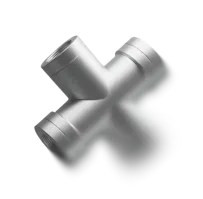
Types of Cast Iron


Types of cast iron refer to distinct classifications of iron-carbon alloys, each characterized by different cooling rates, carbon distributions, and alloying additions. Types of cast iron share a carbon content ranging from 2% to 4%, yet the form that carbon takes within the microstructure determines each material's mechanical behavior. The graphite structure, whether in flake, nodular, or temper carbon form, directly influences properties like tensile strength, hardness, and brittleness.
Types of cast iron differ across grades based on composition, microstructure, and mechanical performance. For example, Grey cast iron contains flake graphite that promotes damping but reduces tensile strength to around 100 to 350 MPa. Ductile cast iron achieves tensile strengths of 414 to 827 MPa through nodular graphite formation. White cast iron, with a hardness reaching 700 HB, offers extreme wear resistance but poor ductility. Malleable cast iron, treated through annealing, restores toughness to brittle white iron. Alloy cast iron incorporates elements (nickel, chromium, molybdenum) to achieve heat or corrosion resistance beyond standard grades.
1. Grey Cast Iron
- Contains graphite in flake form distributed across a ferritic or pearlitic iron matrix
- Fracture surfaces appear grey due to exposed graphite flakes
- Tensile strength ranges from 100 to 350 MPa, with compressive strength reaching 570 MPa
- Brinell hardness falls from 150 to 300 HB
- Density measures approximately 7.15 g/cm³
- Melting point sits near 1,200°C, lower than most ferrous alloys
- Thermal conductivity ranges from 46 to 51 W/(m·K)
- Offers excellent vibration damping, good machinability, and high castability
- Carbon content ranges from 2% to 4%, with silicon from 1% to 3%
- Classified under ASTM A48, spanning Class 20 to Class 60, with the Grey Cast Iron referring to the most widely produced cast iron type valued for castability and cost efficiency
2. White Cast Iron
- Carbon remains locked as iron carbide (Fe₃C), known as cementite, with no free graphite present
- Fracture surfaces appear white and crystalline due to the cementite phase
- Hardness reaches 400 to 700 HB, the highest of all cast iron types
- Tensile strength is low at 140 to 180 MPa with near-zero ductility
- Compressive strength reaches approximately 1,400 MPa
- Carbon content ranges from 2.5% to 3.5%, with manganese from 0.25% to 0.80%
- Extremely brittle with an elongation value of less than 0.5%
- Rapid cooling during solidification suppresses graphite formation, producing the carbide-dominant structure
- Classified under ASTM A532 for abrasion-resistant white irons
3. Ductile Cast Iron (Nodular Cast Iron)
- Graphite forms as spherical nodules within the iron matrix after magnesium treatment during casting
- Fracture surfaces appear dark gray with rounded graphite particles distributed throughout the structure
- Hardness ranges from 130 HB to 300 HB, depending on ferritic or pearlitic microstructure composition
- Tensile strength reaches 414 MPa to 900 MPa with elongation values from 2% to 18%
- Compressive strength reaches approximately 1,000 MPa to 1,600 MPa under heavy loading conditions
- Carbon content ranges from 3.0% to 4.0%, with silicon from 1.8% to 2.8%
- Impact resistance remains significantly higher than gray cast iron due to the nodular graphite structure
- Slow cooling during solidification preserves graphite nodules instead of forming cementite networks
- Classified under ASTM A536 for ductile iron castings used in industrial and automotive applications
- Machinability remains favorable because the graphite nodules reduce cutting resistance during machining operations involving Ductile Cast Iron (Nodular Cast Iron).
4. Malleable Cast Iron
- Graphite exists as irregular temper carbon clusters after prolonged heat treatment of white cast iron
- Fracture surfaces appear black and granular due to the temper carbon distribution within the matrix
- Hardness ranges from 120 HB to 250 HB, depending on ferritic or pearlitic heat treatment conditions
- Tensile strength reaches 350 MPa to 450 MPa with elongation values from 5% to 15%
- Compressive strength reaches approximately 900 MPa to 1,300 MPa under static loading conditions
- Carbon content ranges from 2.0% to 2.7%, with silicon from 0.9% to 1.9%
- Impact resistance exceeds that of white cast iron because the annealing process reduces brittleness in the structure
- Prolonged annealing at temperatures from 850°C to 950°C decomposes cementite into tempered carbon particles
- Classified under ASTM A47 for ferritic malleable iron castings used in mechanical and structural applications
- Machinability remains favorable because the tempered carbon structure lowers cutting resistance during processing involving Malleable Cast Iron
5. Alloy Cast Iron
- Alloying elements (chromium, nickel, molybdenum, copper) modify the microstructure and mechanical properties of the iron matrix
- Fracture surfaces vary from gray to white, depending on carbide formation and alloy concentration levels
- Hardness ranges from 180 HB to 700 HB based on alloy composition and heat treatment conditions
- Tensile strength reaches 300 MPa to 900 MPa under high-strength industrial casting applications
- Compressive strength reaches approximately 1,000 MPa to 1,800 MPa during heavy mechanical loading conditions
- Carbon content ranges from 2.0% to 3.8%, with alloying elements reaching 0.5% to 30% depending on grade classification
- Wear resistance increases significantly due to carbide formation from chromium and molybdenum additions
- Corrosion resistance improves through nickel and copper additions in chemically aggressive environments
- Controlled cooling and alloy stabilization refine the microstructure for elevated temperature performance
- Classified under ASTM A532 and ASTM A439 for abrasion-resistant and heat-resistant alloyed cast iron applications involving Alloy Cast Iron
How Do Cast Iron Grades Differ?
Cast iron grades differ based on composition, microstructure, and mechanical properties. The form of carbon present in the alloy, whether as graphite flakes, nodules, or carbides, defines the grade classification. The carbon content in cast iron ranges from 2% to 4%, and the way carbon is distributed across the matrix determines the material's behavior under load.
Variations in alloying elements such as silicon (1% to 3%), manganese (0.2% to 1%), sulfur, and phosphorus further separate one grade from another. Silicon, for instance, promotes graphite formation, while manganese stabilizes the iron carbide phase. The microstructure resulting from the combination of carbon form and alloying elements dictates whether the material exhibits brittle fracture or moderate flexibility. For example, Gray cast iron contains lamellar graphite flakes that act as stress concentrators, reducing tensile strength to a range from 100 MPa to 370 MPa. Ductile cast iron contains spherical graphite nodules, raising tensile strength to a range from 400 MPa to 900 MPa. The grade system communicates precise mechanical thresholds, allowing engineers to match material performance to structural demands.
What Do Cast Iron Grades Indicate About Strength and Hardness?
Cast iron grades indicate the level of strength and hardness a material delivers under specific loading and environmental conditions. Each grade corresponds to measurable mechanical values, including tensile strength in megapascals, Brinell hardness numbers (BHN), and yield strength thresholds. Gray iron grades, classified under ASTM A48, range from Class 20 to Class 60, where the number directly reflects the minimum tensile strength in ksi (kilopounds per square inch). A Class 20 gray iron has a tensile strength of 20 ksi, while a Class 60 delivers 60 ksi.
Higher grades reflect improved mechanical performance through refined microstructures and controlled alloy additions. Ductile iron grades under ASTM A536, for example, include Grade 60-40-18, Grade 80-55-06, and Grade 120-90-02, where the first number represents tensile strength, the second represents yield strength, and the third represents percent elongation. The hardness values for gray cast iron range from 150 BHN to 320 BHN, depending on grade, while ductile iron ranges from 140 BHN to 300 BHN. The grades guide material selection by providing engineers with standardized performance benchmarks, helping match the right cast iron type to specific structural, thermal, or wear-resistance requirements.
Are Higher Grades Associated With Better Mechanical Properties?
Yes, higher grades are associated with better mechanical properties. Higher-grade cast irons exhibit greater tensile strength, increased yield strength, and improved resistance to deformation under load. A Grade 80-55-06 ductile iron, for instance, delivers a tensile strength of 80 ksi and a yield strength of 55 ksi, outperforming Grade 60-40-18 in load-bearing applications. The refined graphite morphology and heat treatment processes applied to higher grades reduce internal stress concentrations, increasing resistance to fatigue and impact. Higher-grade gray iron, classified as Class 40 or Class 60 under ASTM A48, achieves a finer pearlitic matrix, which contributes to greater surface hardness and wear resistance. The performance advantage of higher-grade cast iron becomes evident in heavy-duty applications (engine components, hydraulic housings, and structural machine bases), where consistent mechanical behavior under cyclic stress is required. The superior load performance of higher grades confirms their role in demanding industrial environments.
What Is the Role of Iron in Cast Iron Types?
The role of iron in cast iron types acts as the base element in all cast iron types, forming the primary structural matrix that supports and interacts with carbon and other alloying elements. Cast iron is an iron-carbon alloy where the iron content ranges from 92% to 96% by weight, making it the dominant phase in the material's composition. The crystalline structure of the iron matrix, whether ferritic, pearlitic, or martensitic, determines the mechanical behavior of the final casting. A ferritic matrix promotes ductility, while a pearlitic matrix increases hardness and strength.
The iron phase acts as the host structure into which carbon precipitates during solidification. Depending on cooling rate and silicon content, carbon either forms graphite or iron carbide (Fe₃C) within the iron matrix. The properties of cast iron are modified by alloying elements such as carbon, silicon, manganese, sulfur, and phosphorus, while Iron (Fe) remains the main structural component of the material.
How Does Iron Act as the Base Element in Cast Iron?
Iron acts as the base element in cast iron by providing the structural matrix that holds carbon and other elements in cast iron, acting as the continuous phase within which all microstructural features develop. At temperatures above 1,150°C, iron remains in a liquid state that allows carbon and alloying elements to dissolve and distribute throughout the melt. Upon cooling, the iron solidifies into a crystalline lattice, forming either a ferritic body-centered cubic (BCC) structure or a pearlitic face-centered cubic (FCC) austenite structure, depending on the alloy composition and cooling rate.
The iron matrix determines core properties, including compressive strength, thermal conductivity, and machinability. Gray cast iron, which contains a predominantly pearlitic iron matrix, achieves a compressive strength ranging from 570 MPa to 1,380 MPa, a value driven by the iron phase. Silicon content ranging from 1% to 3% directly controls how the iron matrix responds to carbon, either stabilizing graphite formation or promoting carbide formation. Additives (chromium, nickel, and molybdenum) modify the iron matrix by stabilizing specific crystalline phases, changing hardness and wear resistance. The base iron phase remains unchanged in composition regardless of additive content, maintaining its role as the structural foundation across all cast iron types.
Is Cast Iron Mainly Composed of Iron and Carbon?
Yes, cast iron is mainly composed of iron and carbon. Iron constitutes 92% to 96% of the total alloy weight, while carbon accounts for 2% to 4%. The combination of iron and carbon forms the foundational chemistry of all cast iron types, including gray, ductile, white, and malleable variants. Carbon directly influences the microstructure by either forming graphite phases or iron carbide (cementite, Fe₃C) within the iron matrix. Other elements present in the alloy, including silicon (1% to 3%), manganese (0.2% to 1%), phosphorus (below 0.1%), and sulfur (below 0.05%), are present in significantly smaller concentrations. Silicon is the most influential secondary element, as it controls whether carbon forms as graphite or carbide during solidification. The iron-carbon system at high carbon concentrations defines the eutectic point at 4.3% carbon and 1,147°C, which governs the solidification behavior and final microstructure of the cast iron product.
How Does Ductile Iron Compare to Cast Iron?
Ductile iron compares to cast iron by its nodular graphite microstructure, which improves ductility and tensile strength compared to traditional gray cast iron. Standard gray cast iron contains graphite in a lamellar or flake form, which creates stress concentration points that promote brittle fracture under tensile loading. Ductile iron, produced by adding magnesium (0.03% to 0.05%) or cerium to the molten iron before casting, causes graphite to solidify into spherical nodules rather than interconnected flakes.
The spherical graphite morphology eliminates the sharp internal notches that weaken the iron matrix in gray cast iron. The tensile strength of ductile iron ranges from 400 MPa to 900 MPa, compared to 100 MPa to 370 MPa for gray cast iron. The elongation at break in ductile iron reaches from 2% to 18%, while gray cast iron exhibits near-zero ductility. The improved flexibility of ductile iron allows it to absorb impact energy without immediate fracture, making it suitable for pipes, crankshafts, and gears exposed to cyclic and dynamic loads. Gray cast iron, classified under a broader category of cast iron, remains preferred for vibration damping and compressive load applications due to its graphite flake network.
What Is the Difference Between Nodular Iron and Traditional Cast Iron?
The difference between nodular iron and traditional cast iron is shown in the table below.
Is Nodular Iron Less Brittle Than Standard Cast Iron?
Yes, nodular iron is less brittle than standard cast iron. The spherical graphite nodules in nodular iron eliminate the sharp-edged flake structures that act as internal stress concentrators in gray cast iron. Gray cast iron fractures with minimal plastic deformation because the graphite flakes provide ready-made crack propagation paths under tensile loading. Nodular iron, by contrast, forces cracks to travel around the spherical graphite particles, requiring significantly more energy to propagate a fracture. The elongation at break for nodular iron ranges from 2% to 18%, while gray cast iron records values near 0%. The fracture toughness of nodular iron ranges from 20 MPa√m to 50 MPa√m, compared to 10 MPa√m to 15 MPa√m for gray cast iron. The nodular graphite morphology distributes stress more evenly across the iron matrix, allowing the material to undergo limited plastic deformation before fracturing, which makes it far more reliable in applications exposed to dynamic and impact loading.
What Are the Key Properties of Different Cast Iron Types?
The key properties of different Cast Iron types are listed below.
- Gray Cast Iron: Gray cast iron contains lamellar graphite flakes distributed throughout a pearlitic or ferritic iron matrix. The graphite flakes provide excellent vibration damping and thermal conductivity, with conductivity values ranging from 46 W/m·K to 51 W/m·K. The tensile strength ranges from 100 MPa to 370 MPa, while the compressive strength ranges from 570 MPa to 1,380 MPa.
- Ductile (Nodular) Cast Iron: Ductile cast iron contains spherical graphite nodules formed through magnesium inoculation during casting. The nodular graphite structure raises tensile strength to a range from 400 MPa to 900 MPa and elongation at break from 2% to 18%. The material exhibits high impact resistance and fatigue resistance, making it suitable for dynamic load applications.
- White Cast Iron: White cast iron forms when carbon solidifies entirely as iron carbide (cementite, Fe₃C) rather than graphite, producing a hard and brittle microstructure. The hardness ranges from 400 HB to 700 HB, making it one of the hardest cast iron variants. The tensile strength remains low at approximately 140 MPa to 180 MPa due to the brittle nature of the carbide phase.
- Malleable Cast Iron: Malleable cast iron is produced by annealing white cast iron at temperatures from 900°C to 970°C, converting cementite into temper carbon (irregular graphite clusters). The tensile strength of malleable cast iron ranges from 275 MPa to 550 MPa, with elongation values reaching from 5% to 12%. The annealing process removes most of the brittleness found in white cast iron, producing a material with moderate ductility.
- Compacted Graphite Iron (CGI): Compacted graphite iron contains graphite in a worm-like or vermicular form, positioned from gray cast iron to ductile iron in terms of properties. The tensile strength ranges from 300 MPa to 500 MPa, while elongation at break ranges from 1% to 6%. CGI provides superior fatigue strength and thermal conductivity compared to ductile iron, making it suitable for high-temperature engine components.
- Alloy Cast Iron: Alloy cast iron incorporates elements (nickel, chromium, molybdenum, and copper) into the base iron-carbon matrix to enhance specific properties. Nickel additions from 1% to 6% improve toughness and hardenability, while chromium additions from 0.5% to 3% increase wear resistance and high-temperature strength. The Brinell hardness of alloy cast irons ranges from 180 HB to 800 HB, depending on the alloying system and heat treatment applied.
How Do Graphite Shape and Distribution Affect Cast Iron Properties?
Graphite shape and distribution directly control the strength, brittleness, and thermal behavior of cast iron by determining how stress travels through the iron matrix. In gray cast iron, graphite exists as interconnected lamellar flakes, which act as internal notches within the microstructure. The sharp tips of the graphite flakes create stress concentration factors that initiate cracks under tensile loading, reducing tensile strength to a range from 100 MPa to 370 MPa while leaving compressive strength largely unaffected.
Graphite forms as isolated spherical nodules in ductile iron, which redirect stress around the particle rather than concentrating it at a point. The spherical morphology reduces the stress concentration factor from 4 to 1.5, increasing tensile strength to a range from 400 MPa to 900 MPa. Compacted graphite iron contains a worm-like graphite form that delivers properties from gray to ductile iron, including tensile strength from 300 MPa to 500 MPa and higher thermal conductivity than ductile iron at approximately 38 W/m·K to 45 W/m·K. The distribution of graphite across the matrix also affects machinability, as evenly distributed graphite flakes (gray iron) act as a natural cutting lubricant, reducing tool wear during machining operations. The graphite shape and spatial distribution define performance across mechanical, thermal, and machining parameters.
Is Cast Iron Generally More Brittle Than Steel?
Yes, cast iron is more brittle than steel. The higher carbon content in cast iron, ranging from 2% to 4%, leads to the formation of graphite phases or iron carbide (cementite) within the microstructure, both of which reduce the material's capacity for plastic deformation. Steel contains carbon from 0.02% to 2.1%, which remains dissolved within the iron matrix as a solid solution or fine carbide precipitates, allowing for significantly greater ductility and toughness.
The elongation at break for gray cast iron is near 0%, while structural steels (ASTM A36) achieve elongation values from 20% to 23%. The fracture toughness of gray cast iron ranges from 10 MPa√m to 15 MPa√m, while medium-carbon steels reach from 40 MPa√m to 100 MPa√m. The brittle behavior of cast iron makes it susceptible to sudden fracture under impact or tensile loading without prior visible deformation. Steel deforms plastically before fracture, giving engineers a warning before structural failure occurs. Ductile iron reduces the brittleness gap with steel by converting graphite to nodular form, achieving elongation from 2% to 18%, though it still falls short of the ductility values exhibited by most structural steels. The higher carbon phase content in cast iron is the primary reason for the brittleness difference from steel.
What Are Different Types of Cast Iron Used?
The different types of cast iron used are listed below.
- Gray Cast Iron: Gray cast iron is used in applications requiring high compressive strength, vibration damping, and good machinability. Engine blocks, machine tool bases, and brake rotors rely on the graphite flake network to absorb and dissipate vibrations and heat. The thermal conductivity value from 46 W/m·K to 51 W/m·K makes it effective in heat transfer components (cookware and furnace parts).
- Ductile Cast Iron: Ductile cast iron is used in structural and dynamic load applications where tensile strength and impact resistance are required. Pipes, gears, crankshafts, and automotive suspension components rely on the nodular graphite structure for fatigue resistance and flexibility. The tensile strength from 400 MPa to 900 MPa supports high-load mechanical assemblies.
- White Cast Iron: White cast iron is used in extreme wear environments where hardness from 400 HB to 700 HB is the primary requirement. Wear-resistant liners, grinding balls, and mill plates in mineral processing equipment are made of white cast iron. The high carbide content provides abrasion resistance but limits use in impact-heavy environments due to brittleness.
- Malleable Cast Iron: Malleable cast iron is used in applications requiring moderate ductility and machinability in complex shapes. Pipe fittings, brackets, and hand tools are produced from malleable cast iron due to its capacity for controlled deformation and precise casting geometries. The elongation from 5% to 12% allows it to absorb mechanical stress without fracturing.
- Compacted Graphite Iron (CGI): CGI is used in high-performance diesel engine blocks and exhaust manifolds where thermal fatigue resistance and strength from 300 MPa to 500 MPa are required. The vermicular graphite structure delivers thermal conductivity near 38 W/m·K to 45 W/m·K, superior to ductile iron for heat dissipation. CGI reduces engine block weight while maintaining structural integrity under high cylinder pressures.
- Alloy Cast Iron: Alloy cast iron is used in heat-resistant, corrosion-resistant, and wear-resistant components across chemical processing, pumping systems, and high-temperature industrial equipment. Nickel-alloyed cast irons resist oxidation at temperatures up to 900°C, while chromium-alloyed variants achieve hardness up to 800 HB for abrasion-resistant applications. Pumps handling corrosive fluids, heat exchanger components, and furnace grates rely on alloy cast iron grades for long service life.
1. Gray Cast Iron Used for Engine Blocks, Machine Bases, and Brake Rotors
Gray cast iron is the most widely produced cast iron type, accounting for approximately 70% to 75% of total cast iron production globally. The graphite flake microstructure provides a compressive strength from 570 MPa to 1,380 MPa, making it well-suited for engine blocks that experience high cylinder pressures. Machine bases and lathe beds use gray cast iron for its vibration-damping capacity, which reduces tool chatter and improves dimensional accuracy during machining operations. Brake rotors rely on the thermal conductivity from 46 W/m·K to 51 W/m·K to dissipate frictional heat generated during repeated braking cycles, preventing thermal distortion. The Brinell hardness of gray cast iron ranges from 150 HB to 320 HB, providing adequate surface wear resistance for brake rotor contact faces. The graphite flakes act as a built-in lubricant during machining, reducing cutting forces and extending tool life in high-volume manufacturing environments.
2. Ductile Cast Iron Used for Pipes, Gears, Crankshafts, and Automotive Components
Ductile cast iron is used across piping infrastructure, power transmission components, and automotive drivetrains due to its tensile strength from 400 MPa to 900 MPa and elongation from 2% to 18%. Ductile iron pipes used in water distribution systems conform to ISO 2531 and AWWA C151 standards, with pressure ratings from 16 bar to 100 bar, depending on wall thickness and diameter. Crankshafts manufactured from Grade 80-55-06 ductile iron achieve yield strengths of 55 ksi, providing fatigue resistance under cyclic bending and torsional loads from engine operation. Gears made from ductile iron benefit from the nodular graphite structure, which distributes contact stresses evenly across gear teeth, reducing pitting and spalling wear. Automotive suspension components (steering knuckles and control arms) use ductile iron to absorb road impact loads without brittle fracture, offering a cost-effective alternative to forged steel in high-volume vehicle production.
3. White Cast Iron Used for Wear-Resistant Liners, Grinding Balls, and Mill Plates
White cast iron is used exclusively in high-abrasion environments due to its hardness from 400 HB to 700 HB, derived from the iron carbide (cementite, Fe₃C) phase that forms throughout the microstructure. Wear-resistant liners in ball mills and rod mills protect the shell from ore and mineral abrasion, with white cast iron liners lasting significantly longer than mild steel in comparable grinding environments. Grinding balls used in cement and mineral processing plants are produced from high-chrome white cast iron containing 12% to 28% chromium, which forms M₇C₃ carbides with hardness from 1,200 HV to 1,600 HV. Mill plates in crushing and grinding equipment rely on the continuous carbide network to resist metal loss under sustained abrasive contact with hard minerals. The brittleness of white cast iron limits its use to compressive and sliding wear conditions, where tensile and impact loads remain low during operation.
4. Malleable Cast Iron Used for Pipe Fittings, Brackets, and Hand Tools
Malleable cast iron is produced by annealing white cast iron at temperatures from 900°C to 970°C for periods from 20 to 70 hours, converting brittle cementite into temper carbon clusters within a ferritic or pearlitic matrix. The resulting tensile strength from 275 MPa to 550 MPa and elongation from 5% to 12% allow malleable cast iron to handle mechanical stress without fracturing at stress concentrations. Pipe fittings manufactured from malleable cast iron conform to ASTM A197 and ASTM A220 standards, where the material's machinability and thread-cutting performance support precision thread profiles. Brackets and structural connectors use malleable cast iron for its ability to be cast into complex geometries that require thin sections and sharp internal corners. Hand tools (wrenches, clamps, and vise bodies) rely on malleable cast iron for moderate impact resistance and the ability to deform slightly before fracturing, improving safety in field applications.
5. Compacted Graphite Iron Used for Diesel Engine Blocks and Exhaust Manifolds
Compacted graphite iron is used in diesel engine blocks and exhaust manifolds because it delivers a combination of thermal conductivity from 38 W/m·K to 45 W/m·K, tensile strength from 300 MPa to 500 MPa, and fatigue resistance superior to gray cast iron. Diesel engine blocks manufactured from CGI allow cylinder bore pressures exceeding 200 bar without structural failure, meeting the demands of modern high-performance compression ignition engines. The vermicular graphite structure provides 75% greater tensile strength and 45% greater stiffness than gray cast iron, reducing the need for additional wall thickness and lowering component weight. Exhaust manifolds fabricated from CGI withstand thermal cycling from ambient temperatures to over 700°C without cracking, a critical requirement for turbocharged diesel applications. The material's fatigue strength from 200 MPa to 280 MPa supports the repeated pressure pulses generated during multi-cylinder diesel engine operation at high load conditions.
6. Alloy Cast Iron Used for Heat-Resistant Parts, Pumps, and Corrosion-Resistant Components
Alloy cast iron incorporates elements (nickel, chromium, molybdenum, and copper) to extend the performance of base cast iron into high-temperature, corrosive, and extreme-wear environments. Nickel-alloyed cast irons (Ni-Resist grades) containing 14% to 36% nickel resist oxidation and scaling at temperatures from 800°C to 1,050°C, making them suitable for furnace grates, kiln furniture, and heat treatment fixtures. Chromium-alloyed white cast irons containing 12% to 28% chromium achieve hardness from 550 HB to 800 HB, used in pump impellers and volute casings handling abrasive slurries in mining and mineral processing. Molybdenum additions from 0.25% to 1% increase hardenability and improve high-temperature creep resistance in alloy cast iron components exposed to sustained thermal loads. Corrosion-resistant alloy cast irons containing silicon from 14% to 17% (high-silicon grades) resist concentrated sulfuric acid and nitric acid, making them the preferred material for chemical processing pump bodies and valve housings.
What Are the Advantages of Using Different Types of Cast Iron?
The advantages of using different types of Cast Iron are listed below.
- Gray Cast Iron: Gray cast iron delivers excellent vibration damping due to the graphite flake network, which absorbs and disperses mechanical vibrations across the matrix. The compressive strength from 570 MPa to 1,380 MPa makes it one of the most cost-effective materials for heavy compressive load applications. The graphite flake structure acts as a built-in lubricant, improving machinability and reducing tool wear during high-volume production.
- Ductile Cast Iron: Ductile cast iron provides tensile strength from 400 MPa to 900 MPa, combined with elongation from 2% to 18%, delivering a balance of strength and flexibility absent in other cast iron types. The nodular graphite morphology reduces stress concentrations, increasing fatigue life under cyclic loading. Ductile iron offers a cost advantage over forged steel in many structural applications while maintaining comparable mechanical performance.
- White Cast Iron: White cast iron provides extreme abrasion resistance due to its continuous iron carbide microstructure, with hardness from 400 HB to 700 HB. The high carbide content significantly extends the service life of wear components in grinding and crushing environments. High-chrome white cast iron grades achieve M₇C₃ carbide hardness from 1,200 HV to 1,600 HV, outperforming standard steels in abrasive wear applications.
- Malleable Cast Iron: Malleable cast iron provides moderate ductility from 5% to 12% elongation after annealing, allowing it to absorb mechanical stress without sudden fracture. The material is castable into thin sections and complex geometries that are difficult to achieve with ductile iron. Malleable iron's thread-cutting machinability makes it highly suitable for pipe fittings and precision mechanical hardware produced at an industrial scale.
- Compacted Graphite Iron (CGI): CGI delivers 75% greater tensile strength than gray cast iron while maintaining thermal conductivity from 38 W/m·K to 45 W/m·K, superior to ductile iron. The vermicular graphite structure provides higher fatigue strength from 200 MPa to 280 MPa, supporting high-cycle loading in diesel engine applications. CGI allows component weight reduction compared to gray iron equivalents while meeting higher mechanical performance targets.
- Alloy Cast Iron: Alloy cast iron extends service life in corrosive, high-temperature, and abrasive environments beyond the capability of standard cast irons. Nickel-alloyed grades resist oxidation up to 1,050°C, while high-silicon grades withstand concentrated acids in chemical processing environments. Chromium-alloyed variants achieve Brinell hardness up to 800 HB, providing wear resistance in pump, liner, and grinding applications where standard materials fail prematurely.
Disclaimer
The content appearing on this webpage is for informational purposes only. Xometry makes no representation or warranty of any kind, be it expressed or implied, as to the accuracy, completeness, or validity of the information. Any performance parameters, geometric tolerances, specific design features, quality and types of materials, or processes should not be inferred to represent what will be delivered by third-party suppliers or manufacturers through Xometry’s network. Buyers seeking quotes for parts are responsible for defining the specific requirements for those parts. Please refer to our terms and conditions for more information.