Malleable Iron vs Ductile Iron: Differences, Properties, and Applications Compared


Malleable iron vs ductile iron represents two ferrous casting alloys that both achieve graphite nodularity and improved mechanical performance over gray cast iron, yet differ fundamentally in production method, section size capability, and mechanical output. Malleable iron forms temper carbon nodules through a prolonged annealing heat treatment applied to white cast iron castings, requiring 20 to 70 hours of furnace time at 900°F to 1,750°F before the material reaches usable mechanical properties. Ductile iron achieves spheroidal graphite directly during solidification through magnesium inoculation at 0.03% to 0.05%, eliminating the multi-day heat treatment cycle entirely and reducing total production time from days to hours.
Malleable iron carries carbon from 2.0% to 2.9% and silicon from 0.9% to 1.9%, kept deliberately low to ensure full white iron solidification before annealing. Ductile iron carries higher carbon (3.2% to 3.9%) and silicon (1.8% to 2.8%), supported by precise magnesium addition that converts graphite to nodules at the moment of casting. The mechanical output of ductile iron (tensile strength 414 MPa to 800 MPa) exceeds that of malleable iron (345 MPa to 450 MPa) across tensile strength, fatigue resistance, and section size capability, establishing ductile iron as the dominant choice in modern casting applications where malleable iron and ductile iron materials compete.
What Is Malleable Iron vs Ductile Iron in Terms of Definition and Structure?
Malleable iron vs ductile iron in terms of definition and structure refers to the contrast in graphite form created through heat treatment versus direct alloy modification during solidification. Malleable iron is a ferrous casting alloy produced by annealing white cast iron at 900°F to 1,750°F for 20 to 70 hours, converting iron carbide (cementite) into irregularly shaped temper carbon nodules dispersed within a ferritic or pearlitic matrix. The annealing process decomposes the cementite network through solid-state graphitization, producing a material with elongation from 5% to 12% and tensile strength from 345 MPa to 450 MPa. The temper carbon nodules formed during annealing are rounder than gray iron flakes but less geometrically perfect than the spheroidal nodules in ductile iron, retaining minor stress concentration effects at nodule boundaries. Ductile iron achieves spheroidal graphite through magnesium inoculation (0.03% to 0.05%) performed on the molten metal immediately before pouring, causing graphite to nucleate as near-perfect spheres during solidification rather than as flakes or irregular temper carbon. The spherical nodules sit fully isolated within the ferritic or pearlitic matrix, eliminating stress concentration at nodule boundaries and producing elongation from 10% to 18% and tensile strength from 414 MPa to 800 MPa. The structural difference from malleable iron to ductile iron is nodule geometry. Temper carbon in malleable iron retains irregular boundaries from solid-state decomposition of cementite, while spheroidal graphite in ductile iron forms with near-perfect geometry from liquid-state nucleation, producing superior stress distribution and higher mechanical performance across all load types.
What aAre the Types of Malleable Iron vs Ductile Iron?
The types of malleable iron vs ductile iron are listed below.
- Whiteheart Malleable Iron: Whiteheart malleable iron is produced by annealing white cast iron in an oxidizing atmosphere at 1,650°F to 1,830°F for 60 to 100 hours, decarburizing the outer surface to near-zero carbon while leaving a harder carbon-rich core. The surface achieves elongation up to 12% and tensile strength from 350 MPa to 420 MPa, making it suitable for thin-section pipe fittings, agricultural machinery parts, and hand tools produced in European foundry traditions.
- Blackheart Malleable Iron: Blackheart malleable iron is annealed in a neutral atmosphere at 1,650°F to 1,750°F for 20 to 70 hours, converting cementite to temper carbon throughout the full section without decarburization. The resulting material achieves tensile strength from 300 MPa to 450 MPa and elongation from 6% to 12%, forming the dominant malleable iron type in North American production for pipe fittings, electrical conduit fittings, and light-duty brackets.
- Pearlitic Malleable Iron: Pearlitic malleable iron undergoes a controlled annealing cycle that retains pearlite within the matrix rather than converting it fully to ferrite, producing tensile strength from 450 MPa to 700 MPa and hardness from 163 HB to 269 HB. The higher strength and wear resistance of the pearlitic grade make it suitable for gears, crankshafts, and chain links in power transmission applications.
- Ferritic Ductile Iron (Grade 60-40-18): Ferritic ductile iron is produced with a fully ferritic matrix through annealing or controlled low-silicon chemistry, achieving tensile strength of 414 MPa, yield strength of 276 MPa, and elongation of 18%. The high elongation and impact resistance make the grade standard for pressure pipe fittings, automotive brackets, and components requiring plastic deformation before fracture.
- Pearlitic Ductile Iron (Grade 100-70-03): Pearlitic ductile iron develops a pearlitic matrix through normalized heat treatment or controlled chemistry, reaching tensile strength of 689 MPa to 800 MPa, yield strength of 483 MPa, and elongation of 3%. The grade serves high-strength applications, including crankshafts, camshafts, and heavy machinery gears, where fatigue strength (310 MPa to 380 MPa) is the governing design criterion. A comprehensive overview of ductile iron grades and their mechanical property ranges is documented in ASTM A536.
What Is the Chemical Composition of Malleable Iron vs Ductile Iron?
The chemical composition of malleable iron vs ductile iron centers on carbon content, silicon levels, and the presence of nodularizing or heat-treatment-related elements that control graphite formation. Malleable iron and ductile iron share a base iron-carbon-silicon system but differ in target ranges and critical trace element requirements that control graphite morphology during and after solidification. Malleable iron maintains carbon from 2.0% to 2.9% and silicon from 0.9% to 1.9%, deliberately kept low to ensure the casting solidifies as white iron (fully as cementite) with no graphite present. Manganese ranges from 0.2% to 1.3%, sulfur is controlled below 0.18%, and phosphorus is kept below 0.18%. No magnesium or rare earth additions are used. Ductile iron carries higher carbon (3.2% to 3.9%) and silicon (1.8% to 2.8%), which together promote graphite formation during liquid solidification. Manganese is held below 0.5% to minimize pearlite formation in ferritic grades. The defining element is magnesium at 0.03% to 0.05%, introduced through wire injection or the sandwich ladle process. Sulfur must be reduced below 0.02% before magnesium treatment, as sulfur consumes magnesium before it can nodulize graphite. Cerium and rare earth elements (0.001% to 0.003%) are added to stabilize nodule formation in heavy sections above 4 inches. The lower carbon content of malleable iron (2.0% to 2.9%) versus ductile iron (3.2% to 3.9%) reflects the requirement for white iron solidification in malleable production. The higher carbon in ductile iron provides the graphite volume needed for nodule formation, while magnesium governs nodule geometry from the liquid state.
Is Malleable Iron vs Ductile Iron More Flexible or Brittle?
Ductile iron is more flexible than malleable iron and is more flexible than gray cast iron. Malleable iron achieves elongation from 5% to 12% and tensile strength from 345 MPa to 450 MPa through solid-state graphitization of temper carbon during annealing. Ductile iron exceeds malleable iron in flexibility, reaching elongation from 10% to 18% in ferritic Grade 60-40-18 and tensile strength from 414 MPa to 800 MPa in higher pearlitic grades. The flexibility difference originates from the nodule geometry. Temper carbon nodules in malleable iron retain irregular boundaries from solid-state cementite decomposition, creating minor stress concentration at nodule edges that limits elongation below 12%. Spheroidal graphite nodules in ductile iron form with near-perfect geometry from liquid-state nucleation, eliminating sharp boundary effects and allowing the ferritic matrix to deform plastically up to 18% before fracture. In impact resistance, ductile iron sustains Charpy impact values from 7 ft·lb to 40 ft·lb, while malleable iron impact values range from 5 ft·lb to 15 ft·lb at room temperature, confirming ductile iron as the more flexible and impact-resistant material across all comparable grades.
What Are the Key Differences Between Malleable Iron vs Ductile Iron?
The key differences between malleable iron vs ductile iron are shown in the table below.
The most decisive differences lie in section size capability and production cycle time. Malleable iron is restricted to sections below 2 inches thick because the annealing process cannot fully decompose cementite in heavier sections within practical timeframes, leaving hard carbide zones that embrittle the casting. Ductile iron handles sections from 0.25 inches to 24 inches or more with consistent nodularity above 85%, a capability that makes it suitable for large pressure pipe (up to 64-inch diameter), heavy machine castings, and thick-wall structural components inaccessible to malleable iron production.
How Do Mechanical Properties Compare in Malleable Iron vs Ductile Iron?
The comparison of mechanical properties in malleable iron vs ductile iron is shown in the table below.
The fatigue strength comparison carries the greatest engineering consequence. Ferritic ductile iron Grade 60-40-18 achieves fatigue strength from 207 MPa to 310 MPa, meeting or exceeding pearlitic malleable iron (230 MPa to 310 MPa) while delivering substantially higher elongation (18% vs 2% to 8%). Pearlitic ductile iron Grade 100-70-03 reaches fatigue strength from 310 MPa to 380 MPa, exceeding the upper limit of pearlitic malleable iron by 22% to 70 MPa. In rotating components (crankshafts, differential cases, and camshafts) where cyclic loading governs design life, the fatigue strength advantage of pearlitic ductile iron over pearlitic malleable iron directly translates to longer service intervals and reduced failure risk under operating loads.
How Does Microstructure Influence Performance in Malleable Iron vs Ductile Iron?
Microstructure influences mechanical performance in malleable iron and ductile iron by determining how graphite nodule geometry interacts with the surrounding metal matrix under applied stress. In malleable iron, temper carbon nodules form through solid-state decomposition of cementite during annealing, producing nodules with irregular, lobular boundaries rather than perfect spheres. The irregular boundary geometry creates minor stress concentration at nodule edges, with stress concentration factors from 1.5 to 2.5, limiting the matrix from achieving its theoretical tensile strength. The ferritic matrix surrounding temper carbon deforms plastically under load, producing elongation from 10% to 12% in ferritic grades, but crack initiation at irregular nodule boundaries reduces fatigue strength relative to ductile iron. Spheroidal graphite nodules nucleate from the liquid state under magnesium influence in ductile iron, forming near-perfect spheres with smooth boundaries and stress concentration factors approaching 1.0. The smooth nodule geometry eliminates localized stress amplification, allowing the surrounding ferritic or pearlitic matrix to carry load continuously from nodule to nodule without crack initiation at graphite boundaries. The result is elongation reaching 18% in ferritic grades and fatigue strength from 207 MPa to 380 MPa, depending on matrix condition. Heat treatment further differentiates microstructural outcomes in both materials. Annealing malleable iron at 1,650°F to 1,750°F converts pearlite to ferrite, raising elongation from 2% to 12% while reducing tensile strength from 700 MPa to 380 MPa. In ductile iron, the same ferritic annealing cycle raises elongation from 3% to 18%, a larger absolute gain that reflects the superior starting geometry of spheroidal graphite over temper carbon in responding to matrix softening through heat treatment.
What Are the Advantages of Ductile Iron vs Malleable Iron?
The advantages of ductile iron vs malleable iron are listed below.
- Higher Tensile and Fatigue Strength: Ductile iron Grade 100-70-03 achieves tensile strength of 689 MPa and fatigue strength from 310 MPa to 380 MPa, exceeding the upper limit of pearlitic malleable iron (700 MPa tensile, 310 MPa fatigue) while requiring no multi-day annealing cycle. The strength advantage grows in favor of ductile iron at higher grades, where pearlitic matrix control through normalizing raises tensile strength to 800 MPa.
- Greater Impact Resistance: Ferritic ductile iron Grade 60-40-18 sustains Charpy impact values from 15 ft·lb to 40 ft·lb at room temperature, compared to ferritic malleable iron's 5 ft·lb to 10 ft·lb. The impact resistance advantage makes ductile iron the standard choice for components subject to sudden load reversals, drop impacts, or hydraulic surge events in pressure pipe systems.
- Elimination of Heat Treatment Cycle: Ductile iron reaches final mechanical properties within 2 to 8 hours of casting through magnesium inoculation before pouring. Malleable iron requires 20 to 70 hours of annealing at 900°F to 1,750°F, consuming significant furnace energy (400 kWh to 800 kWh per ton) and extending production lead times by 2 to 5 days.
- Unlimited Section Size: Ductile iron handles casting sections from 0.25 inches to 24 inches or more with nodularity above 85%, compared to malleable iron's maximum practical section thickness of 2 inches. The section size capability allows ductile iron to serve large municipal pipe (up to 64-inch diameter), heavy press frames, and thick-wall pressure vessel components entirely outside the capability range of malleable iron.
- Lower Energy Cost per Ton: The elimination of the annealing heat treatment cycle reduces total energy consumption per ton of finished castings by 30% to 50% compared to malleable iron production, directly lowering manufacturing cost per unit despite a 10% to 20% higher raw material premium per unit weight.
Why Is Ductile Iron Stronger than Malleable Iron?
Ductile iron is stronger than malleable iron because spheroidal graphite nodules eliminate the stress concentration mechanisms present at the irregular boundaries of temper carbon in malleable iron. Temper carbon nodules in malleable iron form through solid-state cementite decomposition, producing lobular graphite shapes with stress concentration factors from 1.5 to 2.5 at nodule boundaries. The concentration factors amplify applied tensile and bending loads at nodule edges, causing crack initiation below the theoretical strength of the surrounding ferritic or pearlitic matrix. The maximum tensile strength achievable in pearlitic malleable iron reaches 700 MPa only under tightly controlled chemistry and heat treatment, leaving little room for further improvement within the material system. Spheroidal graphite in ductile iron forms from liquid-state nucleation under magnesium influence, producing near-perfect spherical geometry with stress concentration factors near 1.0. The absence of stress amplification at nodule boundaries allows the ferritic or pearlitic matrix to reach tensile strength from 414 MPa to 800 MPa, with pearlitic grades exceeding the upper limit of malleable iron by more than 100 MPa. The magnesium addition of 0.03% to 0.05% to molten ductile iron, combined with sulfur control below 0.02%, is the singular metallurgical step that produces the spheroidal geometry responsible for the strength advantage over malleable iron.
Can Ductile Iron Replace Malleable Iron in all Applications?
No, ductile iron does not replace malleable iron in all applications, though it covers the majority of modern casting uses. Ductile iron surpasses malleable iron in tensile strength (414 MPa to 800 MPa vs 345 MPa to 700 MPa), elongation (10% to 18% vs 5% to 12%), impact resistance (15 ft·lb to 40 ft·lb vs 5 ft·lb to 15 ft·lb), and section size capability (up to 24 inches vs 2 inches maximum). The advantages have driven the replacement of malleable iron in automotive suspension components, pressure pipe fittings, and heavy structural castings. Malleable iron retains relevance in thin-section precision castings below 0.5 inches thick, where its solid-state annealing process produces more consistent dimensional control than liquid-state ductile iron inoculation. Threaded pipe fittings in sizes from 0.25 inches to 2 inches (NPT), small electrical conduit fittings, and thin-wall hand tool castings represent product categories where malleable iron foundry processes remain economically competitive. The material cost structure of malleable iron in thin-section, high-volume production lines also remains favorable, where the investment in magnesium inoculation equipment for ductile iron is not justified by production volume.
What Are the Applications of Malleable Iron vs Ductile Iron?
The applications of malleable iron vs ductile iron are listed below.
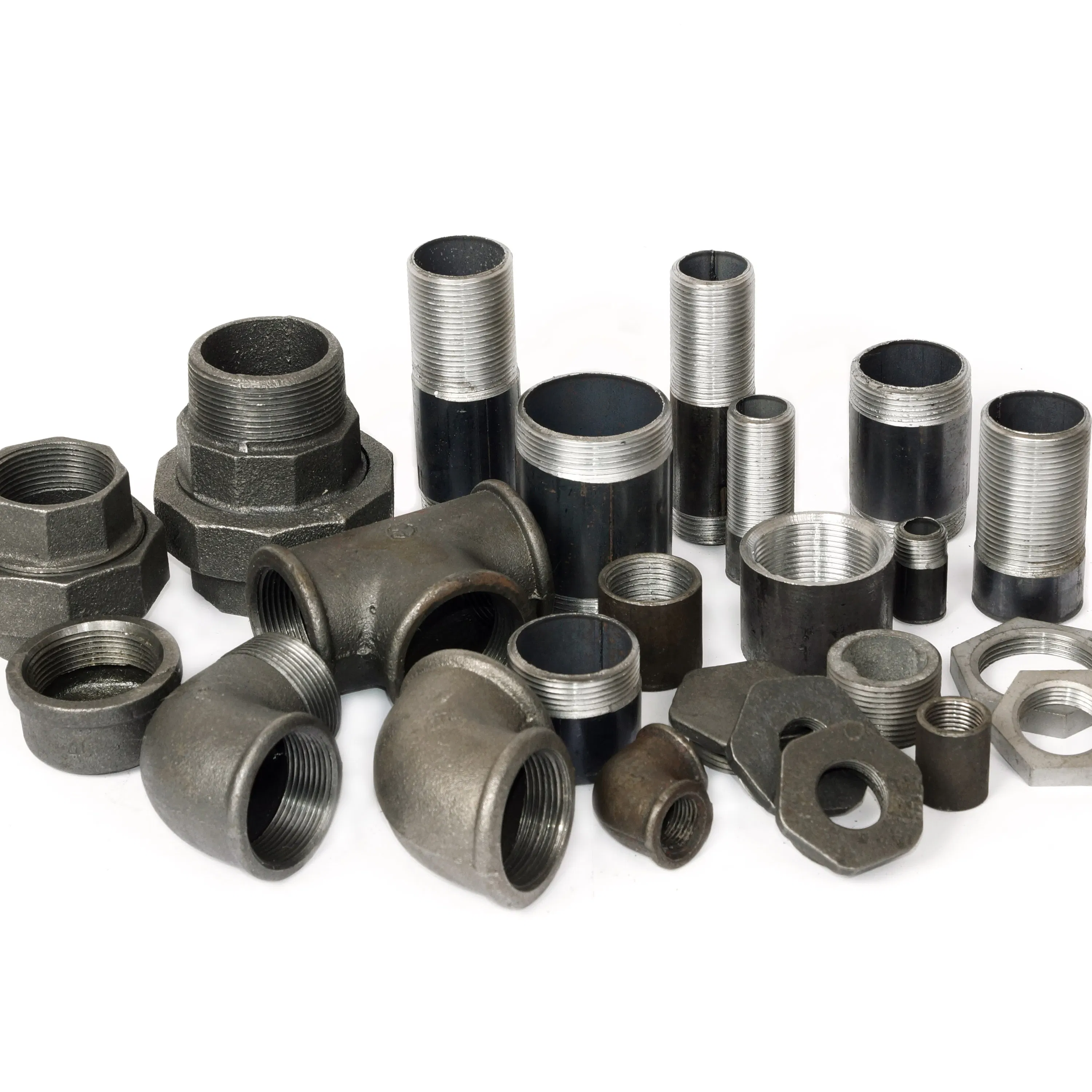
- Threaded Pipe Fittings (Malleable Iron): Malleable iron dominates threaded pipe fittings in sizes from 0.25 inches to 4 inches, produced to ASTM A197 or ASME B16.3 standards with pressure ratings from 300 psi to 2,000 psi depending on class. The thin-section castings (wall thickness 0.1 inches to 0.4 inches) are within the annealing capability of malleable iron, and the material's machinability produces clean NPT threads without the tool wear associated with harder ductile iron grades.
- Municipal Water and Sewer Pipe (Ductile Iron): Ductile iron pressure pipe rated to AWWA C151 standards operates at working pressures from 150 psi to 350 psi with surge resistance up to 500 psi, handling diameters from 3 inches to 64 inches across municipal water distribution and sewer force main applications. The elongation capacity (10% to 18%) prevents pipe fracture during soil settlement cycles that fracture legacy cast iron or malleable iron piping.
- Automotive Suspension and Drivetrain (Ductile Iron): Steering knuckles, control arms, differential cases, and brake calipers are cast in ductile iron Grade 80-55-06 (tensile strength 552 MPa, elongation 6%), combining strength and impact resistance for suspension components subject to road shock loads and fatigue cycles exceeding 500,000 load reversals over vehicle service life.
- Electrical Conduit Fittings (Malleable Iron): Malleable iron conduit bodies, couplings, and locknuts produced to UL 514B standards serve electrical raceway systems in commercial and industrial buildings, providing corrosion-resistant threaded connections in sections below 1 inch wall thickness where the annealing process produces consistent mechanical properties throughout.
- Crankshafts and Camshafts (Ductile Iron): Pearlitic ductile iron Grade 100-70-03 (tensile strength 689 MPa, fatigue strength 310 MPa to 380 MPa) serves medium-duty diesel engine crankshafts and camshafts where cyclic bending and torsional loads govern design life. The fatigue strength advantage over malleable iron (310 MPa to 380 MPa vs 230 MPa to 310 MPa) extends component service intervals in engines operating at 1,800 rpm to 3,600 rpm.
- Hand Tools and Agricultural Fittings (Malleable Iron): Wrenches, clamps, chain links, and agricultural implement fittings produced in malleable iron take advantage of the material's machinability (hardness 110 HB to 156 HB in ferritic grades), thin-section dimensional consistency, and elongation (10% to 12%) sufficient to absorb tool impact loads without fracture.
What Industries Use Malleable Iron vs Ductile Iron and Why?
The industries that use malleable iron vs ductile iron are listed below.
- Plumbing and Pipe Fitting Industry (Malleable Iron): The plumbing industry relies on malleable iron for threaded fittings (elbows, tees, couplings, and unions) in pressure classes from 150 to 3,000 psi, produced to ASME B16.3 and ASTM A197 standards. The thin-section casting capability of malleable iron (wall thickness 0.1 inches to 0.4 inches) and machinability for NPT thread cutting make it the standard material for low-to-medium pressure threaded connections in commercial plumbing, HVAC hydronic systems, and industrial process piping.
- Municipal Water Infrastructure Industry (Ductile Iron): Water utilities specify ductile iron pipe to AWWA C151 for distribution mains at pressures from 150 psi to 350 psi because the material's elongation (10% to 18%) prevents fracture during ground settlement, seismic events, and pressure surges that fracture legacy cast iron mains. Service life exceeding 100 years in corrosive soil (with polyethylene encasement per ANSI/AWWA C105) reduces long-term infrastructure replacement costs.
- Automotive Manufacturing Industry (Ductile Iron): Automotive OEMs use ductile iron Grade 80-55-06 and Grade 100-70-03 for suspension knuckles, control arms, crankshafts, and differential cases because the fatigue strength (207 MPa to 380 MPa) and elongation (3% to 18%) meet SAE J434 requirements for safety-critical components subject to cyclic road loads and crash energy absorption.
- Electrical Construction Industry (Malleable Iron): Electrical contractors specify malleable iron conduit fittings and boxes to UL 514B standards for exposed metallic raceway systems in industrial facilities, where the material's corrosion resistance, thread integrity, and impact strength in thin-section castings (below 0.5 inches wall thickness) meet NEC requirements for rigid metal conduit (RMC) systems at a lower cost than stainless steel alternatives.
- Heavy Equipment and Mining Industry (Ductile Iron): Mining equipment manufacturers select ductile iron for crusher frames, hydraulic cylinder housings, and conveyor components due to tensile strength from 414 MPa to 800 MPa and section capability up to 24 inches, handling the high compressive and impact loads in ore processing applications where malleable iron's 2-inch section limit prevents its use in heavy castings.
How Do Manufacturing Processes Differ in Malleable Iron vs Ductile Iron?
The manufacturing processes differ between malleable iron vs ductile iron are listed below.
- Melt and Charge Preparation (Malleable Iron): The base iron is melted in a cupola or electric induction furnace at 2,600°F to 2,750°F using a charge of pig iron, steel scrap, and ferrosilicon. Carbon is targeted from 2.0% to 2.9% and silicon from 0.9% to 1.9%, deliberately low to ensure the casting solidifies as white iron with no graphite present at this stage.
- White Iron Casting (Malleable Iron): The molten metal is poured into sand molds or permanent molds at 2,550°F to 2,700°F without any magnesium or inoculant addition. The casting solidifies completely as white iron (cementite matrix) within 15 to 60 minutes, depending on section thickness, which must remain below 2 inches to ensure full white iron formation throughout.
- Annealing Heat Treatment (Malleable Iron): The white iron castings are loaded into box annealing furnaces and heated to 1,650°F to 1,750°F for 20 to 70 hours in a neutral or controlled atmosphere. The extended thermal cycle decomposes cementite into temper carbon and iron through solid-state graphitization, producing the temper carbon nodules responsible for malleable iron's ductility. Total furnace cycle, including heating, holding, and controlled cooling, runs from 40 to 90 hours per batch.
- Melt Preparation and Desulfurization (Ductile Iron): The base iron is melted at 2,600°F to 2,750°F with carbon targeted from 3.2% to 3.9% and silicon from 1.8% to 2.8%. Sulfur must be reduced below 0.02% through calcium carbide or magnesium desulfurization before the inoculation step, as residual sulfur above 0.02% consumes magnesium before nodulizing graphite.
- Magnesium Inoculation (Ductile Iron): Magnesium (0.03% to 0.05%) is introduced into the ladle through wire injection, the sandwich process, or the tundish cover method at 2,600°F to 2,700°F. The magnesium reaction is completed within 1 to 3 minutes, after which a secondary ferrosilicon inoculation stabilizes nodule formation. The entire ladle treatment window is limited to 20 to 30 minutes before magnesium fades.
- Casting and Cooling (Ductile Iron): The inoculated molten metal is poured into sand molds within the 20-to-30-minute treatment window. Spheroidal graphite nucleates and grows during solidification over 5 to 30 minutes, depending on section weight. Total cycle from melt to shakeout runs 2 to 8 hours, compared to 40 to 90 hours for malleable iron, including annealing.
What Factors Affect Performance in Malleable Iron vs Ductile Iron?
The factors that affect performance in malleable iron vs ductile iron are listed below.
- Carbon Content Range: Malleable iron carbon content from 2.0% to 2.9% must remain low to guarantee white iron solidification before annealing. Carbon above 2.9% risks graphite flake formation during solidification, preventing a full white iron structure and producing soft spots that resist annealing. Ductile iron carbon from 3.2% to 3.9% provides sufficient graphite volume for nodule formation during liquid solidification under magnesium influence.
- Annealing Time and Temperature Range (Malleable Iron): Annealing temperature from 1,650°F to 1,750°F and hold time from 20 to 70 hours directly control the completeness of cementite decomposition and the ratio of ferrite to pearlite in the final matrix. Shorter cycles (20 hours) at the lower temperature limit produce partially ferritic matrices with reduced elongation (5% to 8%), while full ferritic conversion requires 60 to 70 hours at 1,700°F to 1,750°F to achieve elongation from 10% to 12%.
- Magnesium Content Range (Ductile Iron): Magnesium from 0.03% to 0.05% in the finished casting is required to maintain nodularity above 85%. Magnesium below 0.03% produces compacted or flake graphite with elongation below 5%. Magnesium above 0.06% produces chunky graphite in heavy sections (above 4 inches), reducing elongation to 3% to 6% and tensile strength by 10% to 15%.
- Section Thickness Range: Malleable iron is limited to sections below 2 inches, as cementite in thicker sections cannot fully decompose within practical annealing cycles, leaving carbide zones that embrittle the casting. Ductile iron handles sections from 0.25 inches to 24 inches with proper inoculant additions, including cerium (0.001% to 0.003%) to suppress chunky graphite in sections above 4 inches.
- Operating Temperature Range: Ferritic malleable iron retains useful elongation (8% to 12%) at temperatures from negative 4°F to 400°F, above which rapid oxidation degrades mechanical properties. Ferritic ductile iron maintains elongation above 10% from negative 40°F to 650°F, providing a broader thermal service window of 690°F compared to malleable iron's 404°F effective range.
- Sulfur Content Range (Ductile Iron): Sulfur must be held below 0.02% in the ductile iron melt before magnesium treatment. Sulfur from 0.02% to 0.05% consumes 0.03% to 0.08% additional magnesium before any nodulizing effect begins, reducing available magnesium below the 0.03% threshold required for full nodularity and producing irregular, partially nodular graphite with mechanical properties below Grade 60-40-18 minimums.
Which Is Better: Malleable Iron vs Ductile Iron for Different Applications?
The different applications of malleable iron vs ductile iron are shown in the table below.
The selection decision reduces to three primary criteria: section thickness (malleable iron below 2 inches, ductile iron above 2 inches), fatigue and tensile load requirements (ductile iron for dynamic applications above 345 MPa tensile demand), and production economics (malleable iron competitive in high-volume thin-section precision fittings where magnesium inoculation equipment investment is not justified).
When Should You Choose Malleable Iron vs Ductile Iron?
Choosing malleable iron vs ductile iron by following the five steps below.
- Determine the Maximum Section Thickness. Select malleable iron when casting section thickness remains below 2 inches, as the annealing process cannot fully decompose cementite in thicker sections, leaving brittle carbide zones. Select ductile iron when any section exceeds 2 inches, as magnesium inoculation produces consistent nodularity above 85% from 0.25 inches to 24 inches or more in section thickness.
- Evaluate the Required Tensile and Fatigue Strength. Select ductile iron when tensile strength above 414 MPa or fatigue strength above 230 MPa governs the design, covering automotive drivetrain components, pressure pipe systems, and heavy structural castings. Select malleable iron when tensile requirements fall from 345 MPa to 450 MPa, and thin-section precision is the primary production constraint.
- Assess the Operating Temperature Range. Select ferritic ductile iron for applications requiring impact resistance at temperatures from negative 40°F to 32°F, as ferritic malleable iron loses significant Charpy impact values below negative 4°F. Select malleable iron for applications in the range of 32°F to 400°F where thin-section geometry and threading precision outweigh the broader temperature capability of ductile iron.
- Compare the Total Production Cost. Calculate total cost per unit, including material, energy, and cycle time. Malleable iron annealing consumes 400 kWh to 800 kWh per ton and 40 to 90 hours per batch, adding $30 to $80 per ton in energy cost over ductile iron production. Ductile iron magnesium inoculation adds $15 to $40 per ton in treatment reagent cost but eliminates the annealing energy and furnace depreciation costs entirely.
- Confirm Applicable Standards and Pressure Ratings. Specify ductile iron to ASTM A536 or AWWA C151 for pressure system components above 150 psi, as malleable iron pipe fittings are rated below 300 psi in Class 150 ASME B16.3 and are not available in diameters above 4 inches. Confirm that the chosen material grade meets the applicable ASTM, AWWA, or SAE standard for the application before finalizing material selection.
How Does Ductile Iron Compare to Cast Iron?
Ductile iron compared to cast iron across tensile strength, elongation, impact resistance, and fatigue strength due to the fundamental difference in graphite morphology produced by magnesium inoculation versus uncontrolled solidification. Gray cast iron contains graphite in irregular flake form, with flake tips acting as stress concentrators that limit tensile strength to 100 MPa to 350 MPa and elongation to 0.2% to 0.8%. Ductile iron achieves spheroidal graphite through magnesium addition (0.03% to 0.05%), eliminating stress concentration at graphite boundaries and raising tensile strength to 414 MPa to 800 MPa and elongation to 10% to 18%. The fatigue strength gap is equally pronounced. Cast iron fatigue strength ranges from 69 MPa to 138 MPa, while ductile iron delivers 207 MPa to 380 MPa, a factor of 2 to 3 higher across comparable grades. The impact resistance of ductile iron (7 ft·lb to 40 ft·lb Charpy) versus cast iron (below 5 ft·lb) makes ductile iron the only viable choice for pressure pipe, automotive suspension, and structural castings subject to dynamic or shock loading. Gray cast iron retains advantages in thermal conductivity (46 W/m·K to 51 W/m·K vs ductile iron's 36 W/m·K to 40 W/m·K) and vibration damping (20 to 25 times higher than ductile iron), making it the preferred material for engine cylinder liners, machine tool beds, and cookware where heat dissipation and resonance control outweigh the need for tensile strength. A comprehensive property comparison covering tensile strength, fatigue limits, and application suitability is detailed in the Ductile Iron vs Cast Iron material guide available through Xometry's resources.
Is Cast Iron Better than Malleable Iron?
No, cast iron is not better than malleable iron. Gray cast iron provides superior compressive strength (570 MPa to 1,000 MPa vs malleable iron's 480 MPa to 620 MPa), vibration damping, and thermal conductivity (46 W/m·K to 51 W/m·K), making it the preferred material for engine cylinder liners, machine tool beds, and cookware where heat dissipation and resonance control are primary design criteria. Malleable iron outperforms gray cast iron in tensile strength (345 MPa to 450 MPa vs 100 MPa to 350 MPa), elongation (5% to 12% vs 0.2% to 0.8%), and impact resistance (5 ft·lb to 15 ft·lb vs below 5 ft·lb). The mechanical advantages of malleable iron over gray cast iron make it the standard material for threaded pipe fittings, electrical conduit bodies, and hand tool castings where the casting must withstand tensile and bending loads without fracture. Gray cast iron fractures suddenly at its tensile limit with no plastic deformation warning, while malleable iron deforms from 5% to 12% before fracture, providing advance indication of overload conditions in mechanical and structural components.
Disclaimer
The content appearing on this webpage is for informational purposes only. Xometry makes no representation or warranty of any kind, be it expressed or implied, as to the accuracy, completeness, or validity of the information. Any performance parameters, geometric tolerances, specific design features, quality and types of materials, or processes should not be inferred to represent what will be delivered by third-party suppliers or manufacturers through Xometry’s network. Buyers seeking quotes for parts are responsible for defining the specific requirements for those parts. Please refer to our terms and conditions for more information.