Ductile Iron: Composition and Casting


Ductile iron is a type of cast iron engineered for superior strength, toughness, and ductility through the addition of magnesium (0.03% to 0.05%) to molten iron immediately before casting, which transforms graphite morphology from brittle flakes (as in gray cast iron) to spherical nodules that eliminate stress concentration and enable plastic deformation before fracture. Ductile iron is made of iron (93% to 94% by weight), carbon (3.2% to 4.1%), silicon (1.8% to 2.8%), manganese (0.15% to 0.40%), magnesium (0.03% to 0.05%), and trace amounts of copper, nickel, and molybdenum in alloyed grades, with the nodular graphite microstructure produced by the magnesium treatment defining its mechanical behavior across all grades.
Ductile iron differs from standard gray cast iron in three fundamental ways: graphite morphology (nodules versus flakes), mechanical properties (tensile strength 414 MPa to 827 MPa versus 100 MPa to 400 MPa; elongation 10% to 18% versus below 1%), and production process (magnesium treatment required versus standard inoculation). The combination of cast iron's castability, low cost, and vibration damping with mechanical properties approaching cast steel makes ductile iron the preferred material for water and sewer infrastructure, automotive components, construction parts, industrial machinery, agricultural equipment, energy systems, railway components, and marine applications across global manufacturing.
What Is Ductile Iron?
Ductile iron is a type of cast iron with improved strength and ductility compared to gray cast iron, achieved by converting graphite from a flake morphology to a spherical (nodular) form through magnesium treatment of the melt before casting. Containing carbon from 3.2% to 4.1% by weight, ductile iron belongs to the cast iron family but produces tensile strength from 414 MPa to 827 MPa and elongation from 10% to 18%, mechanical properties that overlap with cast carbon steel and far exceed gray cast iron's tensile strength of 100 MPa to 400 MPa and elongation below 1%. The nodular graphite structure in ductile iron eliminates the stress concentration effect of graphite flakes, allowing the ferritic or pearlitic iron matrix to carry tensile and impact loads without premature crack initiation. Called nodular cast iron or spheroidal graphite (SG) iron, ductile iron was developed in 1943 by Keith Millis at the International Nickel Company, who discovered that adding cerium and magnesium to molten cast iron produced spherical graphite nodules. ASTM A536 governs ductile iron specification in the United States, classifying grades from 60-40-18 (lowest strength, highest ductility) to 120-90-02 (highest strength, lowest ductility) based on tensile strength, yield strength, and elongation requirements.
What Does Ductile Mean in Materials Science?
Ductile in materials science means a material deforms plastically under tensile stress without fracturing, absorbing energy through dislocation movement, grain boundary sliding, and necking before the point of fracture. A ductile material stretches measurably under applied load, showing a defined yield point followed by a plastic deformation region on the stress-strain curve before the ultimate tensile strength and fracture point are reached. Ductility is quantified by percentage elongation at fracture (measuring gauge length increase) and percentage reduction in area (measuring cross-sectional area decrease at the fracture location), with higher values indicating greater ductility. In materials science, a material with elongation above 5% is generally classified as ductile, while materials with elongation below 2% are classified as brittle. Ductile behavior is desirable in structural materials subjected to tensile, impact, and fatigue loading because it provides a warning of impending failure through visible deformation rather than sudden catastrophic fracture, making ductile materials safer in engineering applications than brittle alternatives.
Is Ductile Iron a Type of Cast Iron?
Yes, ductile iron is a type of cast iron, belonging to the cast iron family by virtue of its carbon content from 3.2% to 4.1% (above the 2% threshold defining cast iron), its production by the casting process (pouring molten metal into molds), and its iron-dominated composition (93% to 94% Fe). Ductile iron differs from other cast iron types (gray, white, malleable, chilled) by its microstructure: the magnesium-induced spherical graphite nodules that replace the graphite flakes of gray iron or the cementite of white iron. The nodular microstructure is the sole structural modification that converts gray cast iron's brittleness into the ductile iron's 10% to 18% elongation and 414 MPa to 827 MPa tensile strength, while retaining the casting process, carbon content range, and foundry production methods shared across the cast iron family.
What Is Ductile Iron Made Of?
Ductile iron is made of iron (93% to 94% by weight), carbon (3.2% to 4.1%), silicon (1.8% to 2.8%), manganese (0.15% to 0.40%), magnesium (0.03% to 0.05%), phosphorus (below 0.05%), and sulfur (below 0.02%), with graphite present as spherical nodules occupying approximately 8% to 12% of the microstructure volume. The magnesium addition is the critical component that distinguishes ductile iron from all other cast iron types; magnesium suppresses sulfur and oxygen in the melt to levels below 0.005%, removing the surface-active impurities that promote graphite flake formation and allowing graphite to precipitate in the thermodynamically preferred spherical form during solidification. Silicon at 1.8% to 2.8% promotes graphite formation over cementite, ensuring a fully graphitic microstructure in the nodular form. Manganese at 0.15% to 0.40% neutralizes residual sulfur and stabilizes the pearlite matrix in higher-strength grades. Alloyed ductile iron grades incorporate copper (0.1% to 0.9%), nickel (0.5% to 2.0%), and molybdenum (0.1% to 0.5%) to improve hardenability, strength at elevated temperatures, and corrosion resistance without altering the fundamental nodular graphite microstructure.
What Is the Chemical Composition of Ductile Iron?
The chemical composition of ductile iron contains iron as the balance (93% to 94%), carbon from 3.2% to 4.1%, silicon from 1.8% to 2.8%, manganese from 0.15% to 0.40%, magnesium from 0.03% to 0.05%, phosphorus below 0.05%, and sulfur below 0.02%, with the tight control of phosphorus and sulfur being essential to successful nodularization. Carbon equivalent (CE = %C + (%Si + %P)/3) in ductile iron ranges from 4.2 to 4.7, keeping the composition near the eutectic point to maximize nodule count and minimize cementite formation during solidification. Magnesium is the decisive compositional variable; at levels below 0.03%, nodularization is incomplete, and graphite reverts to flake or vermicular (compacted) morphology. Cementite formation increases at magnesium levels above 0.06%, and magnesium oxide slag defects become problematic. The narrow magnesium window of 0.03% to 0.05% requires precise process control during treatment and pouring.
Does Ductile Iron Contain Graphite Nodules?
Yes, ductile iron contains graphite nodules, spherical graphite particles distributed uniformly throughout the iron matrix that form during solidification when magnesium reduces sulfur and oxygen concentrations to below 0.005%, allowing graphite to grow in its thermodynamically preferred isotropic spherical form rather than as anisotropic flakes. Graphite nodules in ductile iron range from 20 µm to 150 µm in diameter, with nodule count from 100 to 300 nodules per mm² in high-quality iron and nodule roundness (spheroidization) above 80% as measured by ASTM A247 nodularity assessment. The nodule count, size, and spheroidization percentage directly determine the mechanical properties of the casting; higher nodule count and spheroidization produce greater tensile strength, elongation, and impact resistance. The graphite nodules in ductile iron are the microstructural feature that defines the material's superior toughness compared to gray cast iron and its distinction from all other cast iron types.
How Is Ductile Iron Different From Cast Iron?
Ductile iron differs from cast iron by having nodular (spherical) graphite instead of graphite flakes, a microstructural distinction that transforms the material from brittle (gray iron, elongation below 1%) to ductile (elongation 10% to 18%) and from lower tensile strength (gray iron 100 MPa to 400 MPa) to significantly higher tensile strength (414 MPa to 827 MPa). Graphite precipitates as elongated flakes with aspect ratios from 10:1 to 100:1 in gray cast iron, creating stress concentration sites that initiate fracture at low tensile strains and produce Charpy impact energy below 5 J. In ductile iron, magnesium treatment converts graphite to spheres with aspect ratios near 1:1, eliminating stress concentration and allowing the iron matrix to carry load plastically before fracture, producing Charpy impact energy from 7 J to over 100 J depending on grade and testing temperature. The composition of both materials is similar (carbon 2% to 4%, silicon 1% to 3%), confirming that the microstructural difference from flake to nodular graphite, not the bulk composition, is the fundamental distinction separating ductile iron from Cast Iron in performance and application.
What Is the Difference Between Grey Cast Iron and Ductile Cast Iron?
The difference between grey cast iron and ductile cast iron lies primarily in their composition and mechanical properties. Grey cast iron has graphite flakes distributed in a pearlitic or ferritic matrix, while ductile cast iron has spherical graphite nodules in a ferritic, pearlitic, or ausferritic matrix, and the flake-to-nodule graphite morphology difference is the sole microstructural change that produces dramatically different mechanical properties from the two materials at similar bulk composition. Grey iron's graphite flakes act as pre-existing crack-like defects with stress concentration factors from 10 to 100 at flake tips, initiating fracture at applied tensile strains below 0.1% and producing elongation below 1% with Charpy impact energy below 5 J. Ductile iron's graphite nodules have stress concentration factors near 1 (no concentration effect at the spherical surface), allowing the iron matrix to deform plastically before fracture and producing elongation from 10% to 18% and Charpy impact energy from 7 J to over 100 J. Gray cast iron achieves 150 HB to 300 HB hardness and tensile strength from 100 MPa to 400 MPa, while ductile iron achieves 140 HB to 300 HB hardness (grade-dependent) and tensile strength from 414 MPa to 827 MPa. The production difference is also significant: grey iron requires only standard inoculation, while ductile iron requires precise magnesium treatment followed by inoculation before pouring. Xometry's casting services produce Grey Cast Iron and ductile iron components, with material selection guided by the strength, toughness, and ductility requirements of each application.
Is Ductile Cast Iron Less Brittle Than Grey Cast Iron?
Yes, ductile cast iron is less brittle than gray cast iron, with elongation at fracture from 10% to 18% compared to gray iron's elongation below 1%, and Charpy impact energy from 7 J to over 100 J compared to gray iron's below 5 J. The brittleness reduction in ductile iron results from replacing graphite flakes (high stress concentration, crack initiation sites) with graphite nodules (negligible stress concentration, no crack initiation effect), allowing the iron matrix to deform plastically under tensile and impact loading rather than fracturing prematurely at graphite flake tips. The elongation improvement from below 1% (gray iron) to 10% to 18% (ductile iron) is achieved without changing bulk carbon content (both 2% to 4% C) or production method (both cast), confirming that graphite morphology alone determines brittleness in the cast iron family.
How Is Ductile Iron Produced?
Ductile iron is produced by adding magnesium to molten iron at temperatures from 1,450°C to 1,550°C immediately before casting, through a treatment process that reduces dissolved sulfur and oxygen to below 0.005% each and allows carbon to precipitate as spherical graphite nodules during subsequent solidification in the mold. The magnesium treatment is performed by one of three methods: the sandwich process (layering magnesium ferrosilicon alloy in the ladle bottom and pouring molten iron over it), wire injection (feeding magnesium-bearing cored wire into the melt at controlled speed using a wire injection machine), or in-mold treatment (placing magnesium alloy in a reaction chamber within the mold where it contacts the inflowing iron stream during pouring). Each method delivers 0.03% to 0.05% residual magnesium in the treated iron, with wire injection providing the most precise and consistent magnesium recovery. Inoculation with ferrosilicon (0.1% to 0.4% addition) increases nodule count and reduces section sensitivity after magnesium treatment. The treated iron is poured into sand, permanent, or shell molds within 10 to 15 minutes of treatment to prevent magnesium fade (loss of magnesium effectiveness through oxidation and evaporation over time).
How Does the Ductile Iron Casting Process Work?
The ductile iron casting process involves steps to transform molten iron into ductile cast iron, which has enhanced strength and ductility. Molten iron is treated with magnesium and poured into molds where cooling produces the nodular graphite microstructure that defines ductile iron's mechanical properties, through a production sequence involving charge preparation, melting, magnesium treatment, inoculation, pouring, solidification, shakeout, and heat treatment. Charge preparation calculates the proportions of pig iron, ductile iron returns, and steel scrap to achieve the target carbon equivalent (4.2 to 4.7) and low sulfur content (below 0.02%) required for successful nodularization. Melting in an electric induction furnace at 1,480°C to 1,550°C produces a homogeneous melt analyzed by optical emission spectrometry before tapping. Magnesium treatment (sandwich, wire, or in-mold method) adds 0.03% to 0.05% residual Mg within 10 to 15 minutes before pouring. Inoculation with ferrosilicon immediately before or during pouring increases nodule count from below 50 nodules/mm² (without inoculation) to 100 to 300 nodules/mm² (with inoculation). Pouring at 1,320°C to 1,380°C fills the mold cavity before the metal freezes, with solidification taking from 5 minutes (thin sections) to over 2 hours (heavy sections above 100 mm). Heat treatment (annealing at 700°C to 760°C, or austempering at 260°C to 400°C for austempered ductile iron) modifies the matrix microstructure after casting to achieve the target mechanical properties of the specified grade.
Is Magnesium Added to Form Nodular Graphite?
Yes, magnesium is added to form nodular graphite in ductile iron, acting by reducing dissolved sulfur and oxygen in the melt to below 0.005% each, removing the surface-active impurities that promote graphite flake nucleation at specific crystallographic orientations and force graphite to grow isotropically as spheres from symmetric nucleation centers. Sulfur and oxygen adsorb onto specific graphite crystal faces without magnesium treatment, promoting preferential growth in the basal plane direction that produces the flake morphology of gray cast iron. Magnesium at 0.03% to 0.05% residual level removes sulfur as MgS and oxygen as MgO, leaving the graphite free to grow symmetrically as spheres during solidification cooling. The effectiveness of magnesium in producing nodular graphite is verified by metallographic examination of polished and etched samples, where spheroidization percentages above 80% per ASTM A247 confirm successful magnesium nodularization treatment.
What Is the Microstructure of Ductile Cast Iron (Nodular Cast Iron)?
The microstructure of ductile cast iron consists of spherical graphite nodules (8% to 12% of microstructure volume, 20 µm to 150 µm diameter) surrounded by a ferritic, pearlitic, or mixed iron matrix, with the matrix type determining the strength and ductility balance of the specific grade. In ferritic ductile iron (Grade 60-40-18, ASTM A536), the matrix is predominantly ferrite (BCC iron, low carbon content), producing the highest elongation (18%) and lowest tensile strength (414 MPa) among standard grades. The matrix is predominantly pearlite (lamellar ferrite-cementite) in pearlitic ductile iron (Grade 100-70-03), producing the highest tensile strength (690 MPa) at reduced elongation (3%). Mixed ferritic-pearlitic matrices (Grades 65-45-12 and 80-55-06) provide intermediate strength-ductility combinations. Austempered ductile iron (ADI, ASTM A897) replaces the ferrite-pearlite matrix with ausferrite (acicular ferrite plus stabilized austenite), achieving tensile strength from 900 MPa to 1,600 MPa and elongation from 1% to 10% at hardness from 269 HB to 444 HB, placing ADI in mechanical performance overlap with medium-strength steel castings.
How Do Graphite Nodules Improve Strength and Toughness?
Graphite nodules improve strength and toughness in ductile iron by eliminating the stress concentration effect of graphite flakes, allowing the iron matrix to carry the full applied load plastically before fracture rather than initiating cracks at graphite-matrix interfaces at low applied stress. Graphite flakes concentrate applied stress by factors of 10 to 100 at flake tips in gray cast iron, initiating fracture at nominal stresses well below the matrix yield strength. Spherical nodules with smooth surfaces concentrate stress by a factor of approximately 1.5 to 2 at the nodule-matrix interface in ductile iron, a negligible concentration that allows the matrix to reach its yield strength and deform plastically before fracture initiates. The plastic deformation of the ferritic or pearlitic matrix around nodules absorbs energy during loading, producing Charpy impact values from 7 J to over 100 J compared to gray iron's below 5 J. The nodule count (higher count = smaller nodule spacing = shorter crack path to matrix = better toughness) and spheroidization percentage (higher spheroidization = lower stress concentration = better toughness) are the two microstructural parameters that directly control the mechanical property improvement of graphite nodules in ductile iron.
Does Graphite Shape Control the Mechanical Properties?
Yes, graphite shape controls the mechanical properties of cast iron, with the transition from flake graphite (gray iron) to nodular graphite (ductile iron) being the most consequential microstructural change achievable in a cast iron of equivalent bulk composition. Tensile strength increases from 100 MPa to 400 MPa (gray iron) to 414 MPa to 827 MPa (ductile iron) solely from graphite shape change, with composition held nearly constant. Elongation increases from below 1% to 10% to 18%, and Charpy impact energy from below 5 J to 7 J to over 100 J, all attributable to the elimination of stress concentration at nodule surfaces versus flake tips. Intermediate graphite shapes (compacted graphite, vermicular graphite) produce intermediate properties (tensile strength 300 MPa to 450 MPa, elongation 1% to 3%), confirming a direct and quantitative relationship from graphite shape to mechanical property level in all cast iron grades.
What Is the Difference Between Ductile Cast Iron and Malleable Cast Iron?
The difference between ductile cast iron and malleable cast iron is shown in the table below.
How Does Heat Treatment Change Malleable Cast Iron?
Heat treatment converts white cast iron into malleable cast iron by decomposing the continuous cementite (Fe₃C) network of the as-cast white iron into clusters of temper carbon (irregular graphite nodules) dispersed in a ferritic or pearlitic iron matrix through a two-stage annealing process at controlled temperatures from 900°C to 970°C. The first annealing stage at 900°C to 970°C for 5 to 20 hours decomposes cementite into austenite and graphite (temper carbon), removing the brittle cementite that makes white cast iron unmachineable and non-ductile. The second stage involves slow cooling through the eutectoid temperature range (700°C to 760°C) at controlled rates: slow cooling produces ferritic malleable iron (higher ductility, 10% to 12% elongation); faster cooling through the range produces pearlitic malleable iron (higher strength, 1% to 5% elongation). The total heat treatment cycle time ranges from 15 hours for thin-section ferritic malleable to over 80 hours for thick-section pearlitic grades, with the extended annealing time and energy consumption adding 15% to 25% to production cost compared to as-cast ductile iron, requiring no mandatory heat treatment for standard grades.
Is Malleable Cast Iron Produced From White Cast Iron?
Yes, malleable cast iron is produced from white cast iron through a controlled annealing heat treatment that decomposes the cementite microstructure of white iron into temper carbon clusters, converting a brittle, hard material (white iron: elongation below 0.5%, hardness 400 HB to 700 HB) into a moderately ductile material (malleable iron: elongation 5% to 12%, hardness 110 HB to 270 HB). The production of malleable iron requires that the base casting solidifies completely as white iron (no graphite), which limits section thickness to below 50 mm, as thicker sections cool too slowly at their centers to prevent graphite formation during solidification. The white iron base casting is deliberately designed with composition (carbon 2.0% to 2.9%, silicon 0.9% to 1.9%, low silicon to prevent graphitization during casting) and rapid mold cooling to ensure the white iron microstructure required for successful malleable cast iron annealing conversion.
What Is the Difference Between Cast Iron vs Ductile Iron?
The difference between cast iron and ductile iron is listed below.
- Graphite Morphology: Cast iron (gray iron) contains graphite in elongated flake form with aspect ratios from 10:1 to 100:1, acting as stress concentrators that initiate fracture at low applied tensile strains. Ductile iron contains graphite as spherical nodules with aspect ratios near 1:1, eliminating stress concentration at the graphite-matrix interface and allowing plastic deformation before fracture. The graphite morphology difference is the single microstructural variable that separates the two materials despite nearly identical bulk composition.
- Tensile Strength: Gray cast iron achieves tensile strength from 100 MPa to 400 MPa, limited by graphite flake stress concentration. Ductile iron achieves tensile strength from 414 MPa to 827 MPa in standard grades and 900 MPa to 1,600 MPa in austempered ductile iron (ADI), reflecting the iron matrix carrying full load without premature crack initiation at graphite interfaces.
- Ductility and Elongation: Gray cast iron elongation at fracture falls below 1%, classifying it as a brittle material. Ductile iron elongation ranges from 10% to 18% in ferritic grades (ASTM A536 Grade 60-40-18) and 2% to 6% in pearlitic grades, classifying it as a ductile engineering material suitable for tensile and impact-loaded structural applications where gray iron would fracture without warning.
- Impact Resistance: Gray cast iron Charpy unnotched impact energy falls below 5 J, making it unreliable in shock-loaded applications. Ductile iron achieves Charpy impact energy from 7 J to over 100 J, depending on matrix microstructure and testing temperature, with ferritic grades maintaining impact energy above 7 J at -20°C for cold-climate infrastructure service.
- Production Process: Gray cast iron requires standard inoculation (ferrosilicon addition at 0.1% to 0.4%) before pouring to refine graphite flake distribution. Ductile iron requires magnesium treatment (0.03% to 0.05% residual Mg) through sandwich, wire injection, or in-mold methods within 10 to 15 minutes before pouring, followed by inoculation, adding process complexity and cost of approximately 5% to 10% above gray iron production at equivalent section thickness.
- Cost: Gray cast iron raw material and casting costs range from [$400 to $800] per metric ton of finished casting. Ductile iron costs from [$600 to $1,200] per metric ton, reflecting the magnesium treatment consumable cost, tighter process control requirements, and additional inoculation, while remaining 20% to 40% below equivalent cast carbon steel component cost.
- Weldability: Gray cast iron requires preheating from 150°C to 300°C, nickel-based filler metal (ENi-CI or ENiFe-CI), and slow post-weld cooling to prevent cracking in repair welding. Ductile iron follows the same precautions with slightly better weldability in ferritic grades due to higher matrix ductility, but neither material approaches the weldability of carbon steel without specialized procedures. Both materials are designed for cast-to-shape production rather than welded fabrication.
- Typical Applications: Gray cast iron serves compressive-loading and vibration-damping applications: engine blocks, machine tool bases, brake rotors, pipe pressure fittings, and architectural castings. Ductile iron serves tensile, bending, impact, and fatigue-loaded applications: water main pipe, automotive crankshafts, gears, steering knuckles, wind turbine hubs, and structural infrastructure components where gray iron's brittleness makes it unsuitable. The Cast Iron vs Ductile Iron selection decision reduces to brittleness tolerance, loading type, and the cost premium justified by improved mechanical performance in the specific application.
How Does Cast Iron vs Ductile Iron Compare in Microstructure and Strength?
Cast iron vs ductile iron are compared in microstructure and strength through the different ways graphite is present in their composition. Cast iron (gray iron) and ductile iron share nearly identical bulk composition (iron 93% to 95%, carbon 2% to 4%, silicon 1% to 3%) but differ fundamentally in microstructure and resulting strength because graphite morphology, not bulk composition, controls mechanical properties in the cast iron family. Gray cast iron's graphite flakes create a discontinuous iron matrix interrupted by elongated graphite plates occupying 6% to 10% of microstructure volume, with flake tips concentrating applied tensile stress by factors of 10 to 100, limiting tensile strength to 100 MPa to 400 MPa and elongation to below 1%. Ductile iron's spherical graphite nodules occupy the same 8% to 12% of microstructure volume but impose stress concentration factors of only 1.5 to 2 at smooth nodule surfaces, allowing the ferritic or pearlitic iron matrix to reach its full yield strength (276 MPa to 621 MPa) and deform plastically before fracture. The strength comparison from gray iron (100 MPa to 400 MPa tensile) to ductile iron (414 MPa to 827 MPa tensile) represents a 2 to 4 times improvement achieved solely by converting graphite from flakes to nodules through magnesium treatment, confirming that microstructure rather than composition governs the performance gap in the Cast Iron vs Ductile Iron mechanical property comparison.
Is Ductile Iron Tougher and Less Brittle Than Cast Iron?
Yes, ductile iron is substantially tougher and less brittle than gray cast iron across every quantitative toughness metric, with Charpy unnotched impact energy from 7 J to over 100 J compared to gray iron's below 5 J, elongation at fracture from 10% to 18% compared to gray iron's below 1%, and fracture toughness (K_IC) from 22 MPa·m½ to 50 MPa·m½ compared to gray iron's 6 MPa·m½ to 20 MPa·m½. The toughness improvement arises entirely from graphite morphology: spherical nodules in ductile iron impose negligible stress concentration at the graphite-matrix interface, allowing the iron matrix to absorb impact energy through plastic deformation before crack propagation reaches critical velocity, while gray iron's graphite flakes provide pre-existing crack-like defects that propagate at low impact energy without plastic deformation. Ferritic ductile iron (Grade 60-40-18, ASTM A536) achieves the highest toughness among standard ductile iron grades, maintaining Charpy impact energy above 30 J at room temperature and above 7 J at -20°C, properties that allow its use in water main infrastructure, automotive structural castings, and construction components subjected to impact and dynamic loading where gray cast iron brittleness would cause sudden catastrophic fracture without prior deformation warning.
What Are the Mechanical Properties of Ductile Iron?
The mechanical properties of ductile iron are listed below.
- Tensile Strength: Ductile iron tensile strength ranges from 414 MPa (Grade 60-40-18, ferritic) to 827 MPa (Grade 120-90-02, pearlitic), with austempered ductile iron (ADI) reaching 900 MPa to 1,600 MPa. The wide tensile strength range across grades allows ductile iron to substitute for cast steel in many structural applications.
- Yield Strength: Yield strength ranges from 276 MPa (Grade 60-40-18) to 621 MPa (Grade 100-70-03), with a yield-to-tensile ratio from 0.65 to 0.80, indicating significant plastic deformation capacity from yield to fracture.
- Elongation at Fracture: Elongation ranges from 18% (Grade 60-40-18, ferritic matrix) to 2% (Grade 120-90-02, pearlitic matrix). ADI grades achieve 1% to 10% elongation depending on austempering temperature from 260°C to 400°C.
- Hardness: Brinell hardness ranges from 140 HB (Grade 60-40-18) to 300 HB (Grade 120-90-02). ADI achieves 269 HB to 444 HB depending on grade, providing wear resistance approaching that of hardened steel.
- Impact Toughness: Charpy unnotched impact energy at room temperature ranges from 7 J (pearlitic grades) to over 100 J (ferritic grades). Ferritic ductile iron maintains impact energy above 7 J at -20°C, suitable for cold-climate structural applications.
- Fatigue Strength: Rotating bending fatigue endurance limit ranges from 200 MPa to 280 MPa for standard grades, approximately 45% to 50% of tensile strength. ADI achieves fatigue endurance from 350 MPa to 500 MPa, comparable to medium-strength forged steel.
- Elastic Modulus: Ductile iron has an elastic modulus from 168 GPa to 178 GPa, slightly lower than steel (200 GPa) but higher than aluminum (69 GPa), confirming its stiffness advantage over non-ferrous materials in structural applications.
How Are Ductility and Malleability Different in Iron Materials?
Ductility and malleability are different in iron materials through the types of stress they respond to and how they deform. Ductility refers to a material's ability to deform plastically under tensile stress (stretching) without fracturing, measured by percentage elongation and reduction in area in a tensile test, while malleability refers to a material's ability to deform plastically under compressive stress (flattening, pressing, hammering) without fracturing, measured by reduction in thickness before cracking in a compression test. Ductility and malleability describe mechanically distinct behaviors that do not always correlate in iron materials: cast iron is neither ductile nor malleable (gray iron fractures under both tension and compression loading beyond elastic limits), ductile iron is ductile (elongation 10% to 18%) but not readily malleable at room temperature, and wrought iron is both ductile (elongation 20% to 35%) and malleable (formable by hammering at forging temperatures). The engineering significance of Ductility and Malleability in iron materials lies in the application requirements: tensile-loaded structural members require ductility, while forged and shaped components require malleability, and the two properties are evaluated by separate test methods, producing separate quantitative metrics.
Is Ductility a Measure of Plastic Deformation Before Fracture?
Yes, ductility is a measure of plastic deformation before fracture, quantified by the percentage elongation at fracture and percentage reduction in area measured in a tensile test performed according to ASTM E8 or ISO 6892-1. Percentage elongation measures the increase in gauge length (L₀ to Lf) expressed as a percentage of original length: (Lf − L₀)/L₀ × 100. Percentage reduction in area measures the decrease in cross-sectional area at the fracture location: (A₀ − Af)/A₀ × 100. For ductile iron Grade 60-40-18, minimum elongation of 18% confirms substantial plastic deformation capacity before fracture. The plastic deformation measured by ductility tests includes contributions from uniform elongation (before necking) and localized elongation (necking zone), with the combined measurement expressing the material's total energy absorption capacity before fracture in the tensile plastic deformation regime.
How Is Ductility Tested in Ductile Iron?
Ductility in ductile iron is tested using a tensile test performed on machined specimens of standardized dimensions according to ASTM E8 (Standard Test Methods for Tension Testing of Metallic Materials) or ISO 6892-1, where the specimen is stretched to fracture in a calibrated universal testing machine at a controlled strain rate, and the elongation and reduction in area measurements are recorded. The standard tensile specimen for cast iron testing uses a gauge length of 50 mm or 25 mm with a circular cross-section (diameter 12.5 mm for standard specimens), machined from the casting at specified locations defined in ASTM A536 (from separately cast test bars or from keel blocks cast alongside production parts). The specimen is marked at the gauge length boundaries, gripped in the testing machine, and loaded at a strain rate from 0.005/min to 0.05/min until fracture occurs. The fractured halves are reassembled, and the final gauge length (Lf) is measured, along with the minimum cross-sectional area at the fracture location (Af), from which elongation and reduction in area are calculated. The Ductility Test results confirm whether the ductile iron casting meets the minimum elongation requirement of the specified ASTM A536 grade.
What Is a Standard Ductility Test for Cast Metals?
A tensile test is the standard method for measuring ductility in cast metals, including ductile iron, performed according to ASTM E8 (metallic materials) in conjunction with product standard ASTM A536 (ductile iron castings), which specifies test bar geometry, sampling location, and minimum property requirements for each grade. The tensile test records the complete load-extension curve from zero load to fracture, capturing yield strength (0.2% offset proof stress), ultimate tensile strength, elongation at fracture, and reduction in area from a single specimen. For ductile iron, ASTM A536 requires test bars machined from separately cast Y-blocks (12.5 mm, 25 mm, 50 mm, or 75 mm section Y-block, depending on casting wall thickness), ensuring test bar microstructure and properties represent the production casting at the equivalent section thickness. The minimum elongation requirements across ASTM A536 grades range from 2% (Grade 120-90-02) to 18% (Grade 60-40-18), with individual heats tested to verify compliance before shipping. The Ductility Test for ductile iron is a mandatory acceptance criterion in ASTM A536, distinguishing ductile iron from gray iron (which has no minimum elongation requirement in ASTM A48, confirming its brittle classification).
Is Percent Elongation Used to Measure Ductility?
Yes, percent elongation is the primary standardized metric used to measure ductility in ductile iron and all tensile-tested cast metals, calculated as the increase in gauge length from before (L₀) to after (Lf) fracture divided by the original gauge length and multiplied by 100: elongation (%) = ((Lf − L₀)/L₀) × 100. Percent elongation values from 2% to 18% across ASTM A536 grades are the defining property that separates the material from gray cast iron (elongation below 1%) and approaches the elongation of mild steel (18% to 25%) for ductile iron. Percent elongation is complemented by percent reduction in area as a secondary ductility measure, with reduction in area from 10% to 30% typical for ferritic ductile iron. Both metrics are reported in the material certification documents (mill certificates) supplied with ductile iron castings as proof of compliance with the minimum Elongation requirements of the specified grade and standard.
How Do You Calculate Ductility?
Calculating ductility in ductile iron requires performing a standardized tensile test and applying the percentage elongation and percentage reduction in area formulas to measurements taken before and after fracture on the test specimen. Follow the six steps given. First, prepare a machined ductile iron tensile specimen with a gauge length (L₀) of 50 mm and a gauge diameter of 12.5 mm per ASTM E8 requirements, marking the gauge boundaries clearly with a center punch or scribe. Second, measure the original cross-sectional area (A₀) at the gauge center using a micrometer; for a 12.5 mm diameter specimen, A₀ = π × (6.25)² = 122.7 mm². Third, mount the specimen in the universal testing machine grips and apply tensile load at a crosshead speed of 5 mm/min to 10 mm/min until fracture occurs. Fourth, remove the fractured specimen and fit the two halves together end-to-end at the fracture location, then measure the final gauge length (Lf) from gauge mark to gauge mark using a vernier caliper. Fifth, measure the minimum diameter at the fracture neck using a micrometer and calculate the final cross-sectional area (Af). Lastly, calculate percentage elongation using: Elongation (%) = ((Lf − L₀) / L₀) × 100, and percentage reduction in area using: Reduction in Area (%) = ((A₀ − Af) / A₀) × 100, with elongation from 10% to 18% confirming Grade 60-40-18 compliance and reduction in area from 15% to 30% typical for ferritic ductile iron in standard production quality.
What Is the Formula for Percent Elongation in a Tensile Test?
The formula for percent elongation in a tensile test is:
Elongation (%) = ((Lf − L₀) / L₀) × 100
where L₀ is the original gauge length (50 mm or 25 mm per ASTM E8) and Lf is the final gauge length measured after fracture by fitting the broken specimen halves together. Elongation = ((59 − 50) / 50) × 100 = 18% for a ductile iron Grade 60-40-18 specimen with L₀ = 50 mm that fractures at Lf = 59 mm, confirming compliance with the 18% minimum requirement of ASTM A536 Grade 60-40-18. The formula is applied to the gauge length marked before testing, not to the total specimen length, ensuring the measurement captures only the deformation within the uniform gauge section instead of grip deformation. The percent elongation formula is standardized in ASTM E8, ISO 6892-1, and all major metallic materials testing standards, ensuring consistent ductility measurement and reporting across laboratories and material specifications globally.
Is Ductility Calculated From the Change in Gauge Length?
Yes, ductility as measured by percent elongation is calculated from the change in gauge length (Lf − L₀), where L₀ is the original gauge length before testing, and Lf is the gauge length measured after fracture by fitting the broken specimen pieces together. The gauge length change (Lf − L₀) represents the total plastic elongation accumulated in the gauge section from yield point to fracture, including both uniform elongation (distributed across the gauge length) and localized elongation (concentrated at the fracture neck). Measuring Lf by fitting the fracture pieces together ensures the localized neck elongation is included in the total gauge length change, producing the complete elongation value reported in material certifications. The gauge length boundary marks must be made before testing, as the fracture location determines where the two length measurements are summed; if the fracture occurs outside the gauge marks, ASTM E8 specifies the test must be repeated on a new specimen.
Why Is Ductile Iron Preferred Over Other Cast Irons?
Ductile iron is preferred over other cast iron types for applications requiring a balance of strength, ductility, toughness, and castability because it achieves tensile strength from 414 MPa to 827 MPa combined with elongation from 10% to 18%, a property combination unavailable in gray iron (high strength limitation, near-zero elongation), white iron (extreme hardness, no ductility), or malleable iron (moderate strength and ductility with section thickness limitation and high annealing cost). The nodular graphite microstructure of ductile iron delivers cast iron's manufacturing advantages (complex near-net-shape castability, low melting point, good machinability) with mechanical properties approaching cast carbon steel, at a cost 20% to 40% below equivalent steel castings. Ductile iron performs well under tensile, compressive, bending, impact, and fatigue loading, covering the full mechanical loading spectrum that limits gray cast iron to compressive and vibration-damping applications. The combination of performance, versatility, and cost efficiency across a wide range of applications explains why ductile iron accounts for approximately 30% of all cast iron production globally and continues to replace gray iron, malleable iron, and steel castings in new engineering designs.
How Does Ductile Cast Iron Balance Strength and Toughness?
Ductile cast iron balances strength and toughness through its nodular graphite microstructure, where the spherical graphite nodules provide minimal stress concentration at the nodule-matrix interface while the ferritic or pearlitic iron matrix carries tensile and impact loads with full plastic deformation capacity before fracture. The balance from strength to toughness is adjusted by controlling the matrix microstructure through composition (manganese content, carbon equivalent) and heat treatment: ferritic matrices (annealing at 700°C to 760°C) maximize toughness (Charpy energy above 100 J, elongation 18%) at the cost of strength (tensile strength 414 MPa); pearlitic matrices (controlled cooling without annealing) maximize strength (tensile strength 690 MPa to 827 MPa) at reduced toughness (Charpy energy 7 J to 15 J, elongation 2% to 6%). Austempered ductile iron (ADI) achieves the highest strength-toughness balance through austempering heat treatment at 260°C to 400°C, producing an ausferritic matrix with tensile strength from 900 MPa to 1,600 MPa and elongation from 1% to 10%, a combination that outperforms both standard ductile iron and most cast carbon steels in demanding structural applications.
Is Ductile Cast Iron More Impact Resistant Than Malleable Cast Iron?
Yes, ductile cast iron is more impact resistant than malleable cast iron in equivalent section thicknesses, with ductile iron Charpy unnotched impact energy from 7 J to over 100 J compared to malleable cast iron's 5 J to 30 J, reflecting the superior toughness contribution of true spherical graphite nodules (formed during solidification) versus the irregular temper carbon clusters of malleable iron (formed during annealing of white iron). The impact resistance advantage of ductile iron is most pronounced in heavy-section components (above 25 mm wall thickness), where malleable iron's production limitation (section below 50 mm for white iron solidification) forces thinner wall designs that further constrain impact resistance. Ductile iron's superior impact resistance makes it the standard material for water pipes, heavy truck components, and structural castings subjected to shock loading and impact events in service environments where malleable iron's moderate impact resistance is insufficient for long-term reliability.
What Are the Uses of Ductile Iron?
The uses of ductile iron are listed below.
- Water and Sewer Infrastructure: Ductile iron pipe (AWWA C151) carries water and sewage at pressures from 1,380 kPa to 2,400 kPa, exploiting the material's tensile strength, impact resistance, and 100-year-plus service life in underground environments.
- Automotive Components: Crankshafts, differential housings, steering knuckles, brake calipers, and wheel hubs in ductile iron exploit strength, fatigue resistance, and cost-effective complex casting geometry compared to steel forgings.
- Construction and Structural Parts: Manhole covers, drainage frames, structural connectors, and bridge components in ductile iron provide impact resistance and load capacity exceeding gray iron in traffic-loaded and dynamic structural applications.
- Industrial Machinery: Gears, housings, pump bodies, compressor frames, and valve bodies in ductile iron provide strength from 414 MPa to 827 MPa in complex cast geometries for industrial equipment applications.
- Agricultural Equipment: Tractor hubs, implement frames, gearbox housings, and hydraulic components in ductile iron provide toughness and fatigue resistance for agricultural machinery subjected to shock loading during field operations.
- Energy and Power Generation: Wind turbine main shafts, hubs, and nacelle frames in ADI ductile iron exploit fatigue strength from 350 MPa to 500 MPa and complex castability for large structural components in renewable energy systems.
- Railway and Transportation Components: Bogie frames, axle boxes, brake components, and suspension parts in ductile iron provide impact resistance and fatigue life in railway applications requiring safety-critical structural reliability over decades of service.
- Marine Applications: Pump housings, valve bodies, propeller shaft brackets, and structural castings in ductile iron serve marine environments where the material's strength, corrosion resistance (with appropriate coating), and complex castability suit below-decks mechanical and structural applications.
1. Ductile Iron Used for Water and Sewer Infrastructure
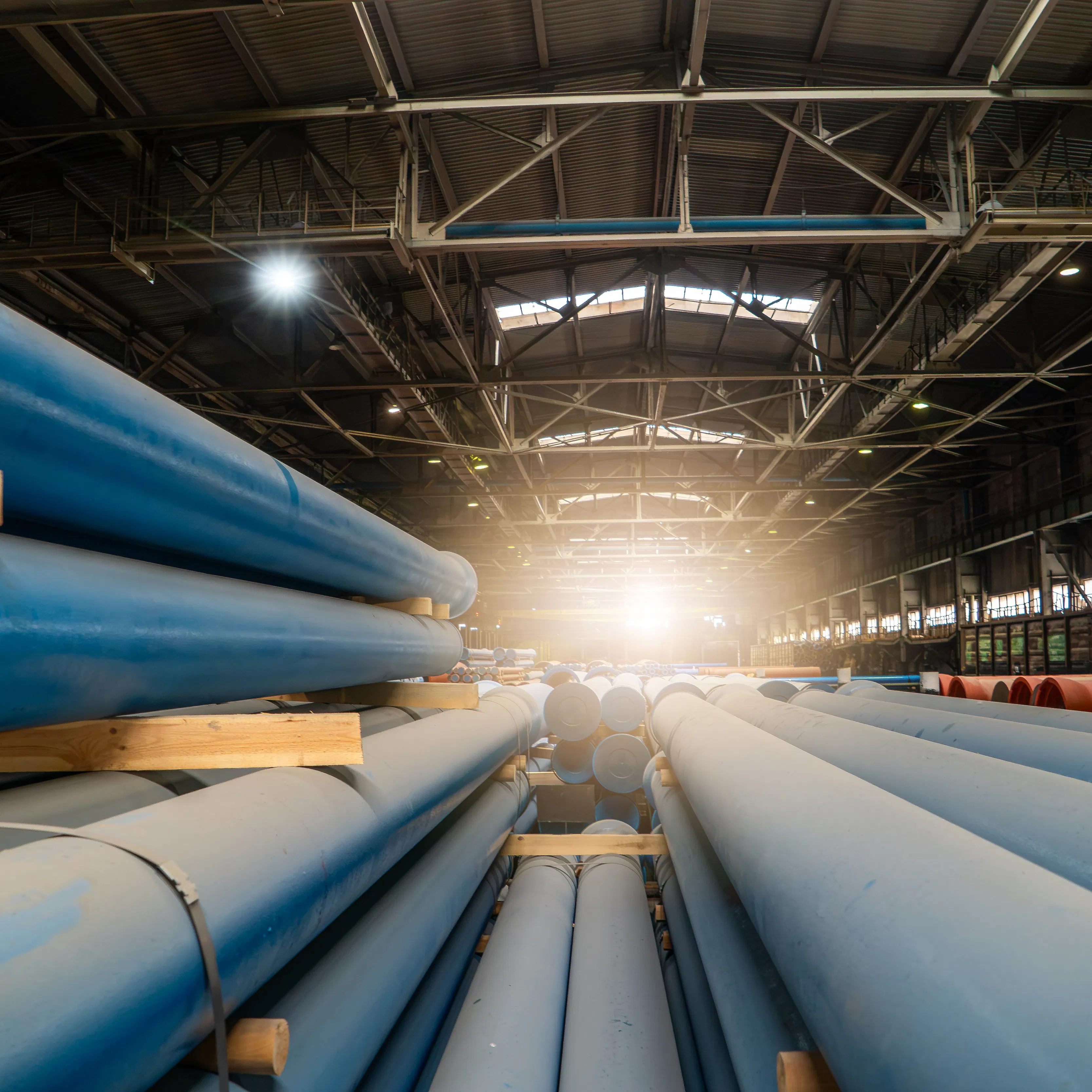
Ductile iron pipe is the dominant material for municipal water distribution mains and sewer force mains globally, produced by centrifugal casting to AWWA C151 (ANSI/AWWA C151/A21.51) specifications in diameters from 100 mm to 1,600 mm with pressure ratings from 1,380 kPa to 2,400 kPa. The tensile strength of centrifugally cast ductile iron pipe (minimum 414 MPa per AWWA C151) and elongation (minimum 10%) provide the structural capacity to withstand internal pressure, soil overburden loading, live traffic loads, water hammer pressure transients, and installation forces from trench compaction and pipe joint assembly without cracking or permanent deformation. Ductile iron pipe's expected service life of 100 years to over 150 years in properly installed and protected conditions, combined with the cement-mortar lining (AWWA C104) that prevents corrosion by potable water chemistry and the polyethylene encasement (AWWA C105) or zinc-aluminum external coating that limits soil-side corrosion, makes it the preferred material for long-life water infrastructure investment. Ductile iron replaced gray cast iron in new water main installation from the 1970s onward, with the toughness improvement from gray iron's below-5-J Charpy energy to ductile iron's above-30-J Charpy energy, eliminating the brittle fracture failures and breaks that characterized aging gray iron water mains under traffic and seismic loading.
2. Ductile Iron Used for Automotive Components
Ductile iron crankshafts, differential housings, steering knuckles, brake calipers, wheel hubs, and suspension components exploit the material's fatigue strength (200 MPa to 280 MPa endurance limit for standard grades; 350 MPa to 500 MPa for ADI), tensile strength (414 MPa to 827 MPa), and complex castability to produce near-net-shape automotive parts at 20% to 40% lower cost than equivalent steel forgings for the same functional performance. Ductile iron crankshafts in passenger cars and light trucks are produced in Grade 80-55-06 (tensile strength 552 MPa, yield strength 379 MPa, elongation 6%), providing the fatigue resistance required for 200,000 km to 300,000 km service life at engine speeds from 600 RPM to 7,000 RPM under cyclic bending and torsional loads. ADI crankshafts achieve fatigue endurance limits from 350 MPa to 450 MPa, enabling the same fatigue life at 10% to 15% lower component weight through section thickness reduction compared to standard ductile iron grades. Steering knuckles, differential housings, and wheel hubs in Grade 65-45-12 or Grade 80-55-06 ductile iron provide the combination of impact resistance (Charpy energy 15 J to 40 J) and yield strength (310 MPa to 379 MPa) required for suspension components subjected to road-induced shock loading at frequencies from 1 Hz to 50 Hz.
3. Ductile Iron Used for Construction and Structural Parts
Ductile iron construction and structural components, including manhole covers, drainage frames, pipe couplings, structural connectors, and architectural castings, exploit the material's tensile strength (414 MPa to 827 MPa), impact resistance (Charpy energy 15 J to over 100 J), and complex castability for components subjected to dynamic traffic loading, installation impact, and long-term structural service in civil infrastructure. Ductile iron manhole covers and frames are produced to EN 124 Group D (40-tonne load class, for carriageway use) and Group F (90-tonne, for aircraft pavements) specifications, replacing gray cast iron covers that fractured under impact from vehicle wheels and required frequent maintenance and replacement. Ductile iron pipe couplings and mechanical joints (AWWA C110, C153) connect water main segments at field joints, exploiting the material's ductility to accommodate pipe deflection up to 15° at bell-and-spigot joints without cracking. Structural ductile iron connectors in timber-frame construction use Grade 65-45-12 or 80-55-06 material for moment-resisting connections in post-and-beam structures, where the combination of tensile strength and elongation prevents sudden brittle failure under seismic or wind lateral loads.
4. Ductile Iron Used for Industrial Machinery
Ductile iron gears, housings, pump bodies, compressor frames, valve bodies, and machine bases exploit the material's strength (414 MPa to 827 MPa tensile), fatigue resistance (200 MPa to 280 MPa endurance limit), vibration damping (3 to 5 times greater than steel, lower than gray iron but adequate for many applications), and complex near-net-shape castability for industrial machinery components produced in geometries requiring internal passages, integral bosses, and variable wall thickness from 5 mm to 150 mm. Ductile iron pump impellers and casings in Grade 65-45-12 resist cavitation erosion and mechanical impact from entrained solids in industrial slurry handling, water supply booster, and chemical process applications where gray iron brittleness would cause premature fracture failure. Gearbox housings and gear blanks in Grade 80-55-06 or 100-70-03 ductile iron provide the strength and fatigue resistance required for industrial gear sets operating at pitch line velocities from 1 m/s to 25 m/s and transmitting power from 10 kW to over 1,000 kW. Valve bodies in ductile iron (ASTM A395 for elevated-temperature service) maintain structural integrity at operating temperatures up to 340°C and pressures from 1 MPa to 25 MPa in steam, water, and gas pipeline valve applications.
5. Ductile Iron Used for Agricultural Equipment
Tractor hubs, implement frames, gearbox housings, hydraulic valve bodies, and PTO (power take-off) components in ductile iron serve agricultural machinery applications where shock loading from field obstacles, soil contact, and implement engagement subjects components to impact energy that gray cast iron cannot absorb without fracture. Agricultural tractor front axle spindles and rear axle housings in Grade 80-55-06 or 100-70-03 ductile iron provide the combined tensile strength (552 MPa to 690 MPa) and elongation (3% to 6%) needed to withstand the bending loads from field implements weighing 500 kg to 5,000 kg at draft forces from 20 kN to 150 kN without permanent deformation or fatigue cracking over 10,000 hours to 20,000 hours of field operation. Ductile iron implement frames for planters, cultivators, and tillage equipment replace gray iron frames that fractured when striking rocks and hard soil obstructions, with the ductile iron's elongation from 10% to 18%, allowing the frame to deflect and return elastically rather than fracturing at stress concentration points.
6. Ductile Iron Used for Energy and Power Generation
Wind turbine main shafts, hub castings, nacelle frames, and gearbox housings in ductile iron and ADI serve the wind energy sector, exploiting the material's fatigue strength (350 MPa to 500 MPa in ADI), complex large-section castability (single castings from 500 kg to over 30,000 kg), and cost advantage over cast steel for the largest structural components in multi-megawatt turbines. Wind turbine main shafts in ADI Grade 1 (ASTM A897: 900 MPa tensile, 600 MPa yield, 10% elongation) transmit torque from the rotor hub to the gearbox at shaft speeds from 5 RPM to 20 RPM under cyclic bending loads from wind gusts and gravity loading of the rotating rotor mass. Hydroelectric turbine components, including runner hubs, guide vane frames, and draft tube linings in ductile iron, provide the combination of casting complexity (internal water passages, complex curvature) and structural performance (tensile strength above 414 MPa, impact resistance above 30 J) required for components operating in flowing water at pressures from 0.5 MPa to 10 MPa over service lives from 30 to 60 years. Nuclear power plant valve bodies and pump casings in ductile iron (ASME SA395 for elevated temperature and pressure service) provide pressure containment integrity at design pressures from 3 MPa to 20 MPa and temperatures up to 340°C.
7. Ductile Iron Used for Railway and Transportation Components
Ductile iron bogie frames, axle boxes, brake components, and suspension parts serve railway applications where fatigue loading at frequencies from 1 Hz to 50 Hz, impact from track irregularities, and decades of service without replacement require materials combining fatigue strength, impact resistance, and reliable properties across a wide temperature range. Ductile iron bogie frames in Grade 80-55-06 or 100-70-03 carry static loads from 15 tonnes to 25 tonnes per bogie and dynamic impact loads up to 3 times the static load during passage over rail joints, points, and crossings, with fatigue life requirements exceeding 10 million load cycles without crack initiation. Brake disc hats and caliper brackets in Grade 65-45-12 ductile iron provide the impact resistance to survive emergency braking events and thermal cycling from ambient temperature to 400°C to 600°C at the rotor surface, with the elongation of 12% preventing brittle fracture from thermal shock that would occur in gray cast iron brake components.
8. Ductile Iron Used for Marine Applications
Ductile iron pump housings, valve bodies, propeller shaft brackets, sea chest fittings, and structural castings serve marine below-decks applications where the material's strength (414 MPa to 827 MPa), complex castability, and adequate corrosion resistance (with epoxy coating or sacrificial anode cathodic protection) provide reliable performance in seawater-cooled machinery and hull structural systems. Marine pump casings in Grade 65-45-12 or 80-55-06 ductile iron handle seawater cooling flow at pressures from 0.3 MPa to 1.5 MPa and flow rates from 10 m³/h to 500 m³/h, with the casting complexity accommodating integral suction and discharge flanges, impeller wear ring bores, and mechanical seal chambers in a single casting rather than the multi-component assemblies required in fabricated steel construction. Sea chest fittings and overboard discharge valves in ductile iron provide structural integrity at hull pressures from 0.1 MPa to 0.5 MPa at operating depths from surface to 50 m, with external epoxy coating and zinc anode cathodic protection extending service life from 15 years to 25 years in seawater immersion service before requiring replacement or inspection.
What Are the Advantages of Using Ductile Iron?
The advantages of using ductile iron are listed below.
- High Strength-to-Cost Ratio: Ductile iron achieves tensile strength from 414 MPa to 827 MPa at raw material and casting costs from [$600 to $1,200] per metric ton of finished casting, providing mechanical performance approaching cast carbon steel at 20% to 40% lower production cost for equivalent complex-geometry components.
- Superior Ductility Among Cast Irons: Elongation from 10% to 18% (ferritic grades) provides plastic deformation warning before fracture and impact energy absorption that gray and white cast iron cannot match, making ductile iron safe for structural applications where sudden brittle failure is unacceptable.
- Complex Near-Net-Shape Castability: Ductile iron casts into complex geometries (internal passages, variable wall thickness from 3 mm to 200 mm, undercuts, integral flanges) in a single casting operation that eliminates the multi-component fabrication and assembly required to produce equivalent geometry in steel plate or forgings.
- Long Service Life in Infrastructure: Ductile iron water and sewer pipe achieves service lives from 100 years to over 150 years in properly installed and coated conditions, providing a low lifecycle cost despite moderate initial investment compared to plastic pipe alternatives.
- Wide Mechanical Property Range: ASTM A536 grades from 60-40-18 to 120-90-02 and ADI grades from ASTM A897 provide tensile strength from 414 MPa to 1,600 MPa within the same production process, enabling ductile iron to serve applications from low-pressure pipe fittings to high-performance automotive crankshafts.
- Good Machinability: Ductile iron machines at cutting speeds from 60 m/min to 150 m/min with carbide tooling, producing good surface finish (Ra 1.6 µm to Ra 6.3 µm) in turning, milling, and boring operations, with graphite nodules providing some lubrication at the tool-chip interface that reduces tool wear compared to equivalent-strength cast steel.
- Fatigue Resistance: Standard ductile iron fatigue endurance limits from 200 MPa to 280 MPa (45% to 50% of tensile strength) and ADI endurance limits from 350 MPa to 500 MPa provide reliable cyclic load performance for rotating and reciprocating machinery components over 10 million to 100 million load cycles.
- Environmental Recyclability: Ductile iron is 100% recyclable through remelting in electric induction furnaces, with casting returns (sprues, risers, rejected castings) reused directly in the charge without property degradation, reducing material waste and supporting sustainable manufacturing practices.
Disclaimer
The content appearing on this webpage is for informational purposes only. Xometry makes no representation or warranty of any kind, be it expressed or implied, as to the accuracy, completeness, or validity of the information. Any performance parameters, geometric tolerances, specific design features, quality and types of materials, or processes should not be inferred to represent what will be delivered by third-party suppliers or manufacturers through Xometry’s network. Buyers seeking quotes for parts are responsible for defining the specific requirements for those parts. Please refer to our terms and conditions for more information.