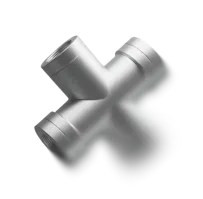
Malleable Iron: Composition, Properties and Uses


Malleable iron is a form of cast iron processed through heat treatment to convert its brittle structure into a ductile, impact-resistant material suitable for mechanical and structural applications. Malleable iron derives its name from the Latin word "malleare," meaning "to hammer," reflecting its capacity to withstand deformation without fracturing. The production begins by casting white iron, where carbon exists as iron carbide (Fe₃C), then subjecting the casting to a prolonged annealing cycle at temperatures from 900°C to 970°C for 50 to 70 hours.
The annealing process decomposes iron carbide, forming temper carbon nodules distributed within a ferrite or pearlite matrix. The primary composition of malleable iron includes 2.2% to 2.9% carbon, 0.9% to 1.9% silicon, 0.15% to 1.2% manganese, with sulfur and phosphorus maintained below 0.18% each. The mechanical properties include a tensile strength from 345 MPa to 450 MPa, a yield strength from 224 MPa to 310 MPa, and an elongation rate from 5% to 18%. The combination of controlled composition and heat treatment positions malleable iron as a reliable material for automotive, pipe fitting, and agricultural equipment manufacturing.
What Is Malleable Iron?
Malleable iron is a type of cast iron that undergoes a controlled annealing heat treatment to transform its brittle white iron structure into a ductile, workable material capable of withstanding mechanical stress without fracturing. The term "malleable" references the material's acquired ability to deform plastically under applied force, a property absent in untreated white iron due to the presence of iron carbide (Fe₃C) in its as-cast state. The heat treatment drives the decomposition of iron carbide into temper carbon nodules distributed throughout a ferrite or pearlite matrix.
The nodular graphite morphology reduces stress concentration within the material, allowing malleable iron to absorb impact energy more effectively than gray or white iron. Malleable iron achieves a tensile strength from 345 MPa to 450 MPa, a yield strength from 224 MPa to 310 MPa, and an elongation rate from 5% to 18%, depending on grade and matrix microstructure. The material is produced in three primary grades (whiteheart, blackheart, and pearlitic), each differing in matrix composition and mechanical performance, making it a preferred material in pipe fittings, automotive brackets, and agricultural equipment.
What Is the Meaning of Malleable Iron in Cast Iron Materials?
Malleable iron, within the cast iron material family, refers to a heat-treated grade engineered to possess ductility and impact resistance absent in standard cast iron forms. It occupies a distinct position among cast iron types (gray iron, white iron, and ductile iron) due to its annealed microstructure. The annealing process converts iron carbide (Fe₃C) into temper carbon nodules, redistributed within a ferrite or pearlite matrix.
The resulting microstructure grants malleable iron mechanical properties unattainable in as-cast white iron. Tensile strength ranges from 345 MPa to 450 MPa, with an elongation rate from 5% to 18%, reflecting measurable ductility. Unlike gray iron, which contains flake graphite that weakens the matrix, malleable iron contains rounded temper carbon clusters that minimize internal stress concentration. The material bridges the performance gap from brittle cast iron to more ductile ferrous materials in industrial applications.
Is Malleable Iron a Heat Treated Form of Cast Iron?
Yes, malleable iron is a heat-treated form of cast iron. The production process begins with white iron castings, where carbon is locked as iron carbide (Fe₃C), making the material hard but brittle. The castings are subjected to annealing at temperatures from 900°C to 970°C for 50 to 70 hours, decomposing iron carbide into temper carbon nodules within a ferrite or pearlite matrix. The heat treatment elevates tensile strength to a range from 345 MPa to 450 MPa and introduces an elongation rate from 5% to 18%, properties unattainable in untreated white iron. The mechanical change distinguishes malleable iron from other grades, making it a structurally refined and impact-resistant cast iron.
How Is Malleable Iron Made?
Malleable iron is made through a two-stage manufacturing process involving the casting of white iron, followed by a prolonged annealing heat treatment. White iron is first produced by melting an iron charge composed of 2.2% to 2.9% carbon and 0.9% to 1.9% silicon, then pouring the molten metal into molds at temperatures from 1,300°C to 1,400°C. The rapid solidification locks carbon as iron carbide (Fe₃C), producing a hard, brittle white iron casting that functions as the starting material.
The white iron castings are then loaded into annealing furnaces and heated to temperatures from 900°C to 970°C for 50 to 70 hours. The prolonged heat exposure decomposes iron carbide into temper carbon nodules distributed within a ferrite or pearlite matrix, depending on cooling rate and composition. Faster cooling produces a pearlitic matrix with higher strength, while slower cooling yields a ferritic matrix with greater ductility. The controlled annealing cycle transforms the brittle white iron into malleable iron, achieving an elongation rate from 5% to 18% and a tensile strength from 345 MPa to 450 MPa.
How Does Heat Treatment Change White Cast Iron Into Malleable Cast Iron?
Heat treatment changes white cast iron into malleable cast iron by decomposing iron carbide (Fe₃C) into temper carbon nodules through a controlled annealing cycle. White cast iron enters the annealing furnace with carbon fully locked in a hard, brittle carbide form, producing a material with near-zero ductility and an elongation rate below 1%. The annealing cycle runs at temperatures from 900°C to 970°C for 50 to 70 hours, providing sufficient thermal energy to break down iron carbide structures progressively.
The decomposed carbon precipitates as irregularly shaped temper carbon nodules within a ferrite or pearlite matrix, reducing internal stress concentration across the material. The nodular carbon morphology raises the elongation rate from 5% to 18% and tensile strength from 345 MPa to 450 MPa. The cooling rate after annealing determines the final matrix, where slow cooling favors ferrite and faster cooling retains pearlite, with the entire change driven by controlled heat treatment.
Is Annealing Required to Produce Malleable Iron?
Yes, annealing is required to produce malleable iron. White iron castings in their as-cast state contain carbon entirely as iron carbide (Fe₃C), making the material too brittle for structural or mechanical applications. Annealing at temperatures from 900°C to 970°C for 50 to 70 hours provides the thermal energy necessary to decompose iron carbide into temper carbon nodules within a ferrite or pearlite matrix. Without annealing, the iron carbide structure remains intact, preventing the development of ductility and impact resistance characteristic of malleable iron. The annealing cycle directly determines the elongation rate from 5% to 18% and tensile strength from 345 MPa to 450 MPa, making it an indispensable stage in malleable iron production.
What Is the Chemical Composition of Malleable Iron?
The chemical composition of malleable iron is listed below.
- Carbon (2.2% to 2.9%): Carbon is the primary alloying element in malleable iron. Its concentration determines the volume of tempered carbon nodules formed during annealing. Higher carbon content increases graphitization but reduces fluidity during casting.
- Silicon (0.9% to 1.9%): Silicon promotes the decomposition of iron carbide during the annealing process. It accelerates graphitization, reducing annealing time and improving ferritic matrix formation. Silicon content below 0.9% slows graphitization and extends the required annealing duration.
- Manganese (0.15% to 1.2%): Manganese strengthens the iron matrix and counteracts the embrittling effect of sulfur. It stabilizes the pearlitic matrix in higher-strength malleable iron grades. Manganese content above 1.2% suppresses graphitization and increases hardness.
- Sulfur (below 0.18%): Sulfur is a controlled impurity that retards graphitization during annealing. Excess sulfur prolongs annealing time and weakens the final matrix structure. Manganese is added to neutralize sulfur by forming manganese sulfide (MnS).
- Phosphorus (below 0.18%): Phosphorus increases the fluidity of molten iron during casting. Excess phosphorus reduces impact toughness and introduces brittleness in the solidified casting. Phosphorus content is strictly controlled to maintain mechanical integrity across malleable iron grades.
How Does Carbon Content Affect Malleable Cast Iron Composition?
Carbon content directly affects malleable cast iron composition by controlling the volume of temper carbon nodules formed during annealing and the resulting mechanical properties of the finished material. Carbon in malleable iron is maintained from 2.2% to 2.9% by weight, a range deliberately narrower than other cast iron grades. Carbon below 2.2% reduces the graphitization potential during annealing, producing an incomplete nodule distribution that weakens ductility and lowers elongation rates.
Carbon above 2.9% increases graphitization but introduces shrinkage defects during solidification, compromising casting integrity. The optimal carbon range produces a uniform temper carbon nodule distribution within the ferrite or pearlite matrix, achieving tensile strength from 345 MPa to 450 MPa and elongation from 5% to 18%. Carbon content interacts directly with silicon levels, where a combined carbon-silicon value from 3.3% to 4.5% governs graphitization rate and annealing efficiency in malleable cast iron.
Does Malleable Iron Contain Temper Carbon Instead of Flake Graphite?
Yes, malleable iron contains temper carbon instead of flake graphite. Flake graphite, present in gray iron, forms sharp-edged discontinuities within the iron matrix that act as stress concentrators, reducing tensile strength and impact resistance. Malleable iron eliminates flake graphite through annealing, where iron carbide (Fe₃C) decomposes into irregularly shaped temper carbon nodules distributed throughout a ferrite or pearlite matrix. The rounded nodule morphology minimizes stress concentration, producing an elongation rate from 5% to 18% and tensile strength from 345 MPa to 450 MPa, values unattainable in gray iron. The absence of flake graphite and the controlled precipitation of temper carbon nodules define the superior mechanical performance attributed to Carbon (C) in malleable iron.
What Are the Key Properties of Malleable Cast Iron?
The key properties of malleable cast iron are listed below.
- Tensile Strength (345 MPa to 450 MPa): Tensile strength measures the maximum stress malleable cast iron withstands before fracturing under axial load. Pearlitic grades reach the upper tensile range, while ferritic grades perform closer to 345 MPa.
- Yield Strength (224 MPa to 310 MPa): Yield strength defines the stress point at which malleable cast iron begins permanent deformation without fracturing. Ferritic matrices contribute to lower yield values, while pearlitic matrices push yield strength toward 310 MPa.
- Elongation (5% to 18%): Elongation measures the percentage of plastic deformation malleable cast iron sustains before fracture. Ferritic malleable iron achieves the highest elongation values, 18%, while pearlitic grades range from 5% to 10%.
- Hardness (110 to 270 HB): Hardness in malleable cast iron is measured on the Brinell scale, ranging from 110 HB in ferritic grades to 270 HB in pearlitic grades. Ferritic grades at 110 to 150 HB offer the best machinability among malleable iron types.
- Impact Resistance (5 J to 25 J): Malleable cast iron absorbs impact energy through the plastic deformation capacity of its ferritic or pearlitic matrix. Impact resistance values range from 5 J to 25 J on the Charpy V-notch test, depending on grade and matrix composition.
- Thermal Conductivity (37 to 50 W/m·K): Thermal conductivity measures the rate at which malleable cast iron transfers heat through its structure. Pearlitic grades exhibit slightly lower thermal conductivity due to carbide retention within the matrix.
- Machinability (120% relative to gray iron): Malleable cast iron machines more cleanly than gray iron due to the absence of flake graphite that causes abrasive tool wear. Ferritic grades achieve machinability ratings of 120% relative to standard gray iron at 100%.
How Do Strength and Toughness Relate to Ductility and Malleability?
Strength and toughness in malleable iron relate to ductility and malleability through the microstructural balance achieved during annealing, where temper carbon nodules within a ferrite or pearlite matrix enable the material to absorb stress without sudden fracture. Strength defines the load a material resists, while toughness measures the total energy absorbed before fracture, and properties depend directly on the matrix microstructure developed through heat treatment.
Ferritic malleable iron prioritizes ductility, achieving elongation from 12% to 18% at tensile strengths from 345 MPa to 380 MPa, making it suitable for applications requiring plastic deformation tolerance. Pearlitic malleable iron shifts toward higher strength from 400 MPa to 450 MPa at reduced elongation from 5% to 10%, trading deformation capacity for load resistance. The interdependence of strength, toughness, and matrix composition defines the mechanical range attributed to ductility and malleability in malleable iron grades.
Is Malleable Iron Considered One of the More Ductile Materials Among Cast Irons?
Yes, malleable iron is considered one of the more ductile materials among cast irons. Gray iron contains flake graphite that acts as an internal stress concentrator, limiting elongation to below 1% and preventing meaningful plastic deformation. White iron, in its as-cast state, exhibits near-zero ductility due to its continuous iron carbide network. Malleable iron, through annealing, converts iron carbide into rounded temper carbon nodules that minimize stress concentration, producing elongation rates from 5% to 18% depending on grade. Ferritic malleable iron achieves the highest elongation at 18%, surpassing gray iron and white iron by a measurable margin. The temper carbon nodule microstructure positions malleable iron among the most capable ductile materials within the cast iron family.
How Does Malleable Iron Compare to Other Metal Materials?
The comparison of malleable iron to other metal materials is listed below.
- Malleable Iron vs Grey Cast Iron: Grey cast iron contains flake graphite that limits elongation to below 1%, making it significantly more brittle than malleable iron. Malleable iron achieves elongation from 5% to 18% and tensile strength from 345 MPa to 450 MPa, outperforming grey cast iron in impact resistance and ductility.
- Malleable Iron vs Ductile Iron: Ductile iron achieves tensile strength from 414 MPa to 827 MPa through magnesium-induced spheroidal graphite nodules formed during casting. Malleable iron produces comparable ductility through annealing, but is restricted to section thicknesses below 40 mm, where ductile iron performs across thicker sections without restriction.
- Malleable Iron vs Wrought Iron: Wrought iron produces tensile strength from 310 MPa to 380 MPa with elongation from 10% to 20% through mechanical working. Malleable iron matches wrought iron in ductility but offers superior castability, allowing complex geometries unachievable through wrought iron's mechanical forming process.
- Malleable Iron vs Carbon Steel: Carbon steel achieves tensile strength from 400 MPa to over 1,000 MPa, exceeding the upper tensile range of malleable iron at 450 MPa. Malleable iron offers superior castability and vibration damping, making it preferable for complex-shaped components (pipe fittings and brackets) where carbon steel requires extensive machining.
- Malleable Iron vs Aluminum: Aluminum alloys exhibit a density of 2.7 g/cm³, one-third the density of malleable iron at 7.2 g/cm³ to 7.4 g/cm³. Malleable iron delivers higher tensile strength from 345 MPa to 450 MPa compared to aluminum alloys at 150 MPa to 310 MPa, making it the preferred choice in load-bearing applications across a broad range of metal materials.
1. Malleable Iron vs Grey Cast Iron
The comparison of malleable iron and grey cast iron is listed below.
- Graphite Morphology: Malleable iron contains rounded temper carbon nodules, while grey cast iron contains flake graphite formed during solidification. Flake graphite acts as an internal stress concentrator, limiting grey cast iron elongation to below 1%.
- Tensile Strength: Malleable iron achieves tensile strength from 345 MPa to 450 MPa, outperforming grey cast iron at 100 MPa to 350 MPa. The temper carbon nodule structure distributes load more effectively than flake graphite.
- Elongation: Malleable iron achieves elongation from 5% to 18%, significantly exceeding grey cast iron at below 1%. The annealed ferritic or pearlitic matrix permits plastic deformation unattainable in grey cast iron.
- Hardness: Grey cast iron ranges from 150 HB to 300 HB, overlapping with pearlitic malleable iron at 200 HB to 270 HB. Ferritic malleable iron at 110 HB to 150 HB offers superior machinability.
- Vibration Damping: Grey cast iron exhibits superior vibration damping due to its flake graphite network, making it preferable for machine bases and engine blocks. Malleable iron provides moderate damping, prioritizing mechanical strength over vibration absorption.
- Castability: Grey cast iron offers superior castability with lower shrinkage rates, producing complex geometries at lower production costs. Malleable iron requires additional annealing from 50 to 70 hours, increasing production cost relative to grey cast iron.
2. Malleable Iron vs Ductile Iron
The comparison of malleable iron and ductile iron is listed below.
- Graphite Morphology: Ductile iron forms spheroidal graphite through magnesium treatment during casting, while malleable iron develops temper carbon nodules through annealing. Spheroidal graphite produces a more uniform stress distribution across the iron matrix.
- Tensile Strength: Ductile iron achieves tensile strength from 414 MPa to 827 MPa, exceeding malleable iron at 345 MPa to 450 MPa. The higher strength range makes ductile iron preferable for heavy-load structural applications.
- Elongation: Ductile iron achieves elongation from 2% to 18%, comparable to malleable iron at 5% to 18%. Pearlitic grades of materials perform at the lower elongation range.
- Section Thickness: Malleable iron is restricted to section thicknesses below 40 mm due to white iron formation requirements. Ductile iron performs across thicker sections without restriction, expanding its application range.
- Production Process: Malleable iron requires annealing for 50 to 70 hours, increasing energy consumption and production time. Ductile iron achieves its nodular structure directly during casting through magnesium addition, eliminating the annealing stage.
- Hardness: Ductile iron ranges from 140 HB to 300 HB, overlapping with malleable iron at 110 HB to 270 HB. Ferritic ductile iron at 140 HB to 180 HB exhibits slightly higher hardness than ferritic malleable iron at 110 HB to 150 HB, reflecting matrix differences in malleable iron vs ductile iron.
3. Malleable Iron vs Wrought Iron
The comparison of malleable iron and wrought iron is listed below.
- Production Process: Malleable iron is produced through casting and annealing, while wrought iron is mechanically worked through repeated hammering and rolling at high temperatures. Wrought iron's mechanical working produces a fibrous slag inclusion structure absent in malleable iron.
- Tensile Strength: Malleable iron achieves tensile strength from 345 MPa to 450 MPa, exceeding wrought iron at 310 MPa to 380 MPa. The annealed matrix of malleable iron distributes load more effectively than wrought iron's fibrous structure.
- Elongation: Wrought iron achieves elongation from 10% to 20%, slightly exceeding malleable iron at 5% to 18%. The fibrous slag structure of wrought iron contributes to its higher deformation capacity.
- Hardness: Malleable iron ranges from 110 HB to 270 HB, exceeding wrought iron at 80 HB to 100 HB. The lower hardness of wrought iron limits its wear resistance in high-friction mechanical applications.
- Castability: Malleable iron offers superior castability, producing complex geometries (pipe fittings and brackets) through casting. Wrought iron requires mechanical forming processes, restricting it to simpler shapes and sections.
- Corrosion Resistance: Wrought iron exhibits superior corrosion resistance due to its slag inclusion network, which forms a protective barrier against oxidation. Malleable iron requires protective coatings (paint and galvanizing) to match the corrosion resistance of wrought iron.
4. Malleable Iron vs Carbon Steel
The comparison of malleable iron and carbon steel is listed below.
- Tensile Strength: Carbon steel achieves tensile strength from 400 MPa to over 1,000 MPa, significantly exceeding malleable iron at 345 MPa to 450 MPa. Higher carbon content and heat treatment push carbon steel beyond the mechanical range of malleable iron.
- Elongation: Carbon steel achieves elongation from 10% to 30%, exceeding malleable iron at 5% to 18%. Low-carbon steel grades reach the upper elongation range, offering greater deformation capacity than pearlitic malleable iron.
- Hardness: Carbon steel ranges from 120 HB to 500 HB, depending on carbon content and heat treatment, exceeding malleable iron at 110 HB to 270 HB. Higher hardness in carbon steel provides superior wear resistance in high-friction applications.
- Castability: Malleable iron offers superior castability, producing complex geometries (pipe fittings and brackets) through casting at lower machining costs. Carbon steel castings require extensive post-casting machining to achieve equivalent dimensional precision.
- Vibration Damping: Malleable iron exhibits superior vibration damping due to its temper carbon nodule structure, absorbing mechanical vibrations more effectively than carbon steel. Carbon steel transmits vibration across its homogeneous matrix, requiring additional damping components in dynamic applications.
- Machinability: Ferritic malleable iron achieves machinability ratings of 120% relative to standard gray iron, outperforming medium and high-carbon steel grades. Carbon steel machinability decreases as carbon content rises, increasing tool wear and cycle time relative to carbon steel.
5. Malleable Iron vs Aluminum
The comparison of malleable iron and aluminum is listed below.
- Density: Aluminum exhibits a density of 2.7 g/cm³, one-third the density of malleable iron at 7.2 g/cm³ to 7.4 g/cm³. The lower density of aluminum makes it preferable in weight-sensitive applications (aerospace and automotive body panels).
- Tensile Strength: Malleable iron achieves tensile strength from 345 MPa to 450 MPa, exceeding common aluminum alloys at 150 MPa to 310 MPa. Malleable iron is preferable in load-bearing applications where aluminum lacks sufficient mechanical strength.
- Hardness: Malleable iron ranges from 110 HB to 270 HB, significantly exceeding aluminum alloys at 15 HB to 150 HB. The higher hardness of malleable iron provides superior wear resistance in high-friction mechanical applications.
- Thermal Conductivity: Aluminum exhibits thermal conductivity from 150 W/m·K to 237 W/m·K, significantly exceeding malleable iron at 37 W/m·K to 50 W/m·K. Aluminum is preferable in heat dissipation applications (heat sinks and cooling components).
- Corrosion Resistance: Aluminum forms a natural oxide layer that provides superior corrosion resistance without additional coatings. Malleable iron requires protective coatings (paint and galvanizing) to resist oxidation in exposed environments.
- Castability: Malleable iron produces complex geometries through sand casting at lower tooling costs than aluminum die casting. Aluminum die casting achieves tighter dimensional tolerances at faster production rates, making it preferable for high-volume components, reinforcing the performance distinctions of the aluminum element.
What Are the Uses of Malleable Iron?
The uses of malleable iron are listed below.
- Pipe Fittings and Plumbing Connectors: Malleable iron is used in pipe fittings and plumbing connectors for water, gas, and steam systems. Its ductility and pressure resistance allow fittings to withstand operating pressures from 150 psi to 300 psi without fracturing under mechanical stress.
- Automotive Components: Malleable iron is used in brackets, axle housings, and suspension parts where impact resistance and dimensional stability are required. Its tensile strength from 345 MPa to 450 MPa and elongation from 5% to 18% accommodate dynamic load fluctuations in automotive systems.
- Industrial Equipment Parts: Malleable iron is used in gears, levers, and machine supports where moderate strength and machinability are required. Ferritic malleable iron achieves machinability ratings of 120% relative to gray iron, reducing tool wear and machining cycle time.
- Electrical Fittings: Malleable iron is used in conduit fittings and junction boxes where mechanical durability and thread integrity are critical. Its castability allows precise thread formation in conduit connectors, maintaining secure electrical enclosure connections under mechanical vibration.
- Agricultural Machinery Components: Malleable iron is used in tractor fittings and couplings where resistance to impact, vibration, and outdoor exposure is required. Its elongation from 5% to 18% accommodates mechanical shock loads common in field operation conditions across agricultural machinery applications.
1. Malleable Iron Used for Pipe Fittings and Plumbing Connectors in Water, Gas, and Steam Systems
Malleable iron is extensively used in pipe fittings and plumbing connectors across water, gas, and steam distribution systems due to its pressure resistance and thread integrity. The material withstands operating pressures from 150 psi to 300 psi without fracturing, making it reliable in pressurized pipeline networks. Malleable iron fittings are produced to ASTM A197 and ASME B16.3 standards, covering elbow, tee, coupling, and union configurations in sizes from 1/8 inch to 6 inches. The castability of malleable iron allows precise internal thread formation, producing leak-resistant connections in threaded pipeline assemblies. Its elongation from 5% to 18% accommodates mechanical stress from thermal expansion in steam systems operating at temperatures of 300°C, reinforcing its reliability across pressurized plumbing applications.
2. Malleable Iron Used for Automotive Components Such As Brackets, Axle Housings, and Suspension Parts
Malleable iron is used in automotive components where impact resistance, dimensional stability, and fatigue strength are required under dynamic load conditions. Brackets, axle housings, and suspension parts produced from malleable iron withstand tensile loads from 345 MPa to 450 MPa and absorb road-induced mechanical shocks through an elongation rate from 5% to 18%. Pearlitic malleable iron grades with hardness from 200 HB to 270 HB are preferred in axle housings and suspension components where wear resistance is critical. The castability of malleable iron allows complex bracket geometries to be produced in a single casting operation, reducing machining requirements and component weight compared to fabricated steel assemblies. Ferritic malleable iron achieves machinability ratings of 120% relative to gray iron, reducing manufacturing cycle time in high-volume automotive component production.
3. Malleable Iron Used for Industrial Equipment Parts, Including Gears, Levers, and Machine Supports
Malleable iron is used in industrial equipment parts where moderate strength, machinability, and vibration damping are required in mechanical systems. Gears, levers, and machine supports produced from malleable iron operate under tensile loads from 345 MPa to 450 MPa, with pearlitic grades at 200 HB to 270 HB preferred for gear and wear-surface applications. Ferritic malleable iron achieves machinability ratings of 120% relative to gray iron, producing clean chip formation and reduced tool wear during high-volume gear and lever machining operations. The tempered carbon nodule structure of malleable iron absorbs mechanical vibration, reducing stress transmission across machine support frames in continuous industrial operations. Malleable iron parts are produced to ASTM A220 standards, covering pearlitic grades with tensile strength from 380 MPa to 450 MPa for demanding industrial equipment applications.
4. Malleable Iron Used for Electrical Fittings Like Conduit Fittings and Junction Boxes
Malleable iron is used in electrical fittings where mechanical durability, thread integrity, and impact resistance are required in conduit and enclosure systems. Conduit fittings and junction boxes produced from malleable iron maintain secure threaded connections under mechanical vibration and thermal cycling in industrial electrical installations. Malleable iron electrical fittings comply with UL 514B and ANSI C80.1 standards, covering conduit bodies, couplings, and junction boxes in trade sizes from 1/2 inch to 4 inches. The elongation rate from 5% to 18% prevents brittle fracture in conduit fittings subjected to mechanical impact during installation and field operation. Its castability allows precise fitting geometries with consistent wall thickness from 3 mm to 8 mm, maintaining structural integrity across threaded conduit connections in commercial and industrial electrical systems.
5. Malleable Iron Used for Agricultural Machinery Components Such As Tractor Fittings and Couplings
Malleable iron is used in agricultural machinery components where resistance to impact, vibration, and outdoor environmental exposure is required in field operation conditions. Tractor fittings and couplings produced from malleable iron withstand mechanical shock loads generated during soil engagement, equipment attachment, and field transport operations. The elongation rate from 5% to 18% accommodates sudden load fluctuations common in agricultural power transmission systems, preventing brittle fracture under impact. Pearlitic malleable iron grades at 200 HB to 270 HB are preferred in coupling and fitting applications where wear resistance extends component service life across seasonal field operations. Malleable iron agricultural components are produced to ASTM A602 standards, covering grades from M3210 to M8501 with tensile strength from 310 MPa to 586 MPa for diverse agricultural machinery applications.
What Are the Advantages of Using Malleable Iron?
The advantages of using malleable iron are listed below.
- Ductility: Malleable iron achieves elongation from 5% to 18%, allowing plastic deformation without fracture under applied mechanical loads. The annealed temper carbon nodule structure permits deformation tolerance unattainable in gray or white cast iron.
- Impact Resistance: Malleable iron absorbs impact energy from 5 J to 25 J on the Charpy V-notch test, preventing brittle fracture under sudden mechanical loads. The ferritic or pearlitic matrix distributes impact energy across temper carbon nodules, reducing crack propagation.
- Machinability: Ferritic malleable iron achieves machinability ratings of 120% relative to gray iron, producing clean chip formation and reduced tool wear. The temper carbon nodule structure prevents the abrasive tool wear associated with flake graphite in gray iron.
- Castability: Malleable iron produces complex geometries (pipe fittings, brackets, and conduit bodies) through sand casting in a single operation. Its castability reduces post-casting machining requirements, lowering manufacturing costs for complex-shaped components.
- Tensile Strength: Malleable iron achieves tensile strength from 345 MPa to 450 MPa, providing reliable load-bearing capacity across mechanical and structural applications. Pearlitic grades reach the upper tensile range, expanding performance in high-stress applications.
- Wear Resistance: Pearlitic malleable iron at 200 HB to 270 HB provides wear resistance suitable for gears, couplings, and bearing surfaces in industrial equipment. The hardness range extends component service life in high-friction mechanical applications.
- Dimensional Stability: Malleable iron maintains dimensional accuracy after casting and annealing, producing components within tight tolerances for threaded fittings and precision mechanical parts. The controlled annealing cycle minimizes distortion and residual stress in the finished casting.
- Vibration Damping: The tempered carbon nodule structure absorbs mechanical vibration more effectively than carbon steel, reducing stress transmission across machine frames and automotive components. Vibration-damping capacity extends fatigue life in dynamically loaded malleable iron components.
Disclaimer
The content appearing on this webpage is for informational purposes only. Xometry makes no representation or warranty of any kind, be it expressed or implied, as to the accuracy, completeness, or validity of the information. Any performance parameters, geometric tolerances, specific design features, quality and types of materials, or processes should not be inferred to represent what will be delivered by third-party suppliers or manufacturers through Xometry’s network. Buyers seeking quotes for parts are responsible for defining the specific requirements for those parts. Please refer to our terms and conditions for more information.