ULTEM 3D Printing Service
Get instant online quotes on custom ULTEM 3D printed parts. Free shipping on all US orders. Xometry is certified to ISO 9001:2015, ISO 13485, IATF 16949:2016, and AS9100D.


About ULTEM 3D Printing
ULTEM is the trade name for a class of PEI (polyetherimide) thermoplastics that have exceptional properties that even approach the performance of some advanced thermoset polymers. ULTEM plastic exhibits excellent temperature, flame, and chemical resistance without sacrificing its mechanical strength. It is by far the strongest plastic available for FDM 3D printing, and some of its grades are also biocompatible, making it a common choice in the medical industry.
When it comes to printing high-performance parts using FDM technology, ULTEM stands alone in its class. This material exhibits excellent mechanical, thermal, and insulating properties, making it ideal for high-performance applications in the automotive, aerospace, and medical fields.
3D Printing ULTEM at a Glance
| Applications | Advantages | Disadvantages | Minimum Lead Time * | Comparative Cost | Max Part Size * |
|---|---|---|---|---|---|
Applications
| Advantages
| Disadvantages
| Minimum Lead Time * 2 Days | Comparative Cost $$$$ (Very High) | Max Part Size * 24” x 36” x 36” (610 mm x 915 mm x 915 mm) |
* Applies to US-based production only.
FDM ULTEM 1010
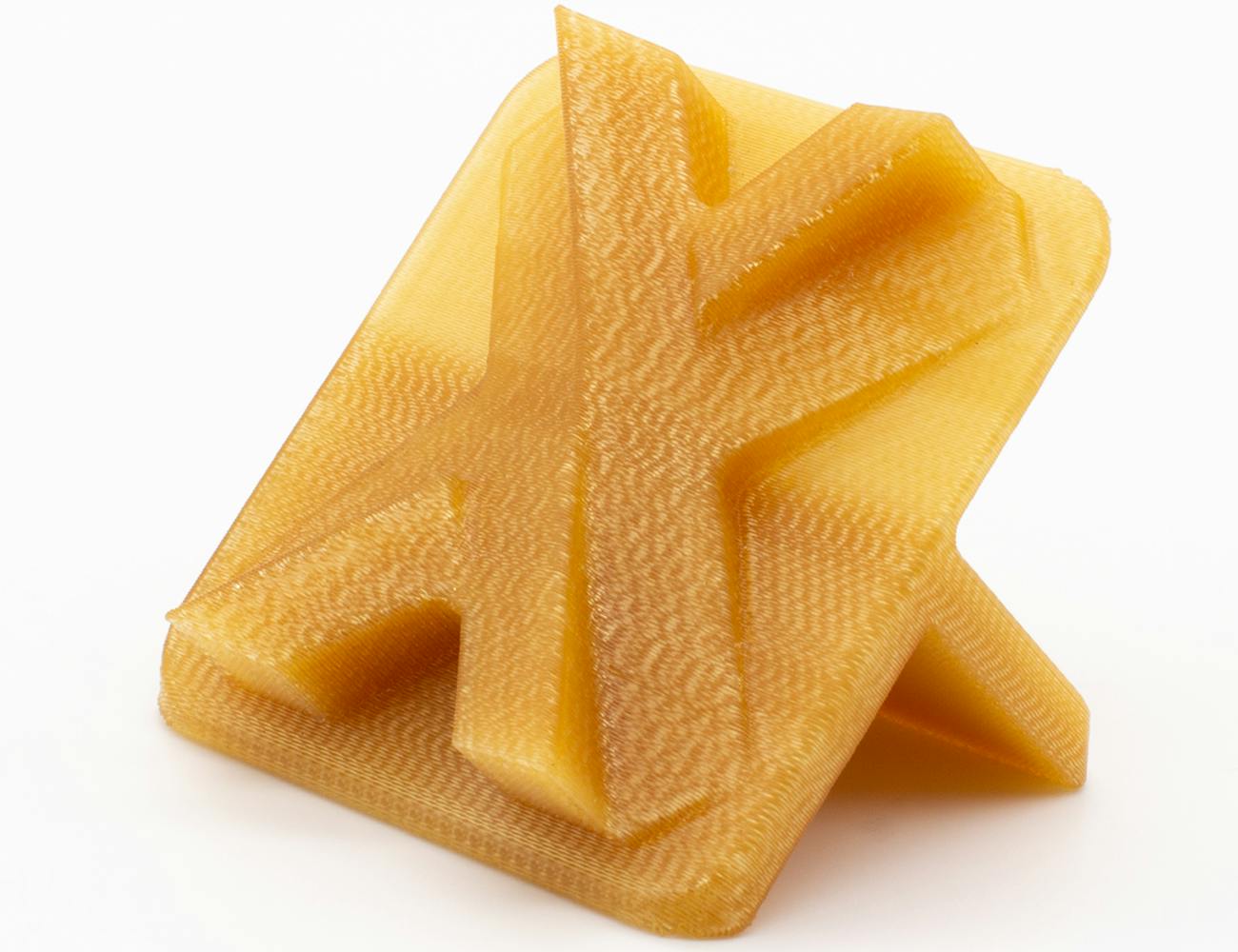
This grade of ULTEM has excellent thermal resistance, allowing it to be used in steam autoclaves without breaking down. If the parts need to come into contact with food, a certified grade (NSF/ANSI 51) is available to ensure compliance. Due to the above-mentioned properties, ULTEM 1010 is used extensively in the automotive, food, medical, and aerospace industries. Applications include jigs and surgical guides that need to withstand periods in a steam autoclave.
Xometry also offers this material in Certified Grade (CG), which is accompanied by documentation for food contact (NSF 51) and biocompatibility (ISO 10993/USP Class VI) compliance.
| Available Colors | Tensile Strength @ Break (MPa) | Elongation at Break (%) | Impact Strength, Notched (J/m) | Heat Deflection Temperature @ 66 psi (℃) |
|---|---|---|---|---|
Available Colors Amber | Tensile Strength @ Break (MPa) 79.2, 28.2 (XZ, ZX) | Elongation at Break (%) 4.0-1.1 | Impact Strength, Notched (J/m) 26.6, 21.7 (XZ, ZX) | Heat Deflection Temperature @ 66 psi (℃) 216 |
Properties achieved by running OEM materials and parameters on OEM Fortus equipment. See our FDM page for complete data sheets.
FDM ULTEM 9085
This grade of ULTEM is specifically formulated to be fire-retardant in accordance with UL 94 V-0 (tan only) and has an excellent FST (fire, smoke, and toxicity) rating. Additionally, ULTEM 9085 boasts an exceptional strength-to-weight ratio. Typical applications can include functional prototypes and composite molds.
| Available Colors | Tensile Strength @ Break (MPa) | Elongation at Break (%) | Impact Strength, Notched (J/m) | Heat Deflection Temperature @ 66 psi (°C) |
|---|---|---|---|---|
Available Colors Tan, Black | Tensile Strength @ Break (MPa) 68.1, 39.4 (XZ, ZX) | Elongation at Break (%) 5.4-1.9 | Impact Strength, Notched (J/m) 88.5, 39.2 (XZ, ZX) | Heat Deflection Temperature @ 66 psi (°C) 178 |
Properties achieved by running OEM materials and parameters on OEM Fortus equipment. See our FDM page for complete data sheets.
Cost-saving Design Tips
Here are some tips and considerations when choosing to print with ULTEM materials:
DFM: When designing parts for printing with FDM technology, special considerations are required. FDM machines construct parts from the bottom up, so any large overhangs will require support. Large internal cavities are not ideal, as their support structures cannot be easily removed. 3D printing in ULTEM can result in parts that have superior strength in the z-axis when compared to other FDM plastics. Nevertheless, to gain the most benefit from the material, parts should not be designed to have loads applied perpendicular to the print layers.
Material Choice: ULTEM is an advanced thermoplastic that is well worth the cost when used in harsh applications. While both grades of ULTEM listed above have excellent mechanical properties, each has specific benefits, such as flame retardance for ULTEM 9085 and biocompatibility for ULTEM 1010 CG. It is essential to select the appropriate material for the task.


Finishes
Surface finishing options for ULTEM materials are limited; however, we are happy to explore custom finishes on a case-by-case basis.
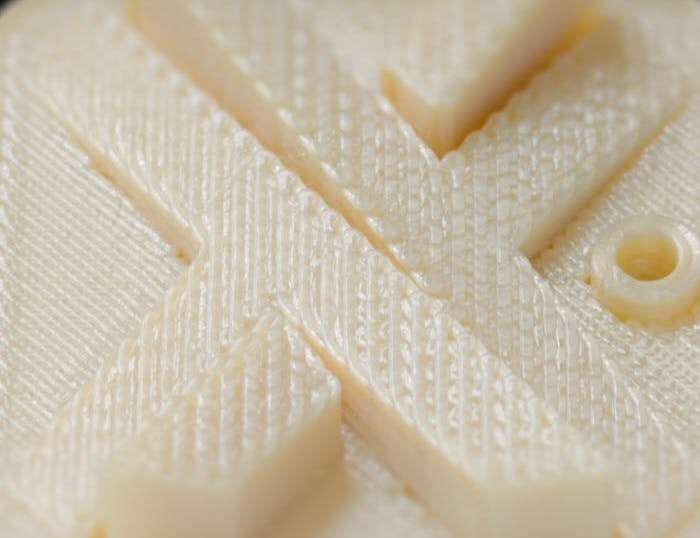
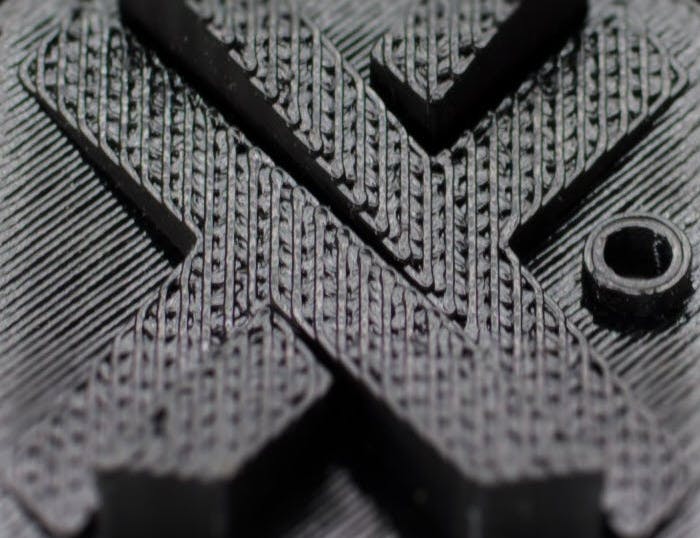
Standard: Support structures are removed, and some light sanding may be performed at the support locations. FDM parts typically exhibit noticeable layer lines, known as stepping. If a smooth surface finish is required right off the machine, then other 3D printing technologies should be considered.
Other: Custom surface finishes, like painting and additional sanding, can be requested.

ULTEM 1010