Composite Material: Definition, Properties, and Types


Composite Materials are engineered blends of a matrix and reinforcement, which work together to achieve performance characteristics that surpass individual components. Composite material relies on the matrix to bond the materials, while the reinforcement enhances strength, durability, and allows controlled deformation under mechanical stress. The interaction between the matrix and reinforcement determines the key properties of composite materials (tensile strength, stiffness, impact resistance, and long-term fatigue resistance) based on their specific composition. The types of composite materials offer a balance of mechanical, thermal, and environmental properties tailored to meet different performance needs. The choice of a composite system influences properties (weight, stability, and service life), making composite materials vital in advanced manufacturing for performance-critical uses. Developing composite technology ensures reliable performance in parts requiring consistent structural integrity and operation across industry uses.
What is a Composite Material?
A composite material is created by combining two or more different substances, producing a structure with improved strength, durability, and performance compared to individual materials. Fiber-reinforced polymers, metal matrix composites, and ceramic composites are common types of composite materials, which are produced using controlled procedures to guarantee consistent and reliable performance in industrial settings. The widespread use of composite materials is due to their high strength-to-weight ratios, corrosion resistance, and dimensional stability, making them ideal for efficiently producing custom components across manufacturing platforms.
What is Composite Material Made Of?
A composite material is made of a matrix that encases a reinforcement material, forming a unified structure that offers greater strength and stability than each component. The matrix is made from polymers, metals, or ceramics, while the reinforcements are fibers, particles, or layered sheets, which boost the strength and stiffness of the final product. The standard raw materials for composites (fiber bundles, resin systems, metal powders, and ceramic elements) are selected to maximize the performance and reliability of custom components for industrial uses. The entire structure of a composite provides balanced features (high strength-to-weight ratios and stable dimensional behavior), making it suitable for manufacturing applications.
How are Composite Materials Manufactured?
Composite materials are manufactured by following the three steps. First, start a composite manufacturing sequence by arranging reinforcement layers in a controlled layup process that forms a stable foundation for structural shaping. Second, create a unified structure through molding methods that press the matrix and reinforcement into a precise geometry suited for the manufacturing of composite materials. Lastly, produce continuous profiles through pultrusion equipment that draws fiber bundles through resin and heated dies to create consistent cross‑sections for industrial parts. Each method supports reliable production demands by delivering strength, stability, and predictable performance across a wide range of engineered components.
What are the Properties of Composite Materials?
The properties of composite materials are listed below.
- Mechanical Properties: Exhibiting strong tensile strength, steady stiffness, and reliable fatigue resistance, ensuring stable performance in custom parts made with advanced fabrication. Their balanced mechanics improve load-bearing components across industry environments.
- Physical Properties: Composite materials that have low density, stable size, and controlled thermal properties, allowing efficient production of lightweight parts via digital manufacturing. Their consistent physical behavior ensures precise shaping and reliable fit for engineered assemblies.
- Chemical Properties: Resistance to corrosion, moisture, and chemical degradation, and each trait supports long‑term durability for parts produced through on‑demand manufacturing systems. Stable chemical behavior protects structural integrity in environments exposed to harsh substances.
What are the Chemical Properties of Composite Materials?
The chemical properties of composite materials are listed below.
- Chemical Resistance: Maintain durability against moisture, solvents, and corrosive agents, supporting long service life in demanding environments. Stable resistance protects integrity when exposed to harsh operating conditions.
- Reactivity: Display controlled interaction between matrix and reinforcement, preventing unwanted reactions that weaken performance. Balanced reactivity ensures consistent stability across varied applications.
- Matrix Chemistry: Rely on polymer, metal, or ceramic matrices that define bonding strength and environmental tolerance. Matrix chemistry governs compatibility with reinforcement and determines the long‑term reliability of manufactured parts.
- Strength: Composite materials deliver strong load‑bearing performance that supports demanding industrial requirements. Reliable strength maintains structural integrity under mechanical stress.
- Stiffness: Composite materials maintain firm resistance to deformation, supporting accurate dimensional control in engineered components. Consistent stiffness preserves part geometry during service.
What are the Physical Properties of Composite Materials?
The physical properties of composite materials are listed below.
- Density: Composite materials present low mass per volume, creating lightweight parts for advanced manufacturing services. Stable density supports efficient handling and precise shaping during production.
- Electrical Conductivity: Electrical conductivity in composite materials refers to the ability of the material to transmit electric current through its structure. Conductivity levels depend on the type of reinforcement and matrix used, with carbon fiber composites showing higher conductivity compared to glass fiber composites.
- Thermal Conductivity: Thermal conductivity in composite materials describes the rate at which heat passes through the material. The property varies with fiber type and resin composition, where carbon-based composites demonstrate higher thermal transfer than polymer-based composites.
- Coefficient of Thermal Expansion: The coefficient of thermal expansion in composite materials measures dimensional changes in response to temperature variations. Fiber orientation and matrix composition influence expansion behavior, with carbon fiber composites exhibiting lower expansion compared to polymer-dominant composites.
Composite materials are best understood as systems, not substances, where performance is deliberately engineered through the interaction of matrix and reinforcement rather than inherited from a single material. Their real value shows up when weight, durability, fatigue resistance, and environmental stability must be tuned simultaneously. The matrix governs load transfer, environmental resistance, and manufacturability, while the reinforcement dictates stiffness, strength, and failure behavior, making material selection an exercise in balancing anisotropy, processing constraints, and service conditions rather than maximizing a single property. In applied use, composites reward disciplined design and punish shortcuts, as fiber orientation, interface quality, and processing control matter as much as raw material choice. When designed correctly, composites deliver performance envelopes that conventional materials simply cannot reach; when designed poorly, they expose failure modes that are equally unforgiving.
How do Composite Materials Differ from Plastics?
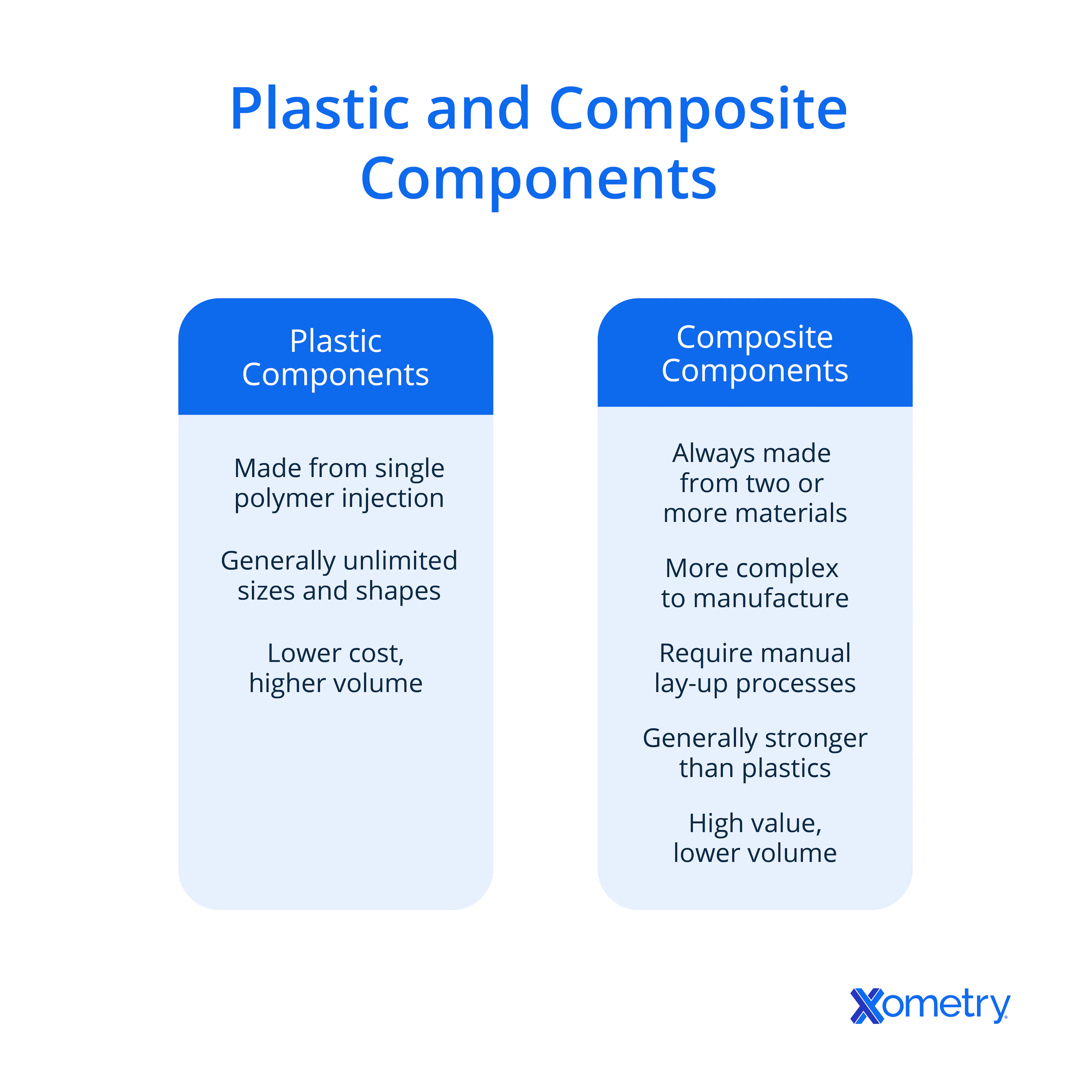
Composite materials differ from plastics by structure and performance, as composite materials rely on a reinforced matrix that delivers stronger mechanical behavior than standard plastics. A composite structure maintains higher strength and greater stiffness, creating a more reliable option for demanding industrial parts. It supports higher heat resistance, while a plastic structure maintains lower thermal tolerance that limits use in high‑temperature environments. A composite structure serves advanced engineering applications that require durability and stability, while a plastic structure serves lighter‑duty components with less demanding performance requirements. A clear difference emerges between the two materials, as composite materials rely on a reinforced matrix to provide greater strength and structural stability than standard plastic materials, in composite vs plastics.
What are the Types of Composite Materials
The types of composite materials are listed below.
- Nanocomposites: A type of composite material that has matrix structures reinforced with nanoscale particles that improve mechanical and thermal properties for precision parts. Each formulation meets advanced performance needs for lightweight, dimensionally stable product components.
- Metal Matrix Composites (MMCs): The combination of metal matrices with reinforcements to enhance stiffness and wear resistance, supporting demanding environments that need strength retention under high conditions.
- Polymer Matrix Composites (PMCs): A type of composite material that uses polymer matrices with fibers or particles to create lightweight structures with consistent mechanical strength, supporting efficient custom part production for industrial use applications.
- Glass Fiber Reinforced Polymers (GFRPs): A type of composite material that uses glass fibers in polymer matrices for strength and corrosion resistance. They support structural parts needing durability in different operating conditions.
- Hybrid Composites: The composites mix different reinforcements to achieve balanced strength, stability, and performance for specific parts' weight.
- Ceramic Matrix Composites (CMCs): A type of composite material that uses ceramic matrices reinforced with strong fibers to maintain stability under extreme heat, supporting high-temperature applications that demand thermal resistance and shock.
- Natural Fiber Composites (NFCs): The embed plant fibers in polymers to produce lightweight, eco-friendly materials supporting moderate-strength components with lower environmental impact.
- Carbon Fiber Reinforced Polymers (CFRPs): CFRPs combine carbon fibers with polymer matrices to deliver high stiffness and strong tensile behavior. Each material supports advanced engineering parts that require low weight and long service life.
- Aramid Fiber Reinforced Polymers (AFRPs): AFRPs use aramid fibers within polymer matrices to create structures with strong impact resistance. Each configuration supports components that require toughness and dimensional stability.
- Functionally Graded Composites (FGCs): FGCs present gradual changes in composition across a single structure to control mechanical and thermal behavior. Each gradient supports parts that require smooth transitions between strength, stiffness, and heat tolerance.
1. Nanocomposites
Nanocomposites present a material structure that incorporates nanoscale reinforcements within a continuous matrix to raise strength, stability, and functional performance for advanced manufactured parts. Each formulation delivers refined mechanical behavior through controlled dispersion of particles that influence stiffness, durability, and thermal response. The compact scale of the reinforcement supports precise engineering needs by creating lightweight structures with dependable structural integrity across demanding production environments.
- Rely on nanoscale particles that strengthen mechanical behavior and support stable performance in engineered components.
- Deliver improved stiffness, refined thermal stability, and steady dimensional control for high‑precision parts.
- Support lightweight construction, long service life, and reliable function in advanced manufacturing systems.
2. Metal Matrix Composites (MMCs)
Metal Matrix Composites (MMCs) have a material system that combines a metal matrix with strong reinforcements to create structures that maintain high strength, stiffness, and thermal stability for advanced manufactured parts. Each composition maintains mechanical integrity in demanding environments by withstanding high temperatures and continuous load conditions. The reinforced metal structure delivers reliable performance for precision‑engineered components produced through modern digital manufacturing services.
- Depend on metal matrices strengthened by fibers or particles that raise stiffness and load‑bearing capacity.
- Maintain stability under high heat, supporting components that operate in temperature‑intensive environments.
- Offer long service life, strong wear resistance, and dependable performance for industrial assemblies.
3. Polymer Matrix Composites (PMCs)
Polymer Matrix Composites (PMCs) are material systems that combine a polymer matrix with reinforcing elements to create lightweight structures with consistent mechanical strength. The formulation ensures reliable performance by balancing stiffness, durability, and controlled thermal behavior for precision‑made application parts. The reinforced polymer structure delivers stable characteristics that suit advanced manufacturing services requiring dependable dimensional accuracy and long service life.
- Use on polymer matrices bonded with fibers or particles that strengthen mechanical behavior and support stable performance.
- Provide balanced stiffness, controlled thermal response, and dependable durability for engineered components.
- Allow lightweight construction, long service life, and reliable function across diverse industrial manufacturing needs.
4. Glass Fiber Reinforced Polymers (GFRPs)
Glass Fiber Reinforced Polymers (GFRPs) are materials that combine glass fibers with a polymer matrix to create structures with balanced strength, corrosion resistance, and stable dimensional properties. The composition type guarantees reliable performance by evenly distributing loads through strong fiber networks that reinforce the surrounding material matrix. The resulting structure delivers dependable durability for manufactured parts that require lightweight construction and steady mechanical stability across varied operating conditions.
- Rely on glass fibers embedded in polymer matrices that strengthen mechanical behavior and support long‑term stability.
- Deliver steady stiffness, corrosion resistance, and controlled thermal response for engineered components.
- Support lightweight construction, dependable durability, and consistent performance across industrial manufacturing environments.
5. Hybrid Composites
Hybrid composites are materials that blend two or more reinforcement types within a single matrix to create balanced mechanical, thermal, and durability characteristics for engineered components. The formulation strengthens structural behavior by combining complementary properties that support stable performance under varied loading and environmental conditions. The resulting structure delivers dependable functionality for manufactured parts that require controlled weight, steady stiffness, and long service life across advanced production environments.
- Combine multiple reinforcement forms that strengthen mechanical behavior and support stable dimensional performance.
- Provide balanced stiffness, controlled thermal response, and steady durability for precision‑engineered components.
- Offer lightweight construction, long service life, and reliable function across diverse industrial manufacturing needs.
6. Ceramic Matrix Composites (CMCs)
Ceramic Matrix Composites (CMCs)are materials that use a ceramic matrix reinforced with strong fibers to create structures that maintain stability under extreme heat and mechanical stress. Each formulation supports demanding environments by resisting thermal shock, oxidation, and wear that weaken conventional ceramics. The reinforced ceramic structure delivers dependable performance for manufactured parts that require long service life, steady stiffness, and reliable strength in high‑temperature industrial settings.
- Rely on ceramic matrices strengthened by fiber reinforcements that raise toughness and maintain stability under severe thermal conditions.
- Deliver strong heat resistance, steady dimensional control, and reliable durability for precision‑engineered components.
- Support long service life, reduced thermal degradation, and consistent performance across advanced manufacturing environments.
7. Natural Fiber Composites (NFCs)
Natural Fiber Composites (NFCs) are materials that incorporate plant‑based fibers within a polymer matrix to create lightweight structures with steady mechanical performance. Each composition promotes environmentally friendly manufacturing by lowering dependence on synthetic reinforcements while ensuring reliable strength for the finished product parts. The resulting structure delivers stable behavior for components that require moderate durability, controlled weight, and consistent dimensional performance across varied industrial environments.
- Depend on natural fibers embedded in polymer matrices that strengthen mechanical behavior and support stable performance.
- Provide balanced stiffness, controlled thermal response, and steady durability for engineered components.
- Offer lightweight construction, reduced environmental impact, and reliable function across modern manufacturing needs.
8. Carbon Fiber Reinforced Polymers (CFRPs)
Carbon Fiber Reinforced Polymers (CFRPs) are materials that combine carbon fibers with a polymer matrix to create structures that maintain high stiffness, strong tensile behavior, and low weight for advanced manufactured parts. A composition that meets demanding engineering needs by maintaining reliable strength under mechanical stress and stable dimensions during operation. The structure provides long service life and dependable performance for precision components produced through modern digital manufacturing services.
- Rely on carbon fibers embedded in polymer matrices that strengthen mechanical behavior and support stable performance.
- Provide high stiffness, strong tensile strength, and controlled thermal response for engineered components.
- Support lightweight construction, long service life, and reliable function across advanced industrial manufacturing environments.
9. Aramid Fiber Reinforced Polymers (AFRPs)
Aramid Fiber Reinforced Polymers (AFRPs) are materials that combine aramid fibers with a polymer matrix to create structures that maintain strong impact resistance, steady tensile strength, and reliable dimensional stability. Each formulation supports demanding engineering needs by resisting abrasion, deformation, and mechanical fatigue in challenging environments. The resulting structure delivers extended service life and dependable performance for precision‑made components produced through advanced manufacturing services.
- Rely on aramid fibers embedded in polymer matrices that strengthen mechanical behavior and support stable performance.
- Deliver strong impact resistance, steady tensile strength, and controlled thermal response for engineered components.
- Support lightweight construction, long service life, and reliable function across industrial manufacturing environments.
10. Functionally Graded Composites (FGCs)
Functionally Graded Composites (FGCs) are materials that feature gradual transitions in composition or structure across a single part, creating controlled variations in strength, stiffness, and thermal behavior. The material composition supports engineered performance by distributing properties in a way that aligns with changing mechanical or environmental demands. The structure delivers stable behavior for manufactured components that require smooth property transitions, long service life, and dependable performance in advanced production environments.
- Depend on gradual compositional changes that strengthen mechanical behavior and support stable dimensional performance.
- Provide controlled stiffness, refined thermal response, and steady durability for precision‑engineered components.
- Offer long service life, reduced stress concentration, and reliable function across modern industrial manufacturing needs.
What Types of Composite Materials are Used for 3D Printing?
Types of composite materials used for 3D printing are listed below.
- Carbon‑Fiber‑Reinforced Filaments: Contain short carbon fibers in a polymer matrix to improve stiffness and strength, producing lightweight, durable printed parts with stable dimensional behavior during printing and long service life in demanding environmental conditions.
- Glass‑Fiber‑Reinforced Filaments: Use strong fibers to boost rigidity and durability in structural parts, ensuring consistent printing and mechanical stability under load.
- Kevlar‑Reinforced Filaments: The materials include aramid fibers that improve impact resistance and limit deformation. Each blend supports printed parts needing toughness and reliable dimensional control.
- Metal‑Filled Composite Filaments: Composite materials combine metal particles with polymer to create densified, wear-resistant printed parts. The formulations support prototypes or components requiring a metallic look or extra strength durability.
- Ceramic‑Filled Composite Filaments: A composite material that uses ceramic particles to boost heat resistance and surface hardness, supporting printed parts needing thermal stability and structural refinement behavior.
What are the Advantages of Using Composite Materials in 3D Printing?
The advantages of using composite materials in 3D printing are listed below.
- High Strength‑to‑Weight Performance: Composite materials provide high mechanical strength while maintaining a low weight, which makes them ideal for applications that require durability and efficiency.
- Improved Dimensional Stability: Reinforced filaments reduce warping and deformation during printing, helping to maintain consistent part geometry and improving the print quality.
- Improved Thermal Resistance: Composite materials offer improved thermal resistance compared to standard polymers, supporting stable performance in heat-exposed environments where conventional materials fail.
- Greater Wear and Impact Durability: Fiber-reinforced composites resist abrasion and mechanical fatigue, extending the service life of printed parts in demanding environments.
- Expanded Functional Applications: The production of structural, mechanical, and functional components that demand higher performance in specialized applications becomes possible by using composite materials in 3D printing.
What are the Disadvantages of Using Composite Materials in 3D Printing?
The disadvantages of using composite materials in 3D printing are listed below.
- Higher Material Cost: Composite filaments require reinforced formulations, which raise production costs compared to standard polymers, making them more expensive for 3D printing applications.
- Increased Nozzle Wear: Reinforcing fibers in composite materials are abrasive and cause increased wear on printer hardware (nozzles), shortening their lifespan and requiring more frequent maintenance.
- More Complex Print Settings: Composite materials require careful temperature control and calibrated extrusion settings to ensure optimal print quality, which adds complexity to the printing process.
- Reduced Surface Smoothness: Reinforced composites tend to have rougher textures due to the inclusion of fibers, which requires post-processing to achieve a smooth and refined finish.
- Limited Flexibility: Composite materials reduce elasticity and increase brittleness, making them less flexible under stress compared to pure polymer formulations.
What Type of Composite Material is the Most Ductile?
The type of composite material that is most ductile is Aramid Fiber Reinforced Polymers (AFRPs) because of the flexibility and tensile resilience of aramid fibers combined with the supportive polymer matrix. Aramid fibers allow moderate elongation and absorb impact energy, but they do not undergo large plastic deformation. The polymer matrix surrounding the aramid fibers improves energy absorption, contributing to the composite’s ductility and improving its ability to deform under load without failure. The combination of aramid fibers and polymer matrix provides toughness, offering reliable deformation capacity, extended service life, and consistent ductile materials found in demanding applications.
What Type of Composite Material is the Most Brittle?
Monolithic ceramics are among the most brittle materials; Ceramic Matrix Composites (CMCs) are less brittle than pure ceramics due to fiber reinforcement. Strong resistance to heat and wear is offered by Ceramic matrices, and their atomic bonding structure limits deformation under stress, contributing to their brittleness. The limited ability of ceramic matrices to absorb impact energy results in a structure that fractures when the applied load exceeds its strain capacity. The combination of high stiffness, low ductility, and poor crack-arresting properties makes Ceramic Matrix composites free from brittle failure among engineered composite materials used in advanced manufacturing.
What are Examples of Composite Materials?
The examples of composite materials are listed below.
- Pykrete: A composite of frozen water and wood pulp increases toughness and slows melting. Each structure is more impact-resistant than plain ice due to the reinforcing fiber matrix.
- Fiberglass: Glass fibers with a polymer matrix create strong, lightweight panels for structural and protective components. Each composite maintains consistent dimensional stability and reliable strength across different manufacturing processes.
- Mud Bricks: Mix soil with natural fibers to strengthen the dried matrix and reduce cracking. Each unit offers stable load-bearing for low-cost construction materials.
- Wood: A natural composite of cellulose fibers bound by lignin, creating a strong, flexible structure. Each piece provides stiffness and durability for engineering and architectural elements.
- Translucent Concrete: Embeds optical fibers in cement, allowing controlled light transmission through solid panels. It retains concrete strength while allowing visual effects for architecture.
- Absorbent Concrete: Absorbent (permeable) concrete is porous, but not usually considered a composite unless it contains reinforcement phases. Porous concrete is a cement-aggregate mix with permeability through voids, not a reinforcement matrix.
- Engineered Bamboo: An example of a composite material that compresses and bonds fibers into uniform panels, enhancing strength and consistency. Each section offers dependable performance for structural and decorative use components.
- Composite Honeycomb: Bonded cell patterns are used from reinforced materials that provide high stiffness with minimal weight. Each panel distributes loads efficiently, supporting strong performance in lightweight manufacturing applications.
What are the Different Applications of Composite Materials?
Different applications of composite materials are listed below.
- Aerospace Structures: Composite materials are used to provide low weight and high mechanical strength, ensuring stable performance under the demanding conditions of flight.
- Automotive Parts: Composite materials are used in panels, brackets, and structural elements to reduce vehicle mass while maintaining high durability and performance under mechanical stress.
- Industrial Equipment: Composite materials are used in housings, fixtures, and machine components to provide corrosion resistance and extend service life in environments subjected to repeated loading.
- Construction Elements: Composite materials are used in reinforcements and architectural features, offering controlled weight, consistent structural behavior, and durability for long-term applications.
- Sporting Goods: Composite materials are used to create sports equipment that benefits from high stiffness, reduced mass, and enhanced mechanical performance during repeated use.
- Marine Components: Composite materials are used in hulls, covers, and structural supports to resist moisture, wear, and corrosion, providing stable performance in continuous water exposure.
What is the Classification of Composite Materials?
The classification of composite materials is listed below.
- Structural Composites: A composite category emphasizing load‑bearing performance and stability. Each structural group ensures reliable stiffness and strength for engineered assemblies.
- Functional Composites: A classification of composites that provide targeted responses (controlled thermal or electrical behavior). Each functional material retains performance traits suited to its operating conditions.
- Matrix‑Based Composites: Materials are classified based on the substance that binds the reinforcement, establishing a clear division within the types of composite. Each matrix group (polymer, metal, or ceramic) determines the mechanical limits and environmental resistance of the final product structure.
- Reinforcement‑Based Composites: A classification organizes the types of composite materials by the form of reinforcement (fibers, particles, or whiskers) affecting the final product's stiffness, toughness, and durability.
What are the Composite Matrix Materials?
The composite matrix materials are listed below.
- Polymer Matrix Materials: A polymer-based composite matrix is common because it offers flexibility, low weight, and steady bonding for reinforcements. The formulations ensure reliable structural behavior for parts with balanced mechanical performance.
- Metal Matrix Materials: Metal-based composite materials provide higher stiffness, thermal resistance, and load‑bearing capacity for advanced engineering. Each metal in modern composites supports high-temperature and stress applications.
- Ceramic Matrix Materials: A ceramic matrix is one of the composite material types that provides high heat tolerance, wear resistance, and stability in extreme heat environments. Each ceramic type in the composite supports components requiring long life and reliable performance under harsh conditions.
What are the Mechanical Properties of Composite Materials?
The mechanical properties of composite materials are listed below.
- Tensile Strength: The key aspect of the mechanical properties of composite materials is that reinforced structures maintain high resistance to pulling forces. Each contribution to composite properties ensures stable load performance, preventing premature failure under tension.
- Stiffness: A defining element within the properties of composites since the matrix and reinforcement work together to restrict deformation under applied stress. Each structural arrangement in modern composite materials provides steady rigidity for precision-made application components.
- Impact Resistance: Impact resistance is important for composite materials because reinforced fibers absorb and distribute sudden forces and energy. Different configurations guarantee reliable toughness during sudden load conditions.
- Fatigue Performance: Fatigue performance forms a critical part of composite material properties, as repeated stress cycles influence long‑term durability. Each material system in composite materials maintains structural integrity through controlled crack growth and stable stress distribution.