6 Disadvantages of Laser Welding


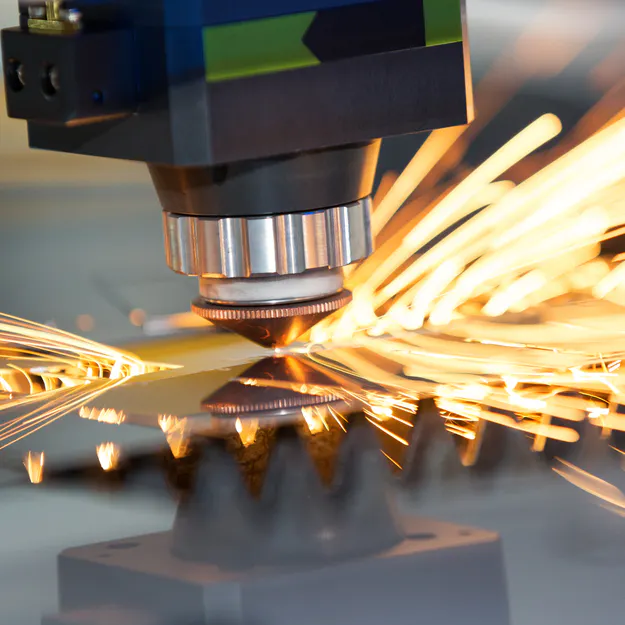
Laser welding is used in many industries because it’s accurate and quick and can be used for many projects. At Xometry, our manufacturing partners may use this technique when welding sheet metal components and assemblies. The laser welding manufacturing process works with a highly concentrated light beam that melts and fuses materials together to create a strong bond.
This method does carry some disadvantages, which we will discuss in this article.
Specifically, we will go over six disadvantages of laser welding and identify any potential difficulties when dealing with this type of welding.
1. High Cost
First off is the price. Laser welding equipment is notoriously expensive and costs more than other types of welding equipment. This is because it has advanced components like modern optics, control systems, and necessary safety features. Plus, you’ll have to factor in repair and maintenance costs.
2. Limited Penetration Depth
While laser welding is great for joining thinner materials, it struggles with thicker ones—the deeper the laser penetrates a material, the weaker it gets, so you may find your laser welding machine grappling when faced with a thick material. If you are set on laser welding thick materials, electron beam welding, which uses electron beams that are powerful enough to penetrate thicker materials, should be able to complete the weld in a single pass.
3. Sensitivity to Materials
Laser welding can’t be used with as wide a range of materials as other types of welders. A laser welder could struggle with materials that are reflective and have high thermal conductivity (i.e., aluminum or copper alloys). Laser welders don’t really like reflective surfaces because, during welding, a lot of the energy is reflected off the surface before it’s absorbed, and whatever is absorbed disperses quickly. This makes it hard for the laser beam to properly heat the surface and create a strong enough weld.
When laser welding materials like high-carbon steel and aluminum alloys, the process’s rapid temperature change could cause them to crack, distort, and even change their material properties.
4. Safety
Laser welding can be a dangerous endeavor without sticking to all the safety precautions and careful and proper operation. If your skin comes in contact with the beam, it could cause serious injury and burns. If you forget to wear protective eye goggles, eye trauma is a real possibility, and if you don’t work in a well-ventilated area, the gasses, vaporized particles, and fumes emitted from laser welding equipment could cause respiratory problems, among others.
To avoid injuries and health problems, make sure you have stocked up on (and wear) the appropriate safety gear, like goggles, face shields, and gloves. You’ll also need to follow the correct safety procedures down to a T and weld in a ventilated area.
5. Limited Joint Access
A laser beam can typically only reach a small portion of the joint, meaning you’ll more than likely have to go over it in several passes or reposition your workpiece, something that could prove time-consuming. This is especially true of more complex and intricate parts.
6. Reduced Weld Strength
The downsides to laser welding include high cooling rates, partially completed fusion and penetration, material sensitivity, and joint design limitations, all of which could lead to weaker and less durable welds. Weak welds are the last thing you’ll want as they can be a potential safety hazard leading to failures.
How Do Environmental Factors Like Temperature and Humidity Affect Laser Welding?
Laser welding processes can be significantly impacted by environmental factors like temperature and humidity. High temperatures have the potential to degrade the quality of a weld by causing thermal distortion and affecting the material's properties. Humidity has the potential to cause the weld zone to become porous and weaken the joint. Although these problems are not unique to plastics, they are usually more obvious in plastic welding due to the material's sensitivity to heat and moisture. High humidity levels can also bring moisture into the welding area, absorbing laser energy and reducing welding efficiency. It is possible to implement cooling systems or temperature-controlled environments to maintain steady operating conditions to overcome these difficulties. Dehumidifiers or drying systems, for example, can be used to minimize the effects of moisture during laser welding, ensuring reliable and consistent weld quality.
How Might Laser Welding in Tight Places Be Safer?
Comparatively speaking to other types of welding, laser welding in confined spaces can present special safety challenges. The issue at hand is the possibility that the laser beam will cause mishaps or damage if it is not properly aimed or controlled. Implementing sophisticated monitoring systems that continuously examine the welding process and look for any anomalies or deviations is one strategy. Operators can quickly address any potential safety risks thanks to real-time feedback. Furthermore, it is essential to implement stringent safety procedures and give operators thorough training. To ensure the safety of operators and nearby staff, protective measures like laser shielding, safety goggles, and the appropriate personal protective equipment should be used. Additionally, routine inspection and maintenance of the laser welding equipment help find any potential problems and guarantee its best performance, lowering the risk of accidents.
What Are the Long-Term Health Consequences of Laser Welding Radiation Exposure?
The effects of laser welding radiation exposure on long-term health can differ depending on the extent and length of exposure as well as individual susceptibility. Long-term exposure to high-intensity laser radiation can cause eye damage, skin burns, and pulmonary infection. There should be a variety of safety measures in place to protect people from these risks. This entails employing stringent safety procedures such as: using suitable laser shielding and enclosures to reduce radiation leakage and making sure operators wear specialized laser safety goggles. Careful setup and monitoring of exposure times are essential in minimizing the long-term health effects of exposure to laser welding radiation, in addition to routine health monitoring, training, and adherence to safety regulations. These precautions assist in preventing excessive radiation exposure for workers while lowering the risks.
How Does Laser Output or Power Affect Laser Weld Quality?
The output (or power) of the laser has a big impact on the effectiveness of laser welding. The depth, width, heat input, and overall penetration of the weld are directly influenced by the power level. Incomplete welds may result from insufficient power, while material damage may occur when excessive power is used. Controlling the laser output precisely is essential for ensuring consistency and quality. The use of cutting-edge laser systems with reliable power sources and closed-loop feedback mechanisms can accomplish this.
Does the Quality of Laser Weld Vary Depending on the Type of Laser Used?
Yes, the type of laser source used affects the quality of the laser weld. Different lasers produce different wavelengths of light and have different pulse duration and power capabilities. For instance, CO2 lasers are better suited for deeper penetration welding of thick materials while fiber lasers are commonly used for high-speed welding of thin materials. Also, Nd:YAG lasers are popular in the aerospace sector due to their precision welding abilities. Therefore, the choice of laser type depends on the material's thickness, welding material, the required welding speed, the joint geometry, and the desired welding quality.
How Do Laser Welding's Constraints Affect Underwater or Space Welding?
When used in space or underwater, laser welding is subject to special limitations. Underwater welding faces difficulties like the water's ability to absorb the laser energy and the requirement for safeguards against rapid cooling. To get around these limitations and create efficient laser welding processes for underwater and space applications, researchers have investigated some techniques, including laser beam welding which doesn't require shielding gasses or a vacuum environment to work. Back in 1989, NASA scientists were already aware of its potential and specifically advised its inclusion in emergency repair kits for satellites and space stations. With these improvements, welds in demanding environments will be trustworthy and of high caliber.
What Are the Typical Applications of Laser Welding?
A wide range of industries use laser welding because it is a versatile joining method. The following are some typical uses for laser welding:
- Automotive Industry: Welding of car bodies, exhaust systems, and engine components.
- Aerospace Industry: Welding of aircraft structures, engines, and fuel systems.
- Medical Industry: Welding of implants, instruments, and medical devices.
- Electronics Industry: Welding of electronic components, batteries, and sensors.
- Jewelry Industry: Welding of precious metals and alloys for jewelry manufacturing.
What Are Some Advantages of Laser Welding?
There are some benefits to using laser welding over traditional welding methods. The following are some of the main benefits of laser welding:
- Precision: Laser welding produces highly precise and accurate welds due to its focused heat source, allowing for fine control over the welding process.
- Speed: Laser welding is a fast process, as the laser beam can be rapidly moved along the joint, resulting in efficient and high-speed welding.
- Minimal Heat-Affected Zone (HAZ): Laser welding generates a narrow and localized heat-affected zone, minimizing distortion and reducing the potential for thermal damage to the surrounding material.
- Versatility: Laser welding can be used to join a wide range of materials, including ceramics, composites, metals, and plastics, making it suitable for many applications.

How Can Xometry Help
At Xometry, we offer a wide array of welding techniques through our global manufacturing network. If you don’t have the capability in-house or are simply looking to outsource work, we can help.
Learn more about our fabrication services on our sheet metal services page.
Disclaimer
The content appearing on this webpage is for informational purposes only. Xometry makes no representation or warranty of any kind, be it expressed or implied, as to the accuracy, completeness, or validity of the information. Any performance parameters, geometric tolerances, specific design features, quality and types of materials, or processes should not be inferred to represent what will be delivered by third-party suppliers or manufacturers through Xometry’s network. Buyers seeking quotes for parts are responsible for defining the specific requirements for those parts. Please refer to our terms and conditions for more information.