How to Smooth 3D Prints: PLA, ABS, and FDM Prints


To smooth 3D prints, achieving a high-quality finish is essential for aesthetic appeal and functionality. A smooth surface increases visual appeal by minimizing visible layer lines and providing a more refined finish. The process makes the print more suitable for subsequent post-processing. Smoothing the surface promotes better adhesion for additional layers or paint, improving the print's durability and functionality. Proper surface preparation is essential to ensure optimal adhesion. Different filament types (such as PLA and ABS) and FDM-printed parts require specific smoothing techniques due to their varying material characteristics. Each filament behaves differently when exposed to heat, solvents, or abrasives. PLA prints can be smoothed using specific solvents such as ethyl acetate or through mechanical methods, while ABS prints are best smoothed with acetone vapor. FDM prints require a combination of sanding and chemical smoothing, depending on the material and finish desired. The guide details methods for how to smooth 3D prints, providing step-by-step instructions and practical tips for smoothing PLA prints, ABS prints, and other FDM prints. The guide ensures that novice and experienced users apply the correct methods. Various techniques (sanding, vapor smoothing, and chemical refinement) are discussed to help achieve a professional-quality finish. Each technique is tailored to the print material and desired results. Each method is explained in precise steps to ensure novice and experienced 3D printers learn how to make 3D prints smooth and improve their print quality through effective 3D print smoothing techniques. The 3D Prints that are smoothed using the proper methods are more appealing and suitable for further post-processing (painting, detailing, or functional use).
1. Using Paint and Sanding Material
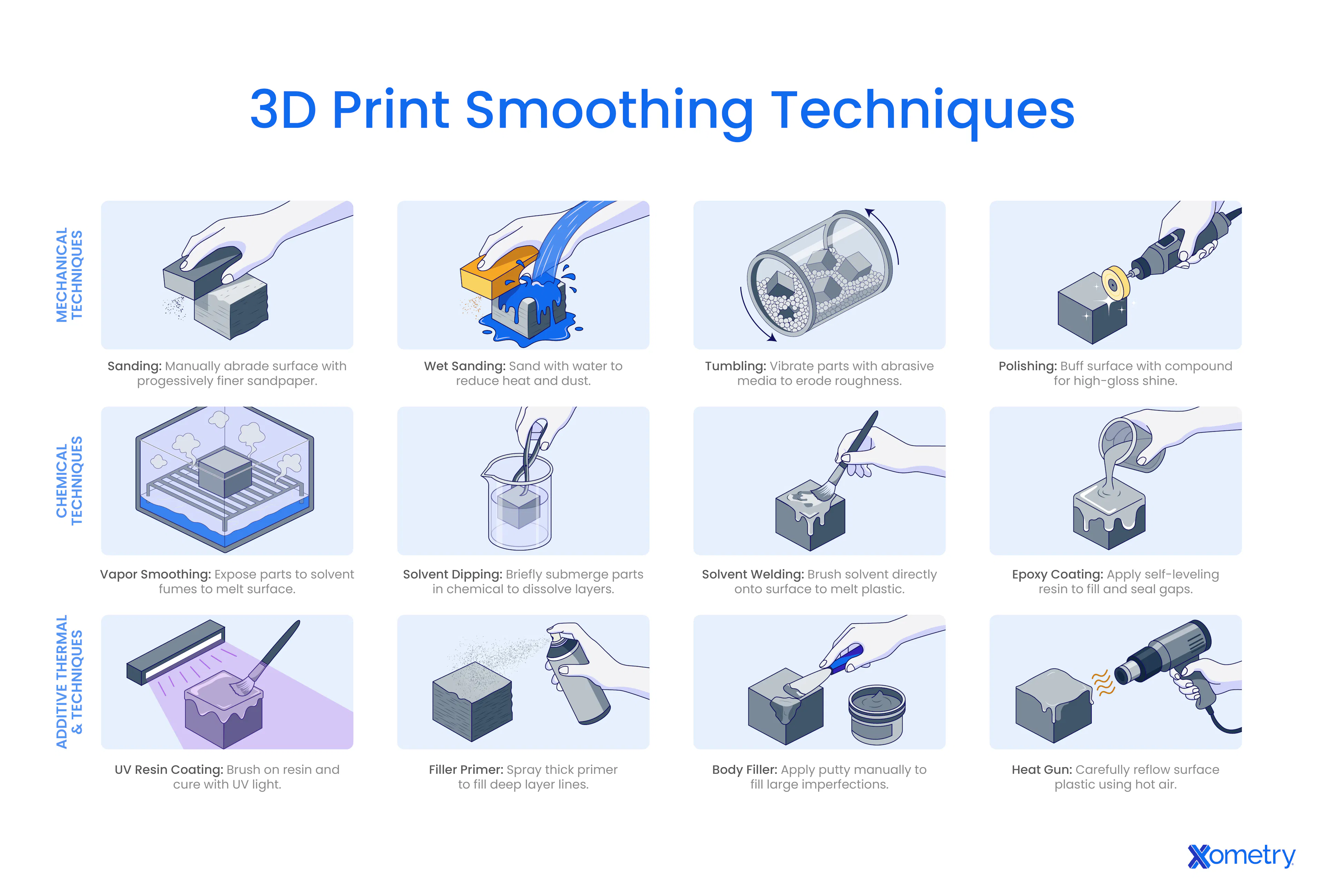
Using paint and sanding material is an effective method for smoothing 3D prints. A filler primer is applied first to fill minor gaps or imperfections, providing a more even surface once it dries. Sanding is used to smooth the surface. Sandpaper with varying grits is employed, starting with medium grit to address flaws and moving to finer grits for a polished finish. The technique helps achieve a smooth, professional appearance on 3D prints for materials (PLA or ABS). The process helps eliminate rough textures and uneven layers, which are common results of 3D printing. The method is beneficial when preparing the print for further painting or post-processing.
2. Using Abrasive Smoothing Methods
Using abrasive smoothing methods is a common technique to refine the surface of 3D prints for materials (PLA, ABS, PETG, and nylon). The process involves using abrasive materials (sandpaper, grinding wheels, or abrasive pads) to remove rough spots and imperfections physically. The process starts with a medium grit to address larger imperfections, followed by progressively finer grits to achieve a smoother finish. Abrasive smoothing is done manually with sandpaper or with mechanical tools, depending on the print's size and desired finish. The method is effective for improving the appearance of 3D prints with visible layer lines or surface defects. The process provides control over the amount of smoothing, allowing for a customized finish. Abrasive smoothing is a cost-effective option that does not require specialized equipment, making it accessible for hobbyists and professionals. The primary advantage is its ability to achieve a smooth surface free from defects, improving the print's quality and preparing it for further post-processing (painting or coating).
Cost: A few hundred dollars for the equipment, or you can have a service like Xometry do it.
"Currently Xometry only offers vapor smoothing for SLS and MJF nylon based materials, as the chemical solvent our network uses is compatible with nylons."
3. Finishing with Fine Sandpaper and Micro-Mesh
Finishing with fine sandpaper and micro-mesh provides a detailed method for smoothing 3D prints when aiming for a high-quality finish. Fine sandpaper is used to smooth the print further after initial sanding with coarser grades, though it does not entirely remove all roughness. Progressing through medium to fine grits before using micro-mesh yields the best results. Micro-mesh pads are effective for refining the surface, working to smooth out micro-imperfections and providing a polished finish. The method is beneficial for smoothing out minor flaws and improving the appearance of the print. The process is effective for delicate projects or when a high-quality finish is essential. The use of micro-mesh and fine sandpaper offers a controlled, step-by-step approach to smoothing, allowing for greater precision than coarser methods. The result is a smooth surface that is ideal for subsequent painting or coating, or for displays where a polished finish is essential.
4. Using Polishing Compounds
Using polishing compounds is an effective method for improving the surface finish of 3D prints to achieve a glossy, smooth appearance. Polishing compounds are applied to refine the surface further after the print has been sanded and most of the rough texture has been reduced. The compounds are designed to work with various materials (PLA and ABS) and contain fine abrasives that help minimize minor imperfections while providing a shiny finish. Polishing is done with a soft cloth or polishing tool, but proper technique is essential to ensure an even application and avoid overheating. Polishing compounds are beneficial for prints that require a glossy finish or improved appearance (display models). Achieving an appearance that mimics injection-molded plastic requires additional post-processing. The primary advantage of the method is its ability to reduce visible surface imperfections, improving the texture without causing damage when used correctly. Polishing compounds make 3D prints appear more polished and durable, ideal for final presentations or functional use where aesthetics are essential.
5. Automotive Filler Primer
Automotive filler primer is an effective method for smoothing 3D prints when preparing them for painting or additional finishing. The product is designed to fill minor imperfections and layer lines that are common in 3D prints. The primer is applied as a thin coat over the surface, but multiple coats are needed to achieve a uniform texture. Primer is sanded carefully to smooth out the surface once the primer has dried, but excessive sanding disturbs the print's shape. The primer improves the appearance and increases the adhesion of subsequent paint layers, though its effectiveness in promoting adhesion depends on the print material and primer quality. The technique is beneficial for prints made of materials (ABS or PLA), where layer lines and surface irregularities are standard. Automotive filler primer is effective at creating a smoother base for painting, making it suitable for high-quality finishes. A primer's ability to fill imperfections and provide a better surface for painting makes it a helpful tool for achieving a professional, glossy appearance, but additional finishing steps are necessary for a flawless result. The method is beneficial when preparing prints for detailed painting or for situations where a smooth surface is essential.
6. Using Heat Gun
Using a heat gun can reduce surface roughness on some 3D prints (including ABS), but it requires careful control to avoid warping. The heat gun works by applying controlled heat to the surface of the print, causing the plastic to soften. The softening allows the material to flow slightly, helping reduce minor imperfections (layer lines and rough spots). The process does not eliminate imperfections. The print is evenly heated by moving the heat gun over the surface, helping to achieve a more uniform finish. Careful control of the temperature and distance from the print is essential to avoid warping or distorting the model. The method is beneficial for prints with noticeable surface roughness or visible layer lines, though it is not as effective for deep imperfections. The heat gun helps smooth the print without extensive sanding, but light sanding is required to achieve the best finish. The process is beneficial for larger prints or models with complex geometries, where traditional sanding is difficult. The heat gun is cost-effective and easy to use, providing a more professional finish without the need for expensive or specialized equipment.
7. Chemical Smoothing (ABS)
Chemical smoothing for ABS involves using solvents (acetone) to smooth the surface of 3D prints. The process works by exposing the print to acetone vapor, which softens the outer layer of the ABS material, allowing the surface to become smoother and more uniform. The process does not eliminate deeper imperfections (visible layer lines) while the softening provides a glossy finish. The print is placed in a sealed chamber with acetone, and the vapor gently softens the outer layers. The process helps smooth out the surface, but additional post-processing is necessary for a polished finish. The method is effective for improving the appearance of ABS prints when a smoother surface is desired. Achieving a high-gloss finish depends on the print's initial quality and the chemical smoothing process. Chemical smoothing reduces the visibility of layer lines, though its effectiveness varies based on print quality and acetone exposure time. The process is beneficial for functional or decorative items where a smoother finish is essential. The advantage of chemical smoothing is that it is able to smooth complex geometries without requiring extensive manual sanding, though fine control is needed in order not to over-smooth delicate areas. The process requires careful handling and proper ventilation, as acetone is a volatile chemical. The process is a cost-effective and efficient way to enhance ABS prints while requiring adequate safety precautions.
8. PLA Layer Vapor Smoothing
PLA layer vapor smoothing is a technique used to improve the surface finish of PLA prints by applying a vapor of a solvent (ethyl acetate) to the print’s surface. The vapor gently softens the outer layer of the PLA material, causing it to flow and smooth out imperfections like visible layer lines and rough patches. The procedure does not ‘melt’ the material but softens it just enough to achieve a smoother finish. Solvent evaporates leaving behind a smoother and slightly glossy surface, which increases the appearance of the print. The level of shine varies depending on the solvent used and exposure time. The method requires careful control of vapor exposure to avoid over-softening the material, which leads to warping or excessive smoothing, affecting the print's shape. The technique is beneficial for PLA prints that require a smoother finish without extensive sanding or manual polishing. The processes reduce the need for further surface preparation but do not fully replace other post-processing steps. PLA layer vapor smoothing is effective for reducing the visibility of print lines and improving the surface finish. The degree of polish depends on solvent exposure and print quality. The process is relatively quick and efficient for prints with complex shapes where traditional sanding is time-consuming or complicated. The results are not always flawless, and additional polishing is necessary for a perfect finish. The Epoxy Resin Coating can be applied after vapor smoothing to provide a more refined, long-lasting finish for prints that require higher gloss or added durability.
9. Hot Water Smoothing (PLA)
Hot water can soften PLA near its glass transition temperature, which may reduce minor surface imperfections but can also cause warping if not carefully controlled. The heat causes the PLA to become more pliable, allowing minor surface imperfections (layer lines and rough patches) to smooth out. The water temperature must be controlled to avoid melting the print, as water that is too hot causes deformation. The print is placed in hot water, around 60-70°C (140-158°F), and left for a brief period. The softened surface must then be smoothed manually or allowed to cool naturally, though some smoothing is required while the print is pliable. The method is helpful for PLA prints that require smoothing without solvents or abrasives. The process is cost-effective and straightforward, making it accessible for hobbyists and professionals. The effectiveness of the method depends on the size and complexity of the print. Hot water smoothing is effective for reducing the visibility of minor imperfections in prints that have not been exposed to solvents or chemicals. The technique is effective at repairing surface-level defects. The process requires careful attention to avoid overheating the print, as excessive heat causes warping or deformation. Hot water smoothing is ideal for smaller prints or areas with minor surface flaws, offering a quick and efficient way to increase the surface quality of PLA models, but larger prints or more significant imperfections require additional post-processing.
"Smoothing 3D prints is less about chasing a perfectly glossy surface and more about understanding how each material responds to heat, solvents, and abrasion. When the post-processing method matches the filament’s behavior, surface quality improves predictably and without compromising part geometry."
10. Cold Welding and Solvent Welding
Solvent Welding (also called Cold welding) is primarily a bonding method for ABS prints that can also provide localized surface smoothing.Cold welding involves applying a solvent (acetone) directly to the surfaces of two parts to bond them together. The solvent softens the outer layers of the parts, allowing them to fuse at a molecular level, creating a smooth connection. The method is used to smooth the surface by softening imperfections and joining rough sections, though it does not eliminate all flaws. Solvent welding uses a similar process but focuses on applying the solvent to a single surface, softening it to reduce imperfections and layer lines. The process helps smooth the surface but does not fully address deep flaws. The methods are effective for improving the appearance and bonding strength of ABS prints when surface smoothing and part joining are needed. Cold welding is beneficial for joining parts, while solvent welding is ideal for refining the surface of a single print. Solvent welding is better suited for smoothing surfaces rather than joining multiple parts. The primary advantage of cold welding and solvent welding is their ability to create a smooth, unified surface or bond without the need for sanding or abrasive methods. The methods do not replace the need for polishing or finishing techniques for a flawless surface. Solvent welding works well for smoothing complex geometries and smaller prints, providing a quick and efficient way to refine the surface. Larger prints require additional methods to achieve a polished finish. The methods require careful handling of solvents and proper ventilation, as the solvents are flammable and harmful if inhaled. Always follow safety guidelines to minimize risks.
11. Using 3D Gloop
Using 3D Gloop is an effective method for smoothing 3D prints made from PLA and ABS. 3D Gloop is a specialized smoothing solution designed to improve surface appearance by applying a thin layer to the print’s surface. The process softens the outer layer of the print and smooths out minor imperfections, giving it a smoother, glossier finish. The print is left to dry after application, resulting in a softer surface that reduces visible layer lines and imperfections. The primary advantage of 3D Gloop is its ease of use and convenience, as it does not require complex setups. The process requires careful application to avoid uneven layers. The method is beneficial for prints that need smoothing before painting, as it helps create a more uniform surface for better paint adhesion, although additional surface preparation is necessary. 3D Gloop is suited for PLA and ABS prints, providing a cost-effective solution to improve the finish of prints with minimal effort, though deeper imperfections are visible depending on the print's complexity.
12. Using XTC-3D
Using XTC-3D is an effective method for smoothing 3D prints when aiming for a high-gloss, polished surface. XTC-3D is a two-part epoxy resin designed for smoothing and coating 3D printed objects. The resin helps fill in layer lines and minor imperfections when applied, resulting in a smoother, glossier finish. The process does not eliminate deep flaws or highly textured surfaces. The process involves mixing the two parts of the epoxy, applying it using a brush or spray, and allowing it to cure for the specified time. The result is a durable, smooth surface that improves the print's appearance and provides added protection, though proper application is essential to avoid streaks or uneven areas. The method is beneficial for prints that require a professional, polished look (display models or functional items) that need a refined finish. XTC-3D provides a durable coating that smooths the surface and adds protection to the print, though the level of durability depends on the print material and curing process. The process is effective for prints with visible layer lines or rough surfaces, filling in imperfections and creating a smoother finish. Deep flaws are visible. The main advantages of using XTC-3D Coating are its ability to smooth the surface, ease of application, and glossy finish. Achieving the best results depends on proper technique and curing time, making it a popular choice for 3D print post-processing.
13. Using Epoxy Resin Coating
Using epoxy resin coating is an effective technique for smoothing and improving the surface of 3D prints for materials like PLA and ABS. The process involves applying a layer of epoxy resin over the print's surface, which helps fill in imperfections (layer lines and minor defects). The process does not eliminate deeper flaws or complex surface irregularities. The resin cures to form a smooth, glossy, and durable finish, though the final texture depends on application technique and curing conditions. Epoxy resin is applied using a brush, spray, or poured over the print, depending on the desired effect, print size, and complexity. The application method affects the finish, requiring more precision for specific geometries. The technique is beneficial for achieving a professional finish on 3D prints for items that are displayed or used in environments requiring durability and a refined appearance. Epoxy resin provides a hard, protective layer that improves the print's surface, making it more resistant to scratches, water, and wear. Formulation and application thickness determine the resistance thickness. The method provides the print with a polished, high-gloss look, making it suitable for functional or decorative objects. The degree of gloss depends on the resin type and curing conditions. The major advantage of using epoxy resin coating is its ability to create a smooth surface and improve surface durability. The final strength depends on the print material and the resin's properties. The results are worth the effort for projects requiring a high-quality finish, while the process is time-consuming. Patience is needed to ensure proper application and curing.
14. Using PolyMaker PolySmooth PVB Filament
Using PolyMaker PolySmooth PVB filament is an effective method for smoothing 3D prints, for makers seeking a high-quality finish with minimal effort. PolySmooth is a specialized filament designed to be smoothed using isopropyl alcohol vapor. The outer layers soften when the printed object is exposed to isopropyl alcohol vapor, allowing imperfections such as layer lines to smooth out and giving the print a glossy, polished surface. The degree of smoothness and gloss depends on exposure time and environmental factors. The vapor process is controlled in a sealed chamber to avoid over-softening or distortion, ensuring a consistent finish. The chamber's conditions (temperature and vapor density) are essential in achieving the desired result. The method is effective for prints made with PolySmooth filament, as the material is engineered to respond to alcohol vapor, creating a smoother surface. The primary advantage of using PolyMaker PolySmooth PVB filament is its ease of use and ability to achieve a high-quality surface finish with minimal post-processing, reducing the need for extensive sanding. The process is an excellent option for achieving a polished, professional finish for decorative or functional items where a refined surface is essential. The finish varies based on exposure time and the intricacy of the print. The result is a smoother, more appealing print with reduced visible defects, giving it a polished appearance ideal for display or presentation. Deeper imperfections are visible, depending on the print’s quality and complexity.
15. UV-Curable Coatings
UV-curable coatings are an effective method for smoothing and finishing 3D prints, for improving surface quality and durability. The coatings are liquid resins that cure and harden when exposed to ultraviolet (UV) light. The curing time varies depending on the resin type and exposure conditions. The UV-curable coating helps fill in layer lines and minor imperfections when applied to a 3D print, creating a smoother, glossier surface. The process does not eliminate deeper flaws or complex surface defects. The process involves brushing or spraying the coating onto the print and exposing it to a UV light source to cure the resin. The exposure time must be controlled to avoid under-curing or over-curing. The results in a durable, high-gloss finish that improves the appearance and increases the print's resistance to scratches and environmental wear. The level of durability depends on the resin formulation and curing process. UV-curable coatings are beneficial for prints that require a polished, professional look or improved durability. The final finish depends on the print's material and the coating's application. The main advantage of the method is its ability to quickly smooth and harden the surface of the print, reducing the need for extensive manual post-processing (sanding or painting). Optimal results require additional finishing steps. The UV curing process is fast, making it a time-efficient solution for finishing multiple prints. The curing time varies depending on the print size and UV light intensity. UV-curable coatings are ideal for models requiring a high-quality finish, (decorative pieces, prototypes, or functional) objects that undergo frequent handling. Prints exposed to heavy use require additional protective layers or coatings for enhanced durability.
16. Post-Processing with Filler and Paint
Post-processing with filler and paint is a common technique for smoothing and refining 3D prints for materials such as PLA, ABS, or PETG. The process starts with applying a filler material (automotive filler putty) to the surface of the print. Selecting the correct filler for the material is essential to ensure proper adhesion and smoothing. The filler helps fill remaining imperfections, such as small gaps or rough spots from the 3D printing process, though larger flaws require additional post-processing. The print is sanded down to create a smoother, more even surface after the filler has dried. Sanding must be done gradually, starting with coarser grits and moving to finer ones to avoid over-sanding. A coat of paint is applied to provide color and protection once the surface is refined. The effectiveness of the paint depends on the type of paint and surface preparation, including the application of a primer. The method is helpful for prints that need to be visually appealing or functional (display models, prototypes, or functional objects). The combination of filler and paint improves the finish by creating a smoother surface and adding durability. The durability depends on the type of filler and paint used. The main advantage of the method is its ability to improve the surface, transforming a rough 3D print into a smoother, glossier product. Achieving a high-quality finish requires careful application and curing. The technique is effective for prints requiring high-quality appearance, as the filler creates a clean base, and the paint provides the final touch for a polished finish. The longevity of the finish depends on the materials and environmental exposure.
17. 3D Pen Smoothing Tool
The 3D pen smoothing tool is a specialized tool used to refine the surface of 3D prints by applying melted filament. The technique does not eliminate all surface defects, but it helps smooth out imperfections, especially larger ones. The pen works by heating the filament, which is extruded through the nozzle and applied directly onto the print's surface. The filament must be compatible with the print material for best results. Using the pen provides control over the smoothing process, allowing the pen to fill gaps, smooth layer lines, and repair minor defects. The method's effectiveness in large-scale smoothing or deeper defects is limited. The tool is used in a back-and-forth motion to blend the applied filament with the existing surface, but it must be used to avoid visible lines or uneven surfaces. The method is beneficial for minor surface corrections and fine details, for smaller prints or areas needing precise work. The process is not as effective for large-scale smoothing or major surface flaws. The primary advantage of using a 3D pen smoothing tool is its ability to directly control filament application and the smoothing process, although a steady hand is required to ensure uniformity. A versatile and accessible solution for addressing specific imperfections. The finish requires additional post-processing for a perfectly smooth finish, while it reduces the need for sanding. The result is a softer surface, though the level of polish varies depending on the technique used. The 3D pen smoothing tool is a valuable option for improving the appearance and quality of 3D prints, but additional steps are required for a fully polished look.
What is the Purpose of Smoothing 3D Prints?
The purpose of smoothing 3D prints is to improve the surface finish, reduce visible layer lines, and improve paint adhesion during post-processing. The process does not strengthen the part unless combined with additional treatments, and smoothing primarily improves surface finish rather than structural integrity. Smooth PLA prints create a more uniform surface that reduces rough textures and imperfections left by the 3D printing process. The smoother surface makes it easier to apply paint and coatings, as the smoother surface allows for better adhesion. Optimal paint adhesion requires priming. 3D print smoothing helps reduce layer lines, resulting in a more polished and professional look, though achieving a flawless finish requires further post-processing. Smoothing PLA prints or other 3D prints primarily improves aesthetics, with limited impact on mechanical performance. The direct effect on structural integrity is limited without reinforcing methods or materials. The improved surface finish is essential for parts that undergo further processing (painting or functional applications), where surface smoothness impacts the final quality and performance.
Frequently Asked Questions on How to Smooth 3D Prints
How Xometry Can Help
3D printing is just one of our specialties, and we offer a range of options to suit the exact products you’re interested in building, as well as the materials you’d like to work with. See our solutions page for a full list, but some of our services include fused deposition modeling, HP multi-jet fusion, selective laser sintering, stereolithography, and metal 3D printing. We also offer a range of finishing options to make your parts nice and smooth - you can specify these in our Instant Quoting Engine® when you get your quote.
Copyright and Trademark Notices
- PolySmooth™ is a trademark of Polymaker (Headquartered in Changshu, China)
Disclaimer
The content appearing on this webpage is for informational purposes only. Xometry makes no representation or warranty of any kind, be it expressed or implied, as to the accuracy, completeness, or validity of the information. Any performance parameters, geometric tolerances, specific design features, quality and types of materials, or processes should not be inferred to represent what will be delivered by third-party suppliers or manufacturers through Xometry’s network. Buyers seeking quotes for parts are responsible for defining the specific requirements for those parts. Please refer to our terms and conditions for more information.