Plastic Extrusion: Definition, Purpose, How It Works, Advantages, and Examples


A guide to understanding this plastic manufacturing process and all that it can do


There are many plastic processing methods available, but there’s one in particular that has managed to solve the inconsistencies and problems that come with making longer pieces—plastic extrusion. Since 1935, manufacturers have leaned on this technique to make products that are longer or require more material, like tubes and trim. If you’re interested in plastic extrusion for your own products and business, we’ve written up a more detailed explainer for this process.
What is Plastic Extrusion?
In the simplest definition, plastic extrusion is a process that melts and molds plastic into different shapes and is done on a pretty large scale. When you put it up against other types of plastic manufacturing, you’ll find this method is better for creating objects that are longer or wider as the machine can properly funnel out a continuous tube, pipe, or sheet of plastic. The applications for plastic extrusion are almost as varied as the types of plastic you can choose between (more on the types available below). Just a few of these include:
- Tubes, fuel lines, and pipes for plumbing and farming
- Doors, window frames, trim, weatherstripping, and decorative moldings
- Insulation and coatings for wires and cables
- Packaging materials and containers for objects, food, and beverages
- Plastic films and sheets
- Straws and utensils
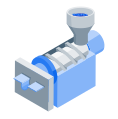
Plastic extrusion requires specialty equipment that’s capable of pumping out long lengths of plastic. Most of these machines have a container to hold the melted plastic, a barrel to funnel it forward, and a die and cutter to shape the product. You can get an idea of how this looks in the image below.
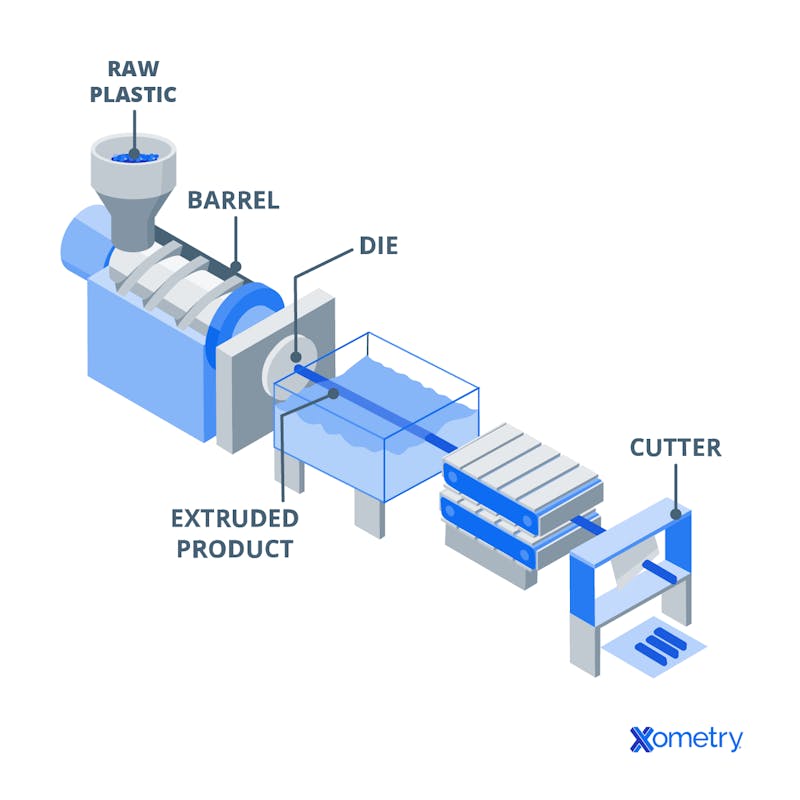
Illustration of the plastic extrusion process melting and extrusion stage.
What Are the Industries That Use Plastic Extrusion?
A lot of industries make use of extruded plastic tubing. It’s of particular importance in the: medical, automotive, construction, electronics, food, and beverage sectors. In the field of medicine, both flexible and rigid tubes are made this way. They wind up in tools like: catheters, IV lines, and medical pouches. In the automotive sector, the value of extruded plastic lies in its durability and cost-effectiveness, since such parts are designed to endure a wide range of environmental conditions. In the food and beverage sectors, this plastic has a role in beverage dispensing systems and food-grade packaging.
How Does Plastic Extrusion Work?
Plastic extrusion works by shaping molten plastic materials into continuous profiles with consistent cross-sectional shapes. It combines heat, pressure, shaping dies, and cooling stages to transform raw plastic into a wide range of products. Extruded plastic can be found in everything from simple pipes to precise medical implants.
What Is the Step-by-Step Process of Plastic Extrusion?
The magic happens when all of these components function correctly. Here’s a step-by-step breakdown of how it all works:
- First, raw plastic pellets or granules will be poured and stored in a hopper—the material will depend on what you’re making and could be anything from polycarbonate to ABS.
- Then the plastic will move into a heated barrel (usually sitting around 200 to 275 ℃) and start melting down into a molten state for easy molding. Inside of this barrel is a screw that’ll rotate at a consistent speed. This keeps the pellets moving and melting at the same rate.
- After it’s melted, the extrusion begins and the molten plastic will move past the screw and through a screen to get rid of contaminants. Then it’ll pass through a die cut into the specific shape needed, which will give the plastic its shape.
- Once it reaches this point, the plastic will either go through a water- or air-based cooling system. This cools the temperature and allows the plastic to fully harden.
- After cooling, the pipes, sheets, tubes, or other shapes will get hauled across rollers and then cut down to the necessary length. If the piece needs further processing, like finishing or adding other components, this is when it would get done.
- The plastic objects will then get checked again to ensure they’re accurate and up to par, quality-wise.
All in all, plastic extrusion is pretty quick, but the timeline can slow if you’re making complex parts or if your objects need to go through intense post-processing. Here’s a picture of a piece of trim that was made through plastic extrusion:


Cost-wise, it all comes down to the type of plastic you choose. For the product materials, you can expect an average of $1,000, whereas the machinery can be a sum of anything between $7,000 to $90,000 depending on the size of your operation and the complexity of the parts you’re making.
What Are the Materials Can Be Used in Plastic Extrusion?
Picking out the right plastic all depends on what you need the final product to do. It might be sitting outside and exposed to UV rays from the sun or extremely cold and hot temperatures, in which cases environmental resistance is important. It could also be a container or method of transporting acids and solutions, so resistance to harsh chemicals is a necessity. Equally, it may just need to look nice and not have too many fancy mechanical properties. To give you some examples of common plastics used for extrusion, we’ve listed out eight below and what they’re good for.
1. Polyethylene (PE)
This plastic is used to make things pipes, packaging, and containers, because it’s chemical-resistant, flexible, and durable, with the added perk of being cost-effective, too. It comes in different types, including low-density (LDPE) and high-density (HDPE).
2. Polypropylene (PP)
Made with fossil fuels, PP has a high melting point, can make strong and impact-resistant products in many colors, like textiles, vehicle parts, and packaging.
3. Polyvinyl Chloride (PVC)
If cost and durability are both important, PVC is a good option. There are two types that manufacturers usually pick between: rigid and flexible. The former is best for products that you know will get exposure to radiation and a certain level of impact, whereas flexible is good for tensile strength and weatherproofing. These include windows, doors, pipes, and refrigerators.
4. Polystyrene (PS)
Polystyrene’s rigid nature makes it ideal for extruded products that get used for packaging and insulation.
5. Acrylonitrile Butadiene Styrene (ABS)
ABS is a common material for 3D printing, but it plays a big part in plastic extrusion, too. It’s often sought out because its finish is shiny and aesthetically pleasing, which can’t be said for all plastics.
6. Polyamide (PA or Nylon)
Nylon is prized for its fantastic mechanical properties, like heat stability and chemical resistance. Depending on the type you use, it makes for great automotive parts and textiles.
7. Polycarbonate (PC)
Using polycarbonate for plastic extrusion is another great in-between for manufacturers since it’s rigid, heat stable, and resistant to abrasion—although it tends to be more expensive. It’s a go-to for items like car components and enclosures for electronics.
8. Polyethylene Terephthalate (PET)
PET is another common plastic, used for food and beverage containers, engineering applications, and as a fiber for making textiles for clothes and home goods.
Comparing Plastics
We’ve put together a simple table that shows what kind of cost, chemical and mechanical properties, and rigidity you can expect from different types of plastics that are used for extrusion:
| Material | Heat Stability | Chemical Resistance | UV Resistance | Rigidity | Cost |
|---|---|---|---|---|---|
Material ABS | Heat Stability Fair | Chemical Resistance Poor | UV Resistance Poor | Rigidity High | Cost Medium |
Material PVC | Heat Stability Poor | Chemical Resistance Poor | UV Resistance Poor | Rigidity Varies | Cost Medium |
Material Low Density Polyethylene (LDPE) | Heat Stability Poor | Chemical Resistance Good | UV Resistance Poor | Rigidity Poor | Cost Low |
Material High Density Polyethylene (HDPE) | Heat Stability Fair | Chemical Resistance Good | UV Resistance Fair | Rigidity High | Cost Low |
Material PETG | Heat Stability Poor | Chemical Resistance Excellent | UV Resistance Good | Rigidity Medium | Cost Medium |
Material UHMW PE | Heat Stability Poor | Chemical Resistance Good | UV Resistance Poor | Rigidity Medium | Cost Low |
Material Polypropylene (PP) | Heat Stability Excellent | Chemical Resistance Excellent | UV Resistance Poor | Rigidity High | Cost Low |
Material Nylon | Heat Stability Excellent | Chemical Resistance Excellent | UV Resistance Fair | Rigidity High | Cost High |
Material Polycarbonate (PC) | Heat Stability Excellent | Chemical Resistance Fair | UV Resistance Excellent | Rigidity High | Cost High |
How Long Does It Take for Plastic Extrusion To Finish?
A plastic extrusion process’ timeline depends on several factors, including: the complexity of the product, the type of plastic being extruded, the speed of the extrusion line, and the manufacturer’s specific requirements. Generally, plastic extrusion is known for its efficiency and the speed with which it can produce high volumes of continuous products.
Simple products with basic shapes, such as straight pipes or profiles, can be extruded relatively quickly. However, more complex products that require intricate profiles, multiple layers, or additional post-extrusion modifications might take longer.
How Accurate Is Plastic Extrusion?
For simple profiles and shapes, plastic extrusion can achieve relatively good tolerances. Modern extrusion machines are equipped with advanced controls and monitoring systems that keep the output close to the specified dimensions. This level of accuracy is particularly crucial in construction, automotive, and electronics products, where precise measurements are essential for proper functionality and compatibility.
However, it's important to note that the accuracy of plastic extrusion might vary based on: the complexity of the design, the type of plastic being extruded, and the overall quality of the manufacturing process. Additionally, factors like die swell (the expansion of plastic after leaving the die) and cooling rates can also influence the final dimensions of the extruded product.
How Much Does Plastic Extrusion Cost?
The cost of plastic extrusion depends almost entirely on the specific material and the design’s complexity. Generally, the products tend to fall within the budget of less than $1,000. However, the plastic extrusion machines typically range between $7,000 and $90,000 and the molds can be anything from a few hundred dollars to $15,000, depending on the complexity and size.
Is Plastic Extrusion Expensive Compared to Die Casting?
No, plastic extrusion is more affordable than die casting. This is because extrusion does not require high-pressure equipment or specialized molds. However, extrusion tends to be slower and less precise than die casting.
What Are the Advantages of Plastic Extrusion?
When you’re planning to manufacture products using plastic extrusion, these are the advantages you’ll find in doing so:
- This is a cheaper option than other types of plastic manufacturing.
- The continuous nature of plastic extruded products means they’re easier to create and there’s less likely to be severe inventory shortages.
- After being extruded, it’s possible to tweak the products before they permanently cool down and harden.
- You can create a wide range of shapes and circumferences with a plastic extrusion machine with the right die and extruder.
- You won’t feel limited by types of material, especially with how many plastics exist.
What Are the Disadvantages of Plastic Extrusion?
Here are a few drawbacks to keep in mind:
- Swelling is a possibility, which happens before the products cool down.
- It isn’t the best or most efficient manufacturing method for all types of plastics, and you’ll find that not all plastic products can be made via extrusion.
- The cost of machinery and dies is extremely expensive compared to other techniques.
- It’s really difficult to use recycled plastics with extrusion machines since they’re built to filter out impurities.
Manufacturers may notice that extreme accuracy with plastic extrusion—especially when it comes to intricate parts—isn’t always possible. This could be due to cooling rates, how much the die swells, or a number of other reasons. In these cases, it might be better to lean on die casting, 3D printing, or plastic injection molding for getting the exact design you need. Still, today’s modern machines have even better capabilities than the ones that came before them and there’s much more control over dimensions and how the output looks.
Tips for Designing Products for Plastic Extrusion
Avoid annoying mishaps and stay from serious design flaws with these design tips from our team at Xometry:
Keep Wall Thickness Consistent
Inconsistent wall thickness could lead to uneven cooling, so keeping these consistent and quite sizable will avoid warping and twisting. A good rule of thumb is not having walls thinner than 0.025 inches.
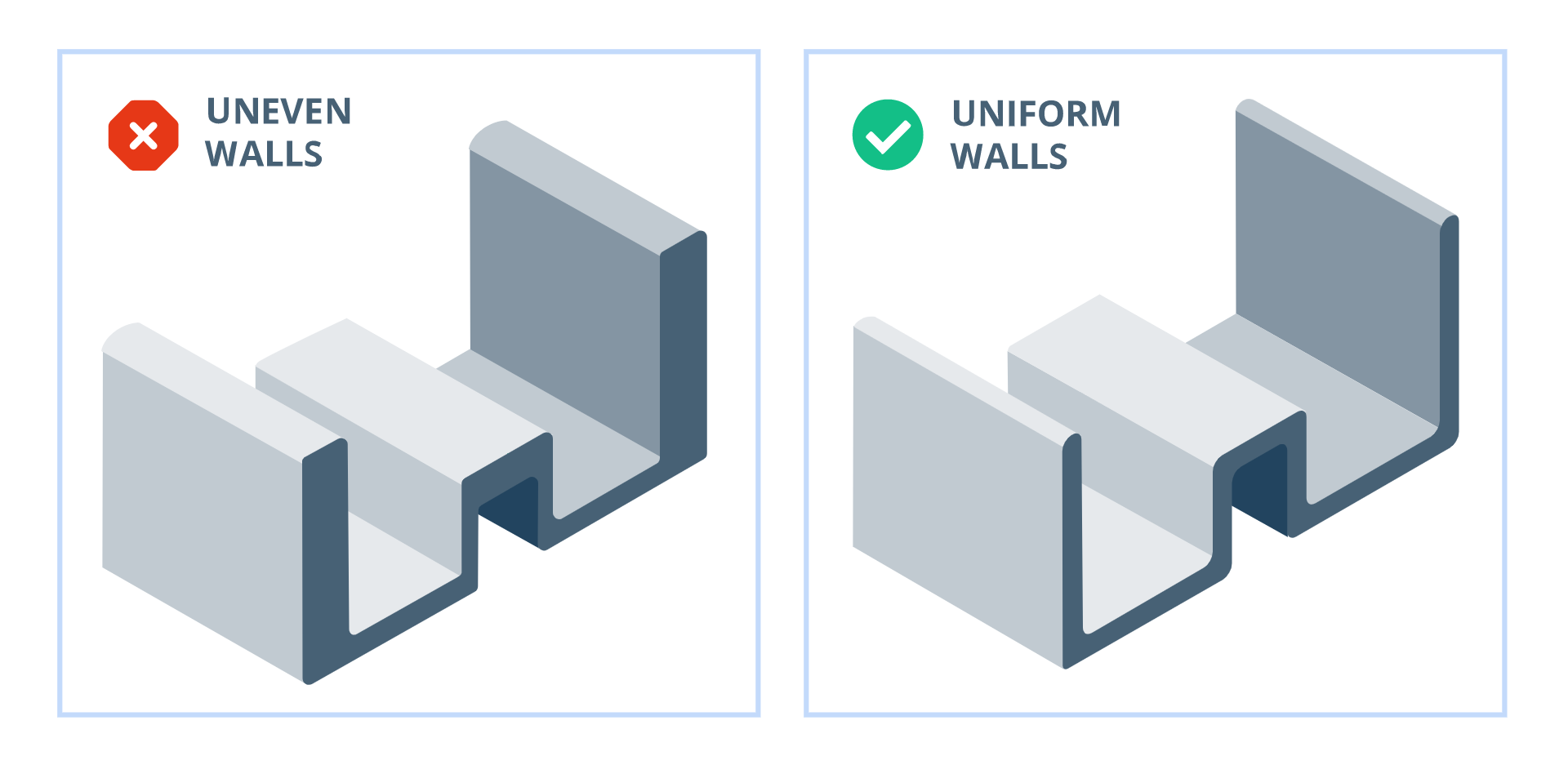
Extrusion design with uneven wall thickness vs. uniform wall thickness.
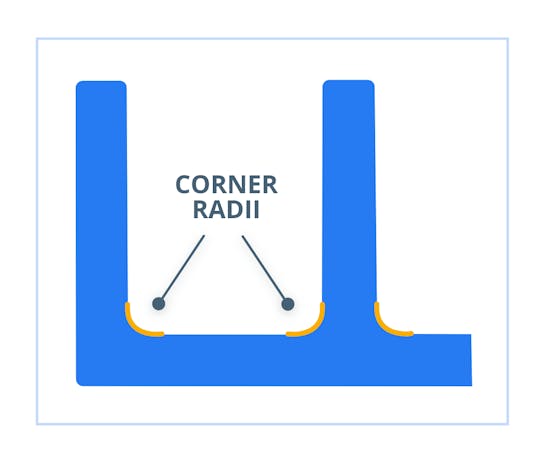
Diagram of an extrusion cross-section depicting proper use of corner radii
Avoid Designing Hollows
Hollows are called lumen in plastic extruding terms, and while it’s possible to create these features, they can cause problems because of the more simplistic design of the extrusion machine. There aren’t ways of affecting air pressure or creating a vacuum, so these areas can collapse or deform. If you have to include lumen, don’t design cavities within cavities and keep protrusions to a minimum.
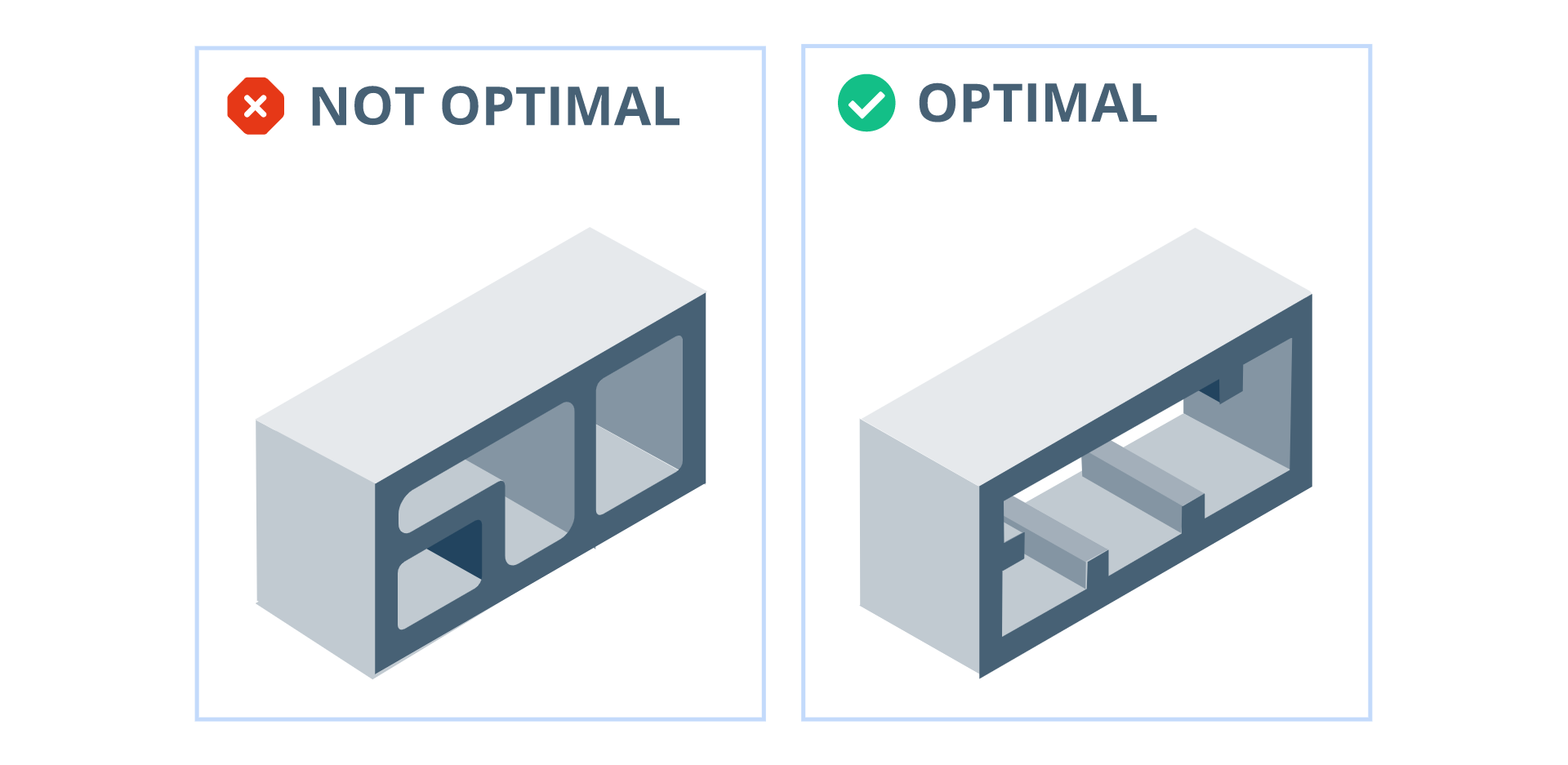
An extrusion design with excessive hollows compared to an optimal design.
Avoid Tight Tolerances
If you have extremely precise and specific measurements, plastic extrusion probably isn’t the manufacturing method for you. There’s a chance of swelling, deformation, and changes in the final product. Aim for standard tolerances and if you have tight tolerances for precise parts, make sure you have the tools and machinery to make this happen or use a different technique.
What Are Examples of Plastic Extrusion Products?
Examples of plastic extrusion products are:
- Tubing and pipes for plumbing, drainage systems, electrical conduits, irrigation, and automotive fuel lines.
- Door and window frames, trim, gaskets, weatherstripping, structural elements, and decorative moldings for automotive, furniture, and construction industries.
- Plastic coatings and insulation for cables and wires.
- Fibers and filaments made of ABS, nylon, PLA, and PET for 3D printing, textiles, and reinforcement materials.
- Flexible packaging materials like plastic films and sheets can be further transformed into bags, pouches, laminates, and shrink wraps.
- Plastic films and sheets are perfect for packaging, signage, construction, and automotive interiors. These sheets can be further processed into containers, trays, roofing membranes, displays, and car dashboards.
What Is the Lifespan of Plastic Extrusion Products?
The lifespan of plastic extrusion products can vary significantly depending on the type of product, the setting, and the raw materials used in its manufacture.
The average lifespan for plastic products is around 10 years, but this number can vary significantly depending on the application. Plastics in the industrial and construction sector can remain in use for decades, with some pipe installations even estimated to reach lifespans of 50 to 100 years. Meanwhile, plastics in the packaging industry are typically disposed of within a year. Items like straws are even discarded after a single use.
What Is the Difference Between Plastic Extrusion and Vapor Smoothing PLA?
Plastic extrusion and vapor smoothing PLA are two distinct processes that pertain to plastic materials. They serve very different purposes and involve different techniques.
The plastic extrusion process shapes molten plastic into continuous profiles with consistent cross-sections. This process is used to create things like: pipes, tubes, sheets, profiles, and more. Vapor smoothing for PLA (polylactic acid), on the other hand, is a post-processing technique used to improve the surface finish of 3D-printed PLA objects. The PLA item is exposed to solvent vapors, usually in a controlled chamber. This process can help reduce the visible layer lines that often show up in 3D-printed objects, giving them a more professional appearance.
To learn more, see our article on Vapor Smoothing Pla.
What Is the Difference Between Plastic Extrusion and Acetone Vapor Smoothing?
Plastic extrusion and acetone vapor smoothing are distinct processes that serve very different purposes.
Plastic extrusion is a manufacturing technique used to shape molten plastic into continuous profiles with consistent cross-sectional shapes. Melted plastic is forced through a specially designed die or mold to create various plastic products such as: pipes, tubes, sheets, and more. Acetone vapor smoothing is a post-processing technique applied to 3D-printed objects, particularly those crafted from materials like ABS (acrylonitrile butadiene styrene). The process involves exposing the 3D-printed object to acetone vapors within an enclosed chamber. This technique enhances the aesthetic appeal of 3D-printed objects, giving them a polished appearance.
To learn more, see our article on Acetone Vapor Smoothing.
How Xometry Can Help
Plastic extrusion isn’t the only plastic-focused process Xometry offers. We have a long list of other services that can handle everything from PET to HIPS, including custom plastic injection molding, plastic 3D printing, plastic laser cutting, and custom plastic fabrication.
Disclaimer
The content appearing on this webpage is for informational purposes only. Xometry makes no representation or warranty of any kind, be it expressed or implied, as to the accuracy, completeness, or validity of the information. Any performance parameters, geometric tolerances, specific design features, quality and types of materials, or processes should not be inferred to represent what will be delivered by third-party suppliers or manufacturers through Xometry’s network. Buyers seeking quotes for parts are responsible for defining the specific requirements for those parts. Please refer to our terms and conditions for more information.