M2 Tool Steel: Composition, Properties, and Applications


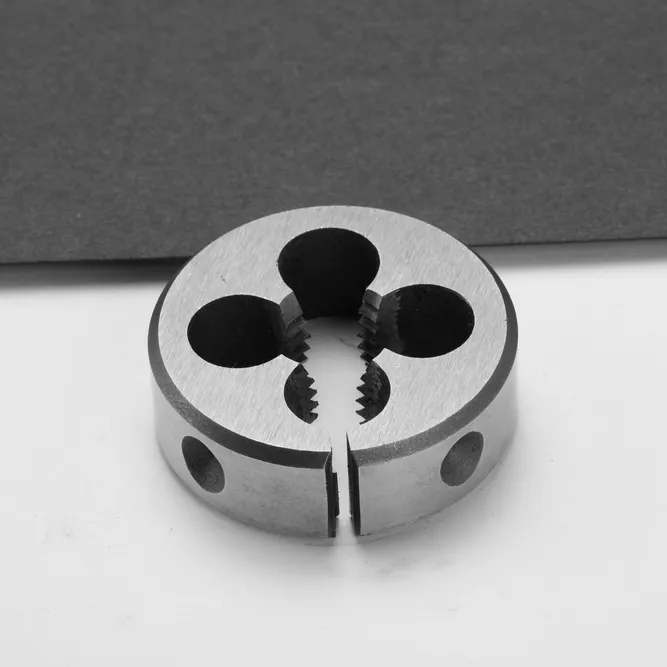
M2 Tool Steel (AISI M2 / DIN 1.3343 / JIS SKH51) is a molybdenum-based m2 high-speed steel for applications requiring a balanced combination of hardness, wear resistance, and toughness. M2 Tool Steel belongs to the tungsten-molybdenum series of HSS material and is used in cutting and forming tools exposed to thermal and mechanical loads. The chemical composition of m2 material includes carbon (0.85%-0.90%), tungsten (5.50% to 6.75%), molybdenum (4.50%-5.50%), vanadium (1.75% to 2.20%), chromium (3.75% to 4.50%), and iron as the base element. The alloying forms a matrix of stable carbides, providing excellent edge retention and thermal resistance. M2 tool steel reaches hardness values between 62 and 67 HRC and maintains significant hardness at elevated temperatures up to 550 to 600°C after proper heat treatment, making it ideal for high-speed machining operations. M2 exhibits outstanding wear resistance, moderate toughness, and exceptional red hardness under high-temperature conditions. M2 Tool Steel's mechanical properties make it suitable for manufacturing drills, taps, end mills, reamers, broaches, punches, lathe tool bits, and cold-forming dies. acero M2, baja M2, 3343 çelik, M2 HSS, and сталь М2 are common trade names. M2 Tool Steel is used across manufacturing, aerospace, and metalworking industries, where reliable cutting performance and long tool life are critical for precision and productivity.
What is M2 Tool Steel?
M2 tool steel is a high-speed steel for cutting tools that require high wear resistance and the ability to retain hardness at elevated temperatures. M2 tool steel is used in drill bits, saw blades, and precision machining tools, where durability and thermal stability are essential. M2 HSS maintains its hardness up to 550 to 600°C, which qualifies it as a high-speed steel and allows it to perform reliably in high-temperature cutting environments. The heat resistance comes from alloying elements (tungsten, molybdenum, and vanadium), which form stable carbides and contribute to wear resistance and secondary hardening. M2 steel preserves its microstructure and cutting performance during high-speed and high-temperature operations, in contrast to plain carbon or standard alloy steels, which soften under high thermal loads. The result is that it is suitable for heavy-duty industrial cutting applications.
What is the Composition of M2 Tool Steel?
The composition of M2 tool steel is listed below.
- Carbon: Carbon increases hardness and strengthens wear resistance by forming stable carbide structures that are essential to m2 chemical composition.
- Chromium: Chromium improves hardenability and contributes to oxidation resistance. Although not the primary carbide former in M2, it does form chromium carbides within the steel and supports M2 material composition.
- Molybdenum: Molybdenum raises hot hardness and increases stability at elevated temperatures. Molybdenum forms molybdenum carbides that play an essential role in reliable tool steel composition for high-heat machining.
- Tungsten: Tungsten improves wear resistance and maintains hardness under heat by forming stable tungsten carbides that resist deformation during cutting. The carbides are a key part of M2's chemical composition and contribute to its red-hardness.
- Vanadium: Vanadium refines grain structure and boosts edge retention through the formation of very hard vanadium carbides. The carbides further strengthen the tool steel composition used in M2.
- Iron: Iron provides the tempered martensitic base matrix that supports the alloying carbides and delivers strength and structural integrity within the M2 material composition.
How is M2 Tool Steel made?
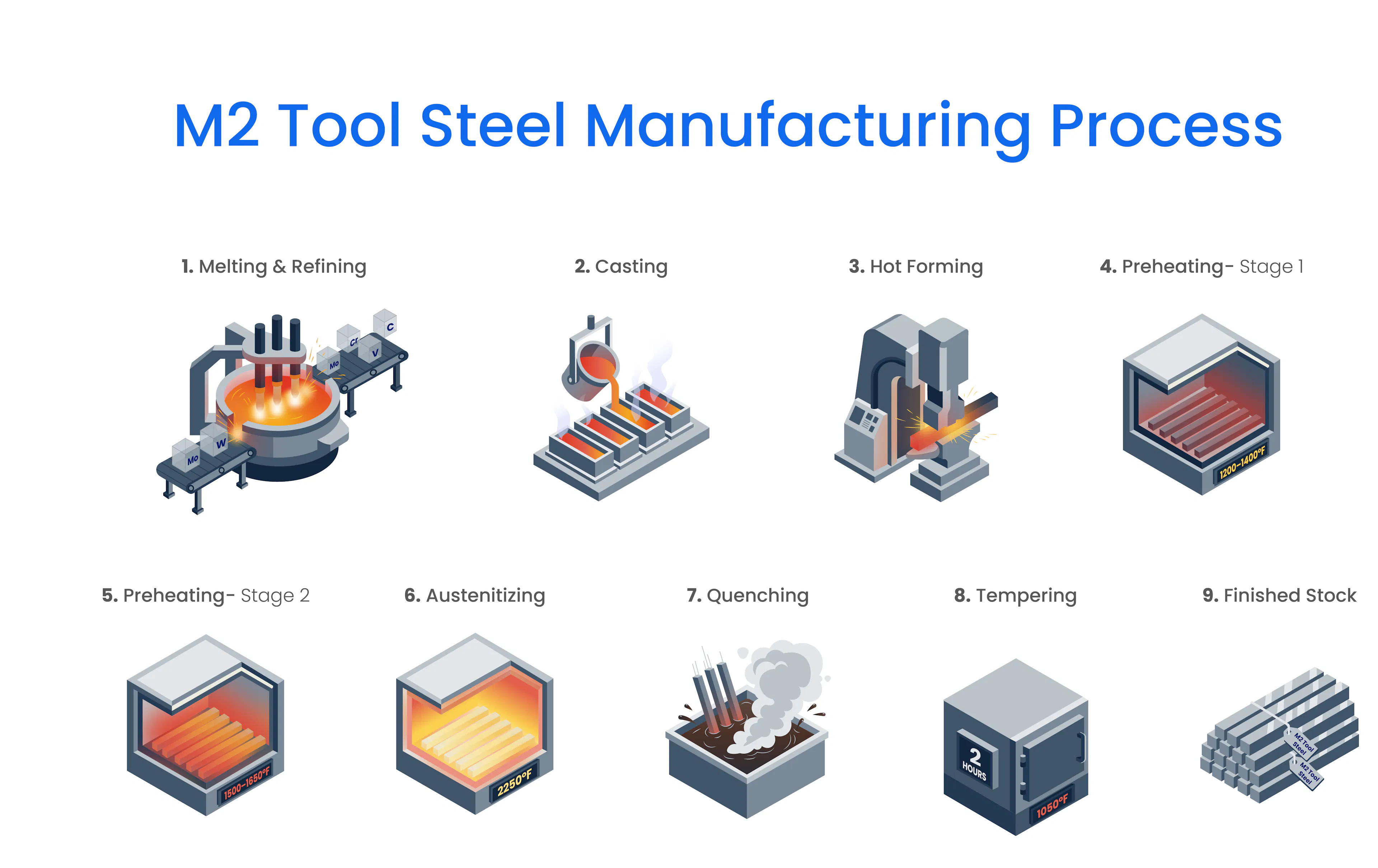
M2 Tool Steel is made by electric arc melting followed by secondary refining (vacuum treatment) to create a uniform alloy structure suited for high-speed cutting applications. The melting process combines the alloying elements consistently, while refining reduces impurities and stabilizes carbide formation. The steel is then cast, forged, and heat-treated to achieve the hardness and wear resistance required for demanding tool applications. M2 steel systems consistently deliver stable performance characteristics, although production methods vary among manufacturers, including ingot casting, remelting using ESR or VAR, or powder metallurgy. M2 Tool Steel is classified under recognized global standards. The American designation is M2 grade, the German system identifies it as DIN 1.3343, and the Japanese standard lists it as SKH51. The classifications specify similar alloy ranges, hardness potential, and hot strength, ensuring consistency across international supply chains. The steel is marketed under multiple trade names and regional labels. The alloy is referred to as M-2 steel in North America, while other regions use equivalent names for the same alloy formulation. The labels confirm that the core properties remain consistent, supporting M2’s widespread use in high-speed cutting and machining operations.
What Are the Properties of M2 Tool Steel?
The properties of M2 Tool Steel are listed below.
- Hardness: M2 reaches a typical hardness range of 62 to 67 HRC after heat treatment. The level of M2 steel hardness provides excellent edge retention and strong resistance to deformation under load.M2 performs better in precision cutting applications compared with standard tool steels and lower-grade HSS.
- Toughness: M2 maintains adequate toughness despite its high hardness. M2 resists cracking and edge chipping during demanding operations, offering a balanced combination of strength and impact resistance among its HSS material properties. The material is tougher than some lower-grade HSS, although not as tough as lower-hardness tool steels.
- Wear Resistance: M2 exhibits high resistance to abrasive wear due to the fine dispersion of alloy carbides. M2 outperforms M1 and conventional tool steels in prolonged service, making wear resistance one of the most reliable M2 tool steel properties for industrial tooling.
- Red Hardness: M2 retains significant hardness above 500°C. The result is sustained cutting performance at high speeds. M2 thermal stability exceeds that of conventional carbon and alloy tool steels, although advanced powder metallurgy HSS grades achieve even higher hot hardness.
How Do the Properties of M2 Tool Steel differ from Stainless Steel?
M2 Tool Steel differs from stainless steel in hardness, thermal stability, and material composition. M2 offers superior wear resistance and red hardness due to its high levels of tungsten, molybdenum, and vanadium, which form strong alloy carbides suited for high-speed cutting applications. Stainless steel contains higher chromium content, providing corrosion resistance, although its hardness and hot-strength capabilities are lower than those of similar materials of M2. Some stainless grades (martensitic varieties) reach high hardness, but they do not match the hot hardness or cutting performance of M2. M2 performs well under heat and cutting stress, retaining stability at elevated temperatures, while stainless steel is selected for environments that require oxidation resistance and application-specific toughness. The differences define M2 as a cutting-grade tool steel and stainless steel as a corrosion-resistant utility alloy suited to a broader range of structural and environmental conditions.
Is M2 Tool Steel stronger compared to Carbon Steel?
Yes, M2 Tool Steel is stronger than carbon steel in terms of cutting performance, wear resistance, and thermal stability. M2 is a high-speed tool steel that provides elevated hardness, exceptional red hardness, and the ability to retain sharp cutting edges at temperatures exceeding 500 °C. M2 Tool Steel alloy composition contains significant amounts of tungsten, molybdenum, vanadium, and chromium, which form complex carbides that resist abrasion and deformation during machining. Carbon steel, although capable of reaching high hardness through heat treatment, lacks the hot hardness and wear resistance required for high-speed cutting applications.
The properties of tool steel are engineered for mechanical durability by combining hardness with dimensional stability and controlled levels of toughness. M2 maintains its hardness during continuous operation where frictional heat is intense, whereas carbon steel softens under similar conditions and loses cutting capability. The M2 steel is less tough than some medium-carbon steels, but its wear resistance and hot strength are greater than what plain carbon steel achieve. The machinability of M2 differs, since the hardened material is harder to grind and machine, but it lasts much longer once processed. Each performance factor makes M2 Tool Steel a superior choice for drills, taps, end mills, and form tools where high cutting strength, heat resistance, and durability are required.
What Are the Mechanical and Thermal Properties of M2 Tool Steel?
The mechanical and thermal properties of M2 Tool Steel are listed below.
- Tensile Strength: M2 exhibits a tensile strength of 2600-3000 MPa, depending on the specific heat treatment and carbide distribution. The values support strong resistance to permanent deformation and place it above conventional steels in tensile capacity.
- Yield Strength: Yield strength values are rarely specified for hardened M2 tool steel, as performance is governed primarily by hardness, compressive strength, and wear resistance rather than elastic yielding. It is aligned with standard tool steel yield strength and exceeds basic HSS yield strength values. The range indicates the onset of plastic deformation while retaining structural performance under compressive or tensile stress.
- Density: The density of M2 is 8.16 g/cm³, which reflects the concentration of heavy alloying elements (tungsten and molybdenum). The value is consistent with the average density of tool steel grades for high-speed performance.
- Thermal Conductivity: M2 demonstrates thermal conductivity of around 20 to 25 W/m·K at room temperature. The lower thermal conductivity compared with carbon steels results in higher localized temperatures, which M2 tolerates due to its red-hardness rather than relying on heat dissipation.
- Hot Hardness: M2 maintains significant hardness at temperatures exceeding 500°C. The characteristic allows the material to continue cutting under high thermal loads without softening or edge degradation.
- Tempering Stability: M2 retains hardness effectively through multiple tempering cycles. The stability contributes to predictable performance following heat treatment or resharpening, which is essential for reusability in tool applications.
- Modulus of Elasticity: The elastic modulus is around 210 GPa. The value provides the rigidity needed for dimensional accuracy in cutting applications while preventing premature failure from excessive brittleness.
Is M2 Tool Steel Considered a Type of High-Speed Steel (HSS)?
Yes, M2 Tool Steel is considered a type of high‑speed steel. M2 belongs to the molybdenum‑based HSS family and is one of the most used grades for cutting tools that operate at elevated speeds. M2 Tool Steel alloy balance of molybdenum, tungsten, vanadium, chromium, and carbon produces strong carbide structures that support wear resistance, hot hardness, and edge stability during high‑temperature machining. M2 provides reliable cutting performance across drills, taps, mills, and form tools, which reinforces its classification as a high speed steel within industrial tooling standards.
M2 tool steel is a molybdenum-based high-speed steel engineered to balance hardness, wear resistance, and thermal stability. It has a dense carbide microstructure formed by tungsten, molybdenum, vanadium, and chromium additions. Heat treatment enables high hardness levels while preserving red hardness above 500 °C, allowing cutting edges to remain stable under sustained frictional heat. The alloy favors abrasive wear resistance and edge retention over corrosion resistance, distinguishing it from stainless steels and positioning it above carbon steels in high-temperature cutting performance. Manufacturing routes such as vacuum refining, ESR/VAR, or powder metallurgy control carbide distribution and directly influence toughness and tool life. These characteristics make M2 a general-purpose HSS for drills, taps, milling cutters, broaches, dies, and specialty blades, where dimensional stability, thermal endurance, and long service life are more critical than ease of machining or environmental resistance.
Does M2 Tool Steel Retain Its Hardness at Elevated Temperatures?
Yes, M2 Tool Steel retains its hardness at elevated temperatures. The M2 alloy contains tungsten, molybdenum, vanadium, and chromium, which form stable carbide phases that resist softening under thermal exposure. The carbides allow M2 to maintain adequate hardness up to 600°C, providing reliable edge retention during continuous high‑speed cutting. The thermal stability achieved by the alloying balance ensures that M2 maintains strength under frictional heat, establishing its role as a preferred material for drills, milling cutters, and other cutting tools that operate under extreme temperature conditions.
Is SKH51 the Same Type of Steel As M2 Tool Steel?
Yes, SKH51 is the same type of steel as M2 Tool Steel. SKH51 is the Japanese JIS designation for the alloy known internationally as AISI M2, and the two classifications refer to the same molybdenum‑based high‑speed steel grade. The chemical balance, carbide structure, and mechanical performance of SKH51 align with the properties associated with M2 (high wear resistance, red hardness, and stability) under high‑speed cutting conditions. The equivalence between the two designations ensures consistent performance across regions, regardless of naming differences in international standards.
Is Acero M2 Steel the Same As M2 Tool Steel?
Yes, Acero M2 Steel is the same type of steel as M2 Tool Steel. Acero M2 is the Spanish-language designation used in Latin American and Spanish markets for the globally recognized M2 high-speed tool steel. The term ‘acero’ translates to ‘steel' in Spanish, and the designation M2 refers to the same molybdenum-based alloy classified under standards (AISI M2, DIN 1.3343, and JIS SKH51). The chemical composition, mechanical properties, and performance criteria remain equivalent, although the naming varies by region. Acero M2 and M2 Tool Steel share the same applications (high-speed cutting tools), due to their wear resistance, red hardness, and carbide stability at elevated temperatures.
What Are the Common Applications of M2 Tool Steel?
The typical applications of M2 Tool Steel are listed below.
- Drills, Taps, and Milling Cutters: Used for producing tools that cut or shape metal under continuous rotation or impact. M2 provides superior hardness and red hardness, making it ideal for twist drills, threading taps, and high-speed milling cutters that operate under thermal load.
- Tool Bits and Metalworking Inserts: Employed in lathes, shapers, and CNC machines for high-speed turning or shaping operations. The tools require edge retention, thermal resistance, and durability, which M2 supports through its carbide-rich structure.
- Cold Forming Dies: Applied in industrial dies for blanking, punching, and stamping. M2 withstands repeated impact and maintains dimensional accuracy under mechanical stress.
- Reamers, Broaches, and Punches: Used where tight tolerances and extended service life are required in metal cutting, finishing, and forming. M2 prevents tool failure from heat buildup and wear.
- Aerospace Components: Machining of high-strength alloys and heat-resistant metals in turbine, airframe, and structural parts benefits from M2’s thermal stability and hardness under continuous duty.
- Automotive Manufacturing: Applied in the shaping of engine, gearbox, and suspension parts. M2 supports mass production under high-speed machining without edge degradation.
- Heavy Equipment Fabrication: Used in forming tools and industrial cutting systems exposed to continuous abrasion, frictional heat, and pressure. M2 resists deformation and premature wear in large-scale production settings.
How Does M2 Tool Steel Compare With Other High-Speed Steels Like T1 or M35?
M2 Tool Steel compares with other high-speed steels like T1 or M35 by offering a balanced combination of hardness, toughness, and wear resistance, making it suitable for general-purpose cutting tools. M2 contains a mix of molybdenum, tungsten, vanadium, and chromium, forming durable carbide phases that provide consistent cutting performance and maintain hot hardness up to approximately 540–560 °C. T1 is generally less tough than M2, but brittleness depends heavily on heat treatment and application. M35 includes cobalt (around 5%), which increases hot strength above that of M2, allowing better performance in extreme-temperature operations. M35 is more expensive and slightly less tough despite its higher red hardness, and it is more difficult to machine.M2 remains the preferred general-purpose option compared to the more specialized performance of T1 and M35 due to its combination of wear resistance, toughness, thermal stability, and cost-efficiency. Drills, taps, milling cutters, broaches, and other tools use it across automated and manual applications.
Is M2 Tool Steel Suitable for Knife Making and Cutting Blades?
Yes, M2 Tool Steel is suitable for specialty knife making and high-performance cutting blades. M2 Tool Steel has high hardness, strong wear resistance, and a carbide-rich structure that supports sharp edge retention and durability in demanding cutting tasks. The steel’s thermal stability allows consistent performance under frictional heat generated during slicing or repetitive cutting. Corrosion resistance is limited compared to stainless grades, so protective finishes, coatings, or careful maintenance are recommended when the blade is exposed to humid or corrosive environments. The mechanical strength and cutting efficiency of M2 make it a preferred choice for industrial knives, precision edge tools, and specialty blades that require long-lasting sharpness and high wear resistance.
Can M2 Tool Steel be used for Additive Manufacturing or 3D Printing?
Yes, M2 Tool Steel can be used for additive manufacturing when supplied in powder form, in processes such as laser powder bed fusion. The alloy responds well to controlled melting and solidification, allowing the production of high-strength components, though achieving the full hardness and wear resistance of conventionally produced M2 requires careful process control. Printed parts need precise heat treatment to dissolve segregated carbides, refine the microstructure, and develop the desired high-speed steel properties. Post-processing steps such as tempering and, in some cases, hot isostatic pressing are applied to improve density, reduce porosity, and ensure mechanical stability. The compatibility of M2 with powder-based manufacturing supports its use in specialized cutting tools and wear-resistant components produced through advanced 3D Printing technologies.
How is M2 Tool Steel Heat-treated for Optimal Hardness?
M2 Tool Steel is heat-treated for optimal hardness by following the six steps below.
- Preheating. Raise the temperature in a two-stage cycle. First, heat to 450°C to 500°C, then increase to 850°C to 900°C to reduce thermal shock and ensure even heating.
- Austenitizing. Heat the steel uniformly to 1190°C to 1230°C. Hold at peak temperature to fully dissolve carbides while avoiding excessive grain growth.
- Quenching. Cool the steel rapidly using oil, a salt bath, or high-pressure inert gas, depending on part geometry. Complete the quench to room temperature before tempering.
- Tempering. Apply three tempering cycles at 540°C to 560°C, holding each for at least two hours. Relieve internal stresses and achieve a final hardness of 62 to 67 HRC.
- Cooling Between Tempering Cycles. Allow the steel to cool completely to room temperature between cycles to maximize hardness stability and reduce residual stress.
- Verifying Final Hardness. Measure hardness with a tester and confirm consistency across the tool surface for reliable wear resistance and mechanical performance.
Frequently Asked Questions About M2 Steel
Summary
This article presented M2 tool steel, explained it, and discussed its composition and various applications. To learn more about M2 tool steel, contact a Xometry representative.
Xometry provides a wide range of manufacturing capabilities and other value-added services for all of your prototyping and production needs. Visit our website to learn more or to request a free, no-obligation quote.
Disclaimer
The content appearing on this webpage is for informational purposes only. Xometry makes no representation or warranty of any kind, be it expressed or implied, as to the accuracy, completeness, or validity of the information. Any performance parameters, geometric tolerances, specific design features, quality and types of materials, or processes should not be inferred to represent what will be delivered by third-party suppliers or manufacturers through Xometry’s network. Buyers seeking quotes for parts are responsible for defining the specific requirements for those parts. Please refer to our terms and conditions for more information.