Compression Set: Meaning, How It Works, and Understanding the Graph


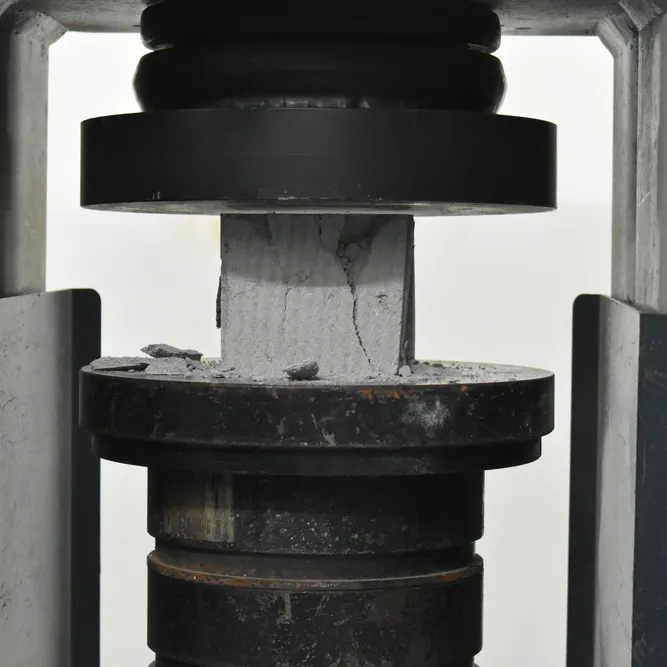
Compression Set describes the permanent deformation remaining in an elastomer after compression, thermal aging, load release, and recovery, and the concept applies directly to rubber seals, silicone gaskets, Thermoplastic Polyurethane (TPU) pads, and foam cushions. Compression Set is measured as a percentage of unrecovered thickness relative to the applied deflection, with lower values indicating stronger elastic recovery. American Society for Testing and Materials (ASTM) D395 defines common test conditions (25% deflection, 22 hours aging, 70°C to 150°C, and a 30-minute recovery period at standard laboratory temperature). A rubber compound that measures 12% compression set at 100°C retains sealing force better than a compound that measures 40% under the same conditions.
Compression Set works through time-dependent polymer relaxation, crosslink rearrangement, and heat-accelerated softening that reduce stored elastic energy during sustained compression. A compression set graph is interpreted by reading compression set percentage on the y axis and aging time or aging temperature on the x axis, then comparing materials at identical conditions. A steep curve from 70°C to 150°C indicates rapid permanent deformation growth, while a flatter curve indicates better rebound retention. A gasket that rises from 15% at 70°C to 35% at 125°C shows a higher leak risk than a gasket that stays below 20% across the same range.
What is a Compression Set?
A compression set is a standardized measure of how much permanent deformation remains in an elastic material after a compressive load is removed. The metric applies mainly to elastomers and flexible polymers (rubber, silicone, TPU, foam) because the materials rely on elastic recovery for functional performance. Compression set matters in real parts because it predicts loss of sealing force, reduction in vibration isolation, and changes in fit. Low compression set supports gaskets and O-rings that must hold pressure, while higher compression set fits parts that tolerate relaxation (pads, bumpers). Designers use compression set data to compare materials under similar test conditions (strain, time, temperature), then select compounds that maintain rebound. Practical examples include plumbing seals, automotive weatherstrips, and enclosure gaskets for electronics.
"In high-performance sealing, the compression set is the single most predictive metric for long-term reliability: if the elastomer loses its ability to push back against the housing, the joint is effectively a leak waiting to happen. Engineers must remember that a material's room-temperature (squish) tells you nothing about its ability to maintain a seal after six months at operational heat."
How to Understand the Compression Set Graph?
To understand the compression set graph, follow the five steps. First, identify the y-axis as compression set percentage (%) and interpret lower values as better elastic recovery after the test. Second, identify the x-axis as aging time (22 hours, 70 hours, 168 hours) or aging temperature (70°C, 100°C, 150°C) and treat higher values as more severe test exposure. Third, confirm the test condition details (ASTM D395, 25% deflection, 30 minutes recovery) because different deflection levels change the baseline values. Fourth, compare material curves by reading the percent change at the same time and temperature, then rank the materials by the lowest compression set at the target service condition. Lastly, interpret steep upward slopes as faster permanent deformation growth, and interpret flatter curves as better long-term sealing force retention.
What is Compression Deflection?
A compression deflection is the thickness reduction applied during a compression test and is reported as a percentage of the starting thickness. Compression deflection sets the strain level in ASTM D395 compression set testing, with 25% and 40% deflection used for many elastomer evaluations. Compression deflection differs from compression set because deflection describes the imposed squeeze during loading, while compression set describes the unrecovered thickness after unloading and a defined recovery period. Larger deflection levels place more strain on the elastomer network and commonly lead to higher measured compression set under identical aging conditions (22 hours, 70 °C to 150 °C, 30 minutes recovery). Compression deflection is used to represent the installed squeeze in gaskets, O-rings, pads, and vibration isolators. Designers choose deflection targets to match assembly squeeze, while compression set quantifies rebound loss after aging.
How does Deflection Different from Compression set? Deflection is different from compression set because deflection is the applied thickness reduction during loading, while compression set is the permanent thickness loss remaining after unloading and recovery. Deflection acts as the controlled input that defines the squeeze level (25% or 40%) during ASTM D395 aging. The compression set acts as the measured output reported after recovery (30 minutes). Higher deflection raises internal strain and tends to increase compression set under the same time and temperature.
How is Compression Deflection Measured?
To measure compression deflection, follow the five steps. First, measure the initial specimen thickness using a calibrated thickness gauge with consistent contact force. Second, select the target deflection percentage (25% or 40%) and calculate the required compressed thickness from the initial thickness. Third, place the specimen in a compression fixture with flat, parallel platens and apply compression until the calculated thickness is reached. Fourth, verify the compressed thickness using gauge blocks, spacers, or fixture stops that lock the deflection level during the test. Lastly, record the deflection percentage, fixture type, specimen thickness, and the referenced standard (ASTM D395) to ensure repeatable compression deflection control.
How Does the Compression Set Relate to 3D Printing?
The compression set relates to 3D printing because flexible printed polymers (TPU, Thermoplastic Elastomer (TPE), elastomer-like resins) lose thickness recovery under sustained load, which affects seals, pads, and damping features. Printed parts show different behavior than molded rubber because layer interfaces and porosity change stress distribution.
Compression set rises in printed elastomers when print settings create voids, low interlayer bonding, or uneven infill. A printed gasket that relaxes loses sealing force, which increases leakage risk. Material choice matters because TPU grades vary in hardness and rebound, and resin elastomers creep under heat. Designers reduce compression set risk by increasing wall thickness (2 mm to 4 mm), selecting higher quality flexible filaments, and avoiding service temperatures above 60°C to 80°C for TPU grades related to compression set to 3D printing.
What is the Importance of Compression Set Testing?
The importance of compression set testing is the process of quantifying permanent deformation after controlled compression, which predicts long-term sealing and cushioning performance. The test matters because elastomer failures occur gradually through loss of rebound rather than sudden fracture. Compression set data supports material selection for O-rings, gaskets, vibration mounts, and medical seals. Testing identifies compounds that resist heat aging, oil exposure, and sustained load. Manufacturers use test results to validate curing chemistry, filler loading, and batch consistency. Designers use the data to reduce warranty risk by choosing materials that retain contact pressure. Testing becomes relevant for parts exposed to heat, where relaxation accelerates.
What is ASTM D395?
ASTM D395 is a standard test method for measuring rubber compression set, which quantifies permanent thickness loss after an elastomer specimen is compressed for a defined period, thermally aged, unloaded, and given a controlled recovery interval. The standard specifies specimen types (Type 1 and Type 2), fixture configurations, and reporting requirements for Method A (constant force) and Method B (constant deflection) compression set testing. Many common test setups use deflection levels around 25% or 40%, exposure times like 22 hours or 70 hours, and oven temperatures that range from about 70 °C up to 150 °C, depending on the material specification. The procedure records initial thickness, applies controlled deflection using spacer control or fixture stops, maintains compression during aging, releases the load, and measures recovered thickness after the defined recovery period. The compression set percentage is calculated from the unrecovered thickness change relative to the applied deflection. ASTM D395 supports elastomer comparison for sealing performance, rebound retention, and long-term stress relaxation behavior.
How is ASTM D395 Conducted?
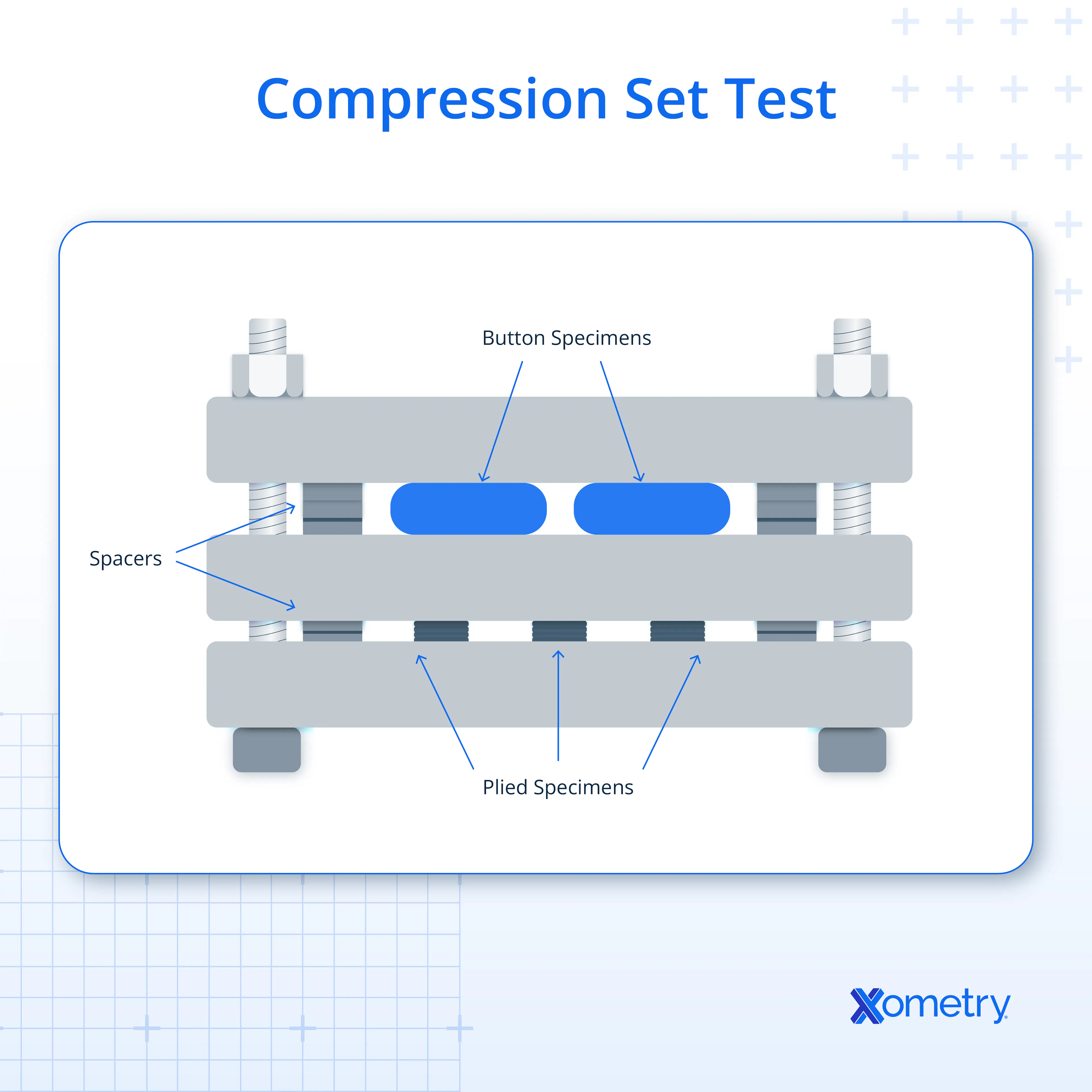
To conduct ASTM D395, follow the six steps. First, prepare a rubber specimen with a standardized geometry and record the initial thickness using a calibrated thickness gauge. Second, select the test method (Method A, constant force or Method B, constant deflection) and set the target compression deflection (25% or 40%). Third, place the specimen in the compression fixture between flat, parallel platens and apply compression using spacers or fixture stops to lock the deflection. Fourth, age the compressed specimen for a defined duration (22 hours or 70 hours) at a defined temperature (70°C, 100°C, 125°C, or 150°C). Fifth, remove the specimen from the fixture while hot, release the load, and allow recovery for a defined time (30 minutes) at standard laboratory temperature (23°C). Lastly, measure the final thickness and calculate the compression set percentage from the unrecovered thickness change relative to the applied deflection.
Is ASTM D395 Important for Material Selection?
Yes, ASTM D395 is important for material selection because compression set performance directly affects long-term sealing load and elastic recovery in service. ASTM D395 provides a consistent compression set test method for vulcanized rubber and rubber-like materials, including many elastomer families used in seals and gaskets. The standard defines fixture methods, deflection levels (commonly 25% or 40%), thermal exposure duration (22 hours or 70 hours in many specifications), exposure temperature ranges, and recovery timing, which supports meaningful compound comparison. A material measured at 10% compression set at 100 °C after 22 hours retains more recoverable thickness than a material measured at 40% under the same conditions. The results help estimate sealing force loss in gaskets and O-rings and thickness loss in pads under sustained compression. ASTM D395 data supports material specifications, supplier qualification, and reduced failure risk in compression-loaded elastomer applications.
How Do They Measure the Compression Set of a Material?
They measure the compression set of a material by recording the initial thickness, compressing the specimen to a defined deflection, holding the deflection during thermal aging for a defined time and temperature, releasing the load, allowing a defined recovery interval, and calculating the percent of unrecovered thickness relative to the applied deflection. ASTM D395 is a common standard for rubber and elastomer compression set testing and defines Method A and Method B fixtures and reporting requirements. Sample preparation uses a die-cut specimen or molded button with flat, parallel faces to reduce thickness variation and improve repeatability. The test uses a compression set fixture with rigid platens and spacer control to maintain target deflection levels, with common deflection settings at 25% or 40%, depending on the method and material. Aging is performed in a controlled temperature oven, with common conditions including 70 °C to 150 °C for 22 hours, and some specifications extending to longer durations. Recovery is measured after a defined time at standard laboratory temperature, and the final compression set percentage is calculated from the thickness loss after recovery.
What is a Compression Tester?
A compression tester is a measurement device that applies a controlled compressive load or controlled deflection to a material specimen to evaluate thickness change, force response, and permanent deformation after recovery. A compression tester setup uses flat, parallel platens, a calibrated force or displacement control system, and a thickness gauge or displacement sensor with a resolution of 0.01 mm. The operation starts by measuring initial specimen thickness, applying a defined deflection (25% or 40%) or a defined force, holding the condition for a set duration (22 hours or 70 hours) at a controlled temperature (70°C to 150°C), then measuring final thickness after a defined recovery time (30 minutes). Accurate results require platen alignment within 0.05 mm, lubricated contact surfaces, and repeatable specimen placement to prevent edge loading. Compression testers support ASTM D395 compression set testing and compression deflection force testing for rubber, silicone, EPDM, FKM, and TPU.
How is it Used to Measure Compression Set? A compression tester measures compression set by compressing a specimen to a defined deflection (25% or 40%), holding the deflection during oven aging, releasing the load, and then measuring permanent thickness loss after recovery. Initial thickness is recorded first, then the specimen is clamped in a compression fixture with spacer stops. Aging runs for 22 hours or 70 hours at 70°C to 150°C. Recovery lasts 30 minutes at 23°C before final thickness measurement and calculation.
1. Compression Set A
A compression set A is the ASTM D395 method that measures compression set under constant force, where a specified load compresses the rubber specimen, and the final permanent deformation is measured after aging and recovery. Method A uses a spring or force-controlled fixture to maintain a target compressive force rather than a fixed thickness reduction. The setup is used when installed parts experience variable squeeze under load rather than a fixed deflection. A practical example is a rubber pad or mount that sees a sustained clamping force where the thickness varies slightly with load and temperature. The compression set A results are reported as a percentage of the original thickness.
2. Compression Set B
Compression Set B is an ASTM D395 test method that evaluates permanent deformation after an elastomer is held at a fixed deflection during thermal aging. The specimen is compressed to a defined thickness reduction and mechanically restrained at the target deflection through spacers or stop-controlled fixtures. Common deflection levels include 25% and 40% of the original thickness, depending on the application and material class. The method aligns with sealing design because gaskets and O-rings operate under a controlled squeeze rather than a controlled load. A representative case involves holding an O ring at 25% deflection for 22 hours at 100 °C, unloading the specimen, allowing a defined recovery interval, and measuring unrecovered thickness to calculate compression set. Method B is widely used for comparing elastomer compounds when fixture control and repeatable deflection are required.
What Factors Affect Compression Sets?
The factors that affect compression sets are temperature, time under compression, compression deflection, material composition, cure system, filler package, and the service environment. Higher aging temperature increases permanent deformation, with elastomers showing sharply higher compression set when aging rises from 70°C to 150°C for 22 hours. Longer time under load increases the set, with 70 hours producing higher values than 22 hours at the same temperature. Higher compression deflection increases the total deformation, though the compression set percentage is typically compared at a standardized 25% deflection for most elastomer evaluations. Material composition changes are set through polymer type, crosslink density, and plasticizer content. Cure system affects heat stability, with peroxide-cured silicone and EPDM retaining a lower set than sulphur-cured systems at 150°C. Fillers and antioxidants influence rebound by reducing oxidation and chain scission during aging. Oils, fuels, ozone, and humidity increase by swelling or degrading the polymer network.
What Does a Higher Percentage Compression Set Mean?
A higher percentage compression set means the material stays noticeably flattened after the compressive force is removed, which indicates poor rebound. High values reduce retained sealing load in gaskets and O-rings and reduce remaining height in pads and bumpers. A gasket measured at 35% compression set at 100 °C shows more permanent thickness loss than a gasket measured at 12% under the same test. Reduced recovered thickness lowers contact pressure, which raises leakage risk in static joints. A vibration pad measured at 40% compression set gradually loses height and transmits vibration into the assembly. High compression set aligns with faster stress relaxation driven by heat, oxidation, or fluid exposure (oil, fuel).
What does a Lower Percentage Compression Set Mean? A lower percentage compression set means the material returns closer to its original thickness after compression and recovery. Low values indicate limited permanent thickness loss under the stated test condition (ASTM D395 with defined deflection, time, temperature, and recovery interval). A 10% result indicates strong recovery after unloading, while a 40% result indicates substantial permanent deformation. A low compression set improves long-term sealing performance because the elastomer retains higher contact stress after extended compression. Low compression set improves cushioning durability because pads keep thickness and continue absorbing vibration and impact. Higher compression set reduces recovered thickness, reduces sealing margin, and increases leak risk.
Should You Avoid High-Compression Set Materials in 3D Printing?
Yes, you should avoid high-compression set materials in 3D printing. High compression set materials are avoided in 3D printing when the part must maintain sealing force or spring-like rebound under sustained load. Printed elastomers with high set lose thickness faster because polymer relaxation combines with layer interface effects during sustained compression at 25% deflection for 22 hours. A printed TPU gasket that measures 35% to 50% compression set after heat aging (70°C, 22 hours, 30 minutes recovery) loses contact pressure and leaks sooner than a material that stays below 20%. Infill and porosity worsen the issue, since voids concentrate stress and reduce effective cross-section by 10% to 30% at 80% to 95% infill. Heat exposure above 60°C accelerates the set in TPU grades. Lower set flexible materials fit printed seals, while higher set materials fit bumpers and feet, where thickness loss has a lower consequence in 3D Printing.
Should You Choose a Higher or Lower Compression Set?
Yes, you should choose a higher or lower compression set. Compression sets are improved through compound selection, cure chemistry changes, and processing control. Improvement magnitude depends on polymer family, crosslink system, and the target service temperature. Crosslink optimization reduces the set by increasing network stability. Peroxide curing reduces the set for silicone and EPDM compared with weaker cure systems at high temperatures. Filler and additive selection improves rebound by stabilizing the polymer backbone against oxidation. Processing improvements and post-curing reduce voids and cure gradients that raise permanent deformation. Material substitution remains the largest lever, since FKM or silicone outperforms general-purpose rubber in high-heat seals. A realistic improvement target ranges from 5% to 15% lower, set at the same D395 condition.
Can You Improve the Compression Set of a Material?
Yes, compression set can be improved through compound selection, cure chemistry changes, and processing control. Improvement magnitude depends on polymer family, crosslink system, and the target service temperature. Crosslink optimization reduces the set by increasing network stability. Peroxide curing reduces the set for silicone and EPDM compared with weaker cure systems at high temperatures. Filler and additive selection improves rebound by stabilizing the polymer backbone against oxidation. Processing improvements reduce voids and cure gradients that raise permanent deformation. Material substitution remains the largest lever, since FKM or silicone frequently outperforms general-purpose rubber in high-heat seals. A realistic improvement target ranges from 5% to 15% lower, set at the same D395 condition.
Does the Rubber have a Low or High Compression Set?
Yes, rubber has low or high compression set depending on compound design, cure chemistry, and test severity. General-purpose rubber compounds fall from 15% to 35% at 70°C for 22 hours. Premium sealing compounds fall from 8% to 20% under the same conditions. High heat exposure raises values, so a compound rated 15% at 70°C exceed 30% at 125°C. Low-set rubber maintains sealing stress in O-rings and gaskets. High-set rubber loses rebound, which increases leak risk and thickness loss. Selection depends on temperature, oil exposure, and required service life.
What is the Compression Set Percentage of Silicone Rubber?
The compression set percentage of silicone rubber falls in a low to moderate range under ASTM D395 style conditions, with many commercial grades landing around 10% to 30% at 25% deflection after 22 hours at 100 °C and a defined recovery interval, while higher performance compounds reach single-digit values. Silicone retains elasticity at elevated temperatures better than many general-purpose elastomers, which supports rebound after thermal exposure. Elevated temperature testing (125 °C to 175 °C) highlights silicone’s stability because the polymer backbone resists thermal degradation compared to hydrocarbon-based rubbers. Typical service temperature capability for many silicone grades spans about −60 °C to 230 °C, depending on formulation and reinforcement. Low compression set silicone compounds fit sealing applications that require long-term force retention (oven gaskets, medical seals, electronics enclosures). Higher compression set silicone compounds still fit static sealing uses where thermal stability matters more than rebound performance.
How Is the Compression Set Percentage Measured in Silicone Rubber?
Compression set percentage in silicone rubber is measured by loading a test specimen to a fixed deflection, holding the deflection during thermal aging, removing the load, waiting for a controlled recovery interval, and calculating permanent thickness loss as a percentage of the original deflection. ASTM D395 provides the standard test framework and specifies key parameters that affect the result, including specimen dimensions, fixture type, deflection level, exposure temperature, exposure duration, and recovery timing for Method A and Method B. Thickness measurement needs low-force gauging because silicone rubber yields under probe pressure and skews the reading. Parallel platens and proper fixture alignment reduce uneven strain that produces misleading recovery thickness. Recovery time selection affects the measured rebound and changes the reported compression set value. A complete report lists the ASTM method, deflection percentage, aging temperature, aging time, recovery time, and the final compression set percentage.
What is the Difference Between Compression Set and Creep (Deformation)?
The difference between compression set and creep deformation is defined by the loading condition and the measurement endpoint. A compression set measures permanent thickness loss after a material is compressed for a defined time and temperature, unloaded, and then given a controlled recovery period. Creep measures time-dependent strain growth while a constant stress or constant load remains applied without unloading. The compression set focuses on elastic recovery loss, which directly affects long-term sealing force in gaskets and O-rings. Creep focuses on progressive shape change under sustained loading, which affects dimensional stability in load-bearing parts and fixtured assemblies. Compression set testing applies a fixed deflection, holds the deflection during aging, releases the load, and measures the final recovered thickness. Creep testing applies a constant load or stress and tracks deformation as a function of time. The performance risk differs because compression set relates to rebound loss, while long-term dimensional drift relates to creep (deformation).
Why Is It Important to Distinguish Compression Set from Creep?
It is important to distinguish compression set and creep because the two properties predict different failure modes in elastomers and polymers. Confusion leads to incorrect material selection and unexpected loss of function. A seal failure is more closely tied to compression set because rebound loss reduces contact pressure after long compression. A structural polymer bracket failure is more closely tied to creep because deformation grows under constant load. Testing and specification differ, so using the wrong metric hides risk. Clear distinction improves design margins and quality control.
Can Confusing the Two Lead to Material Failure?
Yes, confusing the two leads to material failure. The reason for the confusion is that the wrong test data is used to predict real service behavior. Misinterpretation causes parts to relax, leak, deform, or lose fit earlier than expected. A gasket selected using only initial elastic data may show low deformation under load yet still lose rebound after thermal aging, causing leaks.
A plastic part selected using compression set data may rebound well after unloading, yet still creep under sustained stress, causing dimensional drift. Correct property selection reduces warranty risk and improves long-term performance.
How Xometry Can Help
If you have any more questions about compression set or need help choosing the right material for your project, just reach out to one of our representatives, who would be happy to assist. Xometry also offers so many related manufacturing services like CNC machining, laser cutting, and 3D printing. Get started today by requesting your free, no-obligation quote.
Disclaimer
The content appearing on this webpage is for informational purposes only. Xometry makes no representation or warranty of any kind, be it expressed or implied, as to the accuracy, completeness, or validity of the information. Any performance parameters, geometric tolerances, specific design features, quality and types of materials, or processes should not be inferred to represent what will be delivered by third-party suppliers or manufacturers through Xometry’s network. Buyers seeking quotes for parts are responsible for defining the specific requirements for those parts. Please refer to our terms and conditions for more information.