Lost-Foam Casting: Definition, Importance, How It Works, Applications, and Advantages


Lost foam casting is as close as you can get to manufacturing “magic”—the way it can transform a delicate foam model into a solid metal item with almost unreal precision is practically sorcery. This particular process is often used for metal casting, and while it’s certainly a popular expert technique, it’s no less a fascinating option. We’re going to explore exactly what this process is and how it works, plus we’ll explain what downsides and upsides there are and when you should use it.
What Is Lost-Foam Casting?
Also going by the names evaporative casting and the expanded polystyrene process, lost-foam casting is a technique that involves using expanded polystyrene foam as a mold that shapes molten metal and evaporates when it’s done. It came about in the late 1950s and is still a popular method today for both manufacturers and intrigued hobbyists.
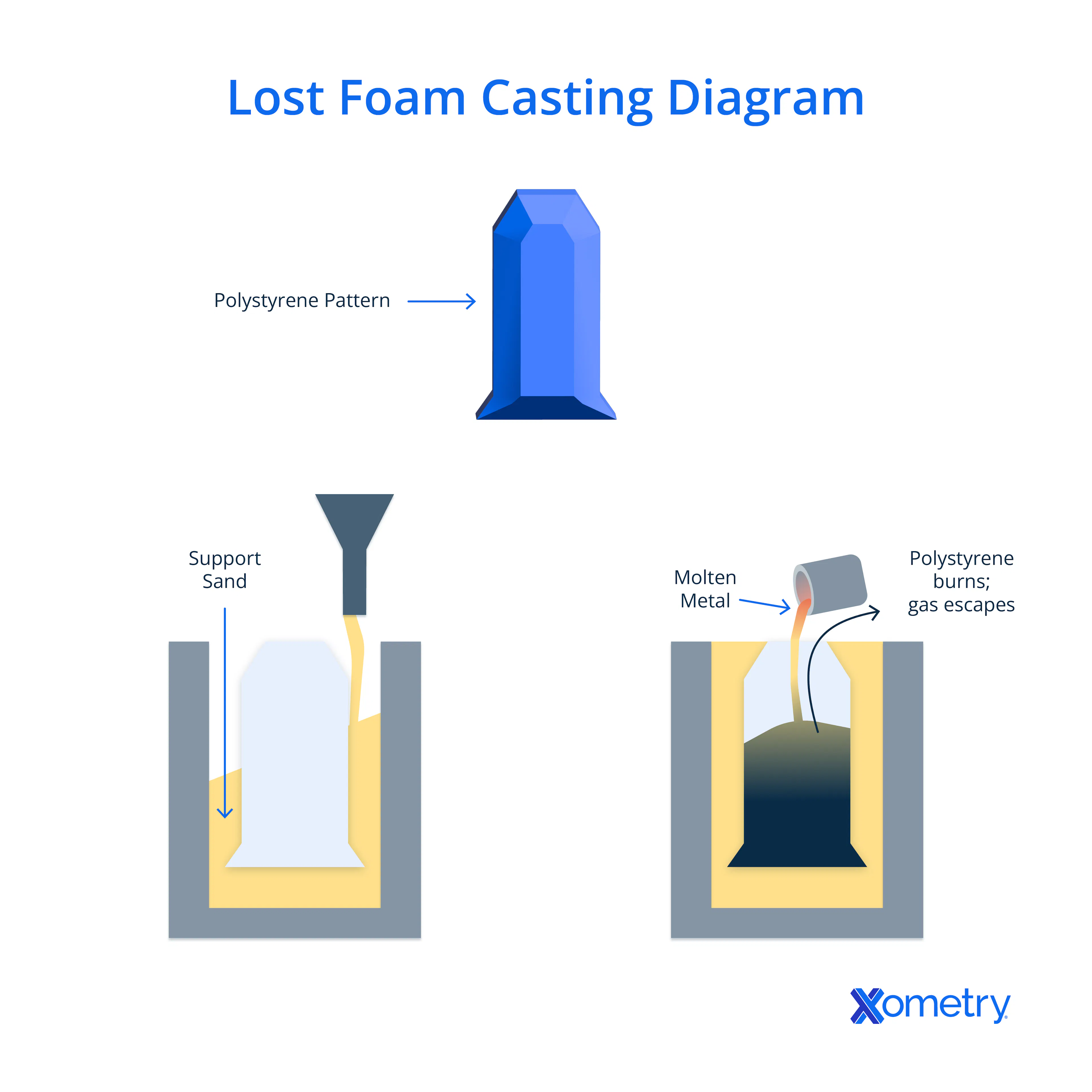
The pattern for the item you’re looking to make is cut from a foam block and coated in ceramic or another covering. This keeps the product separated from the sand that’s poured around it, especially once the mold goes away. It’s similar to injection molding, but with the (intended) disappearance of the mold, it does differ in some respects. You can see how it works in the diagram below.
There are a handful of perks that come with this kind of casting. It’s a top-notch choice for creating precise parts with specific dimensions and it’s a lot simpler than other methods to do so. Because of the way it works, it also avoids flash. The disadvantages of lost-foam casting tend to be the cost of the die (if you’re using a closed-die molding method) and a higher level of porosity in your castings. You also might find that the patterns or molds tend to get damaged more easily.
What Is the Origin of Lost-Foam Casting?
Lost-foam casting has its origins in a patent that H.F. Shroyer filed in April 1956. He proposed the idea of embedding foam patterns within green sand to cast metal. This creative method required cutting a pattern from expanded polystyrene (EPS) and supporting it with bonded sand throughout the casting process. Shroyer's creative strategy, which was formally patented in 1958, served as the basis for lost-foam casting, often known as the whole-mold technique.
What Is the Importance of Lost-Foam Casting in Manufacturing?
Lost-foam casting is important in the industrial industry because it uses less energy than sand casting and has a smaller carbon impact. Additionally, it reduces waste production and metal consumption. This helps to create a cleaner and more productive industrial environment.
How Does Lost-Foam Casting Work?
Here is a look at the step-by-step process for lost-foam casting.
- First, the foam molds are prepared. These are in the shape of the intended finished product and they get filled through a gating system with passages that allow for precise design specs.
- Next, you bond the foam pattern or mold to the gating mechanism to make sure the alignment is spot on.
- Then you’ll apply dip paint, which, when dry, creates a ceramic coating on your mold, boosting its toughness, heat resistance, and ability to handle the high temperatures of the metal.
- Once this is done, you’ll place the mold and gating mechanism (which are now one piece) into a bucket, container, or vessel of dry sand. This holds your piece in place and keeps it in the right position during casting.
- After filling with sand, the container will go through vibration to make sure that the sand fully encompasses the module.
- This is when the molten metal gets poured into the mold. The heat of this makes the mold vaporize (sorcery!), leaving room for the metal to fill in and form.
- Finally, after the molds have cooled, they’ll go through cleaning and finishing. You can also recycle the sand.

"Lost-foam casting allows for the creation of highly complex, near-net-shape parts with intricate geometries that would be difficult or impossible to achieve using traditional casting methods, as the foam pattern eliminates the need for cores and parting lines. This advantage translates into real-world applications such as lightweight automotive engine components, intricate aerospace structures, and efficient pump housings, reducing machining costs and material waste while enabling innovative designs."
What Makes Lost-Foam Casting Stand Out Among Other Types of Casting?
Lost-foam casting has definite advantages over conventional casting techniques like sand casting or investment casting. Complex shapes and elaborate designs are possible that could be difficult with other approaches. Lost-foam casting can also reduce material waste and streamline manufacturing procedures, making it more effective and economical.
To learn more, see our article on types of casting.
What Is the Process of Lost-Foam Casting?
Here is a step-by-step explanation of the procedure:
1. Use Foam Molds for Foam Pattern and Gating System Production
In lost-foam casting, foam patterns mimic the precise geometry of the finished metal object. The gating system has passages that direct molten metal into the mold and may be integrated into the foam pattern or attached (glued on) later. These passages enable precise designs and streamlined metal flow, resulting in castings that are accurate and effective.
2. Bond Patterns and Runners To Create a Mold Bundle Module
Tightly bind the foam patterns and gating mechanisms to form the mold bundle module prior to casting. This assembly makes the casting process easier by ensuring precise component alignment, reducing mistakes, and facilitating reliable, consistent manufacture of complex metal parts.
3. Apply Dip Paint and Allow the Paint To Dry
An application of refractory dip paint follows the assembly of the mold bundle module. When this paint dries, it creates a protective ceramic coating that improves the mold's surface toughness, heat resistance, and capacity to handle the temperature and pressure of the molten metal.
4. Place the Module in a Sandbox and Fill It With Dry Sand
Coat the mold bundle module, set it within a molding flask, and cover it in dry sand. This phase ensures accurate replication of the desired metal part by supporting the module's shape, keeping it in place during casting, and facilitating uniform sand compaction.
5. Vibrate Molding To Fill the Cavity and Compact the Sand
Sand may now flow into every nook and cranny of the mold bundle module thanks to vibrations imparted to the molding flask. Through careful sand compaction and the elimination of air spaces, this procedure enables the creation of a high-quality casting with exact measurements and fine details.
6. Pour Molten Metal To Vaporize the Foam and Create Desired Castings
Carefully pour the molten metal into the mold, replacing the vaporized foam patterns. The metal solidifies to create the desired casting as it fills the spaces the foam left behind. As a result, the finished product closely resembles the planned form while minimizing flaws and blemishes. This technique supports complicated and complex shapes.
7. Clean the Castings After They Have Cooled
After the castings have cooled and set, clean the casting to get rid of any remaining sand, ceramic shells, and other impurities. To produce high-quality and aesthetically pleasing metal parts, this phase means that the final castings fulfill quality requirements, have smooth surfaces, and are ready for subsequent finishing procedures or assembly.
The lost-foam casting process significantly lowers labor requirements and waste production. It is also possible to recycle used dry sand, which is in line with objectives for lowering emissions and using less energy.
What Is the Type of Sand Used in Lost-Foam Casting?
The use of dry sand is common in lost-foam casting. Some practitioners choose "green sand," fine, soft sand that has been blended with bentonite clay. Due to the combination's improved pliability, it can keep its shape even when somewhat damp. Even though "green sand" isn't usually green, its clay content makes it a good material to use when casting complicated foam shapes.
What Are the Metals Used in Lost-Foam Casting?
Here are the types of metals and materials you’ll most usually find in the lost-foam casting process.
Steels and stainless steels
These alloys are popular for melting down and pouring into the mold because they're strong and very resistant to corrosion. Stainless steel is usually a touch more expensive than other metals, but its positive characteristics often make it worth the price.
To learn more, see our full guides on stainless steel and steel.
Aluminum alloys
These are often pretty affordable materials when used for lost-foam casting. Because they’re lightweight, strong, and thermally conductive, manufacturers and hobbyists often look to different aluminum alloys.
Cast irons
Whether gray or ductile, cast iron is strong and resistant to wear, making it a good choice for this manufacturing method. This is especially true for more heavy-duty situations.
Nickel alloys
Thanks to how well they can handle heat and corrosive environments, nickel alloys are another go-to choice for lost-foam casting. They can be more expensive, but knowing the properties of nickel and what’s needed for the particular product you’re creating might make it worth it.
Sand
You’ll typically use dry sand to fill the container for lost-foam molding. Sometimes “green sand” is used, which is a mixture of bentonite clay and sand, giving it a soft, pliable, and slightly-damp feel.
Can Copper Alloys Be Used as Casting Material for Lost-Foam Casting?
Yes, the lost foam casting process can be employed with copper alloys. However, casting copper alloys successfully requires careful consideration due to the unique challenges they pose. Molten copper alloys have the potential to produce sulfurous gases and are prone to absorbing oxygen, which can result in casting defects. Special precautions are necessary to address these issues. The incorporation of specific openings or risers within the mold becomes imperative. These serve a dual purpose: facilitating the controlled pouring of the molten metal and allowing the escape of impurities and gases that may compromise the casting quality.
What Are the Applications of Lost-Foam Casting?
When you want an intricate or complex part with thinner walls or perhaps inner channels, you can look to lost-foam casting to get the job done. You’ll find the likes of cylinder heads, engine blocks, cooling system housings, and other engineered parts made in this way.
What Industries Use the Lost-Foam Casting Products?
A wide range of industries, including: the automotive, marine, military, and agricultural fields, find use for lost-foam casting. It is a useful approach in creating components for these various sectors.
What Is the Quality of Lost-Foam Casting Products?
Lost-foam casting produces high-quality components with intricate details due to its ability to replicate complex shapes accurately. The durability of these products depends on factors such as: the chosen material, design considerations, and proper casting techniques. When executed with precision, lost-foam casting can yield durable and reliable products.
Are Lost-Foam Casting Products Heat Resistant?
Yes, products made with lost-foam casting can be heat resistant. The method is used to make heat-resistant components, especially those with elaborate designs and small sizes. It is often employed to make components that have strong heat-resistance qualities, which helps to make them suitable for a variety of applications.
What Are the Advantages of Lost-Foam Casting?
Listed below are the advantages of lost-foam casting:
- Excels in producing castings with high dimensional accuracy.
- Inherently avoids flash, the unwanted material accumulation on castings. The absence of a draft requirement ensures clean castings with impeccable dimensional accuracy.
- It's simpler than many other casting methods, involving fewer steps.
What Are the Disadvantages of Lost-Foam Casting?
Listed below are some disadvantages of lost-foam casting:
- When closed-die molding is employed for pattern creation, the cost of the die can become a significant factor.
- While patterns are lightweight and easy to handle, they are susceptible to damage and distortion. This requires careful handling throughout the process.
- The presence of burnt polystyrene foam can lead to a higher degree of porosity in the castings. This can potentially affect their structural integrity and quality.
Is Lost-Foam Casting Expensive?
Yes, lost-foam casting is more expensive than other techniques. But, it has the advantage of having tighter tolerances, being lighter, and having features that are as-cast, which cut down on machining and cleanup time. It is possible to cast a large number of components that need milling, turning, drilling, and grinding with a small amount of machine stock.
Is Lost-Foam Casting the Same as Investment Casting?
No, lost-foam casting and investment casting are not the same thing. While lost-foam and investment casting are similar, the latter uses wax patterns while the former uses expanding polystyrene foam. The selection of pattern material distinguishes the two methods even though they are fundamentally similar.
What Is the Difference Between Lost-Foam Casting and Sand Casting?
The table we’ve put together below helps detail the differences between lost-foam and sand casting.
Lost-Foam vs. Sand Casting
Frequently Asked Questions on Lost-Foam Casting
How Xometry Can Help
At Xometry, we have numerous services you can get a free quote for, whether you’re interested in lost-foam casting, or something different, such as die casting, plastic extrusion, or bridge molding.
Disclaimer
The content appearing on this webpage is for informational purposes only. Xometry makes no representation or warranty of any kind, be it expressed or implied, as to the accuracy, completeness, or validity of the information. Any performance parameters, geometric tolerances, specific design features, quality and types of materials, or processes should not be inferred to represent what will be delivered by third-party suppliers or manufacturers through Xometry’s network. Buyers seeking quotes for parts are responsible for defining the specific requirements for those parts. Please refer to our terms and conditions for more information.