
Introduction to Milling: Definition, Work, Operation and Process


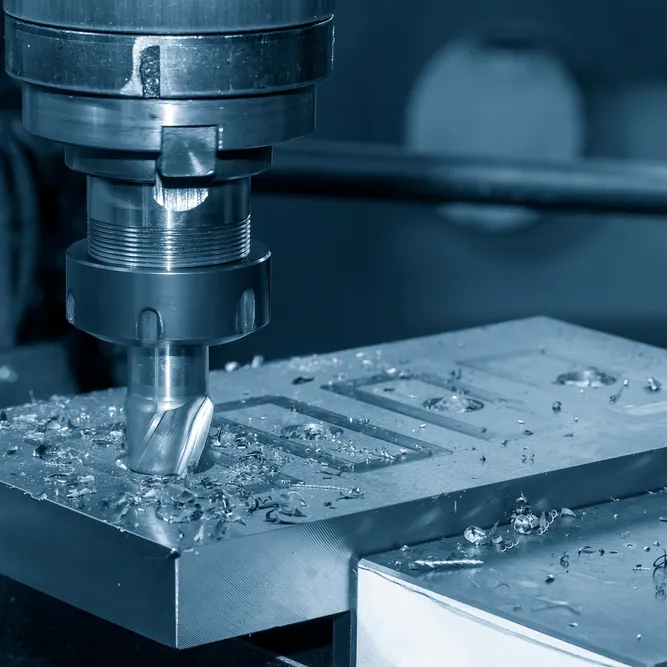
Milling is a subtractive process using a rotating cutter with multiple cutting edges to remove material from a workpiece. The workpiece advances along the X, Y, and Z axes, moving into the rotating cutter for controlled material removal. Face milling, end milling, and slotting are used to create various features.
Manual milling requires operator control, while Computer Numerical Control (CNC) milling automates movements through programmed instructions. Milling produces complex geometries, such as gears and engine components. Swiss machining uses a guide bushing to support slender parts; accuracy and surface finish result from support near the cutting zone, minimized deflection, and controlled feeds and speeds not high-speed rotation alone.
CNC milling is versatile across materials, including metals and plastics, and is essential for both high-volume production and prototyping. It is ideal for flat surfaces, intricate contours, and precision during heavy-duty cutting.
What is Milling?
Milling is a subtractive machining technique. A rotating cutter removes material from either a fixed or advancing workpiece. High-speed rotation produces chips during cutting. Advancement of the workpiece against the cutter forms flat planes, recessed pockets, and linear grooves. Metals, plastics, and composites undergo shaping through this method. Milling can achieve precision depending on machine capability, tooling, setup, and process parameters. Multiple teeth on the cutter allow uninterrupted removal of material. Feed rate establishes the pace of workpiece movement. Rotation speed influences the smoothness of the finished surface. Milling executes roughing operations and finishing operations. Cutter geometry dictates the final contour. Complex three-dimensional structures emerge through successive passes. Dimensional refinement occurs at each stage. Accuracy, consistency, and production capacity secure milling as a cornerstone of machine shops.
Is Milling a Machining Process That Uses a Rotating Cutter?
Yes, Milling is a machining process that uses a rotating cutter. A rotating cutter removes material from a workpiece and generates chips during cutting. The cutter rotates around an axis while the workpiece advances into the cutting edges. Each tooth of the cutter performs a separate cut, producing controlled material removal. Metals and plastics undergo shaping through the method. Cutter speed is selected based on material properties (including hardness), tool material, and cutting conditions; chip evacuation depends primarily on tool geometry, feed rate, and coolant use. Milling involves intermittent cutting (each tooth engages and disengages), not continuous contact. Milling equipment provides stable support that maintains accurate rotation. Precision depends on the stability of both the cutter and workpiece. Cutter geometry defines the operation and establishes the final form. Milling serves industrial tasks that demand reliability, dimensional accuracy, and repeatable performance.
What is a Milling Machine?
A milling machine operates as a power-driven device that removes material through a rotating cutter. The workpiece remains secured on a movable table, allowing precise positioning during machining. The spindle drives the cutter at high speeds, enabling efficient removal of material. Movement of the table along the X, Y, and Z axes provides flexibility in shaping. Feed rate controls material removal rate and chip load, while cutting speed is determined by spindle speed; both influence accuracy.
The rigid frame maintains tight tolerances throughout operation. Modern machines incorporate automated controls that streamline repetitive tasks. Manual versions rely on handwheels for table movement. The frame supports the motor and drive mechanisms, while cooling systems prevent overheating during extended use. Milling machines create components (gears, slots, and flat surfaces). Reliability and accuracy characterize their performance. Different cutters accommodate specialized functions. Manufacturers employ milling machines for heavy-duty removal of metal and for delicate finishing tasks.
How Does a Milling Machine Work in Machining?
The milling machine works by rotating a multi-point cutting tool while feeding the workpiece against it. The motor powers the spindle for high rotational speeds, and the workpiece is clamped on the worktable to prevent movement. The table moves along different axes to guide the material into the cutter, with each tool revolution removing a layer of material in the form of chips.
The operator or computer program controls the cut depth, and lubrication or coolant flows over the cutting zone to reduce friction. The machine’s precision ensures the workpiece meets design specifications. Motion follows linear or circular paths, depending on the desired shape. Rigidity in the machine frame prevents vibrations that affect surface quality. The process repeats until the part reaches the final dimensions. Stability is critical for high-quality results, with the tool-material interaction defining the shaping process.
Does a Milling Machine Remove Material Using a Milling Cutter?
Yes, a milling machine removes material using a rotating milling cutter with multiple sharp teeth. Each tooth removes a small portion of material as the workpiece enters the tool's path, shaping the part. Cutter types vary based on the operation (end mills, face mills, slab mills), with tool sharpness ensuring clean cuts and high accuracy.
Material removal rates depend on spindle speed and feed rate, with the machine providing the necessary torque to shear material effectively. Chip formation indicates cutting efficiency, and proper tool selection prevents excessive heat buildup and wear. The cutter is the primary interface between the machine and workpiece, with high-quality cutters yielding better surface finishes. The mechanical action enables rapid material removal in industrial settings, with each rotation contributing to the part's final geometry.
What is the Milling Process?
The milling process removes material through rotating tools. The operation begins with the selection of a suitable cutter. The workpiece is secured on the machine table using clamps or a vice. The cutter rotates at a defined speed while the table advances the material into the cutting edges. Subtractive machining produces flat planes or contoured surfaces.
Industrial milling employs roughing passes that remove large volumes of material. Finishing passes establish final dimensions and surface quality. Aluminum, steel, and plastics undergo shaping through the method. Machinists oversee accuracy and monitor tool condition. Coolant regulates temperature and clears chips during cutting. Tool paths follow programmed instructions, and precision instruments verify dimensions after machining. Milling remains a standard technique in industrial production due to reliability and repeatability.
How Does the Milling Process Remove Material Step by Step?
The milling process removes material through mechanical cutting actions. Rotation of the cutter at high speeds initiates the operation. The workpiece advances toward the rotating tool at a controlled feed rate. Cutting edges shear chips from the material during contact. Each tooth on the cutter delivers a precise cut and follows the programmed path to form the required features.
The machine applies a force that overcomes material resistance. Chip evacuation occurs as the cutter rotates away from the cutting zone. Multiple passes refine the surface and establish the target depth. Finishing cuts provide smoothness and dimensional accuracy. The process transforms a raw block into a finished component. Accuracy is an important objective throughout the operation, but productivity, surface finish, tool life, and material removal rate are also central considerations.
Is the Milling Process Used in Manufacturing?
Yes, the milling process supports manufacturing across diverse sectors. Complex geometries and tight tolerances are achieved through controlled material removal. Production ranges from small-scale prototyping to large-scale output. Aerospace, automotive, and medical industries depend on milling for critical components.
Machine versatility accommodates varied material dimensions. Automated systems improve workflow efficiency and reduce manual intervention. Integration with computer-aided design ensures dimensional accuracy and consistent quality. Milling produces intricate internal and external features that enhance functionality. Cost-effectiveness and reliability strengthen its role in part fabrication. Precision and repeatability establish milling as a foundation of modern manufacturing. Industry standards are consistently met through this process.
Is the Milling Process used in metalworking? Yes, the milling process is used in metalworking. The process involves a rotating multi-point cutting tool that progressively removes material from a workpiece, producing accurate shapes, slots, and contours. Milling supports diverse operations such as face milling, end milling, and angular milling, enabling manufacturers to create complex geometries with high precision. Its versatility makes it a fundamental machining method across industries (aerospace, automotive, and tooling). Component production requires processes that deliver tight tolerances and repeatable accuracy, which is why this method is widely used.
What Are Milling Machine Operations?
The Milling Machines operations are listed below.
- Set up: Secure the workpiece to the machine table using appropriate fixtures. The machinist ensures the part is level and stable for the cutting process. Proper clamping prevents movement that leads to errors.
- Tool Selection: Choose the correct cutting tool based on the material and operation. The selection depends on the desired shape (flat, grooved, or contoured). High-quality tools ensure better surface finishes and longer tool life.
- Parameter Setting: Adjust the spindle speed and feed rate for the specific material. The parameters dictate the efficiency and safety of the machining process. Correct settings prevent tool breakage and overheating.
- Cutting: Rotate the tool and feed the workpiece to remove material. The mechanical action creates chips and defines the part geometry. Continuous monitoring ensures the operation remains within tolerances.
- Finishing: Perform a final pass with refined settings for a smooth surface. The step removes minor imperfections left during the roughing phase. Precision measurement verifies the final dimensions of the part.
What Are the Types of Milling Operations?
Yes. The types of Milling operations encompass a wide range of methods applied in metalworking. Common types include face milling, end milling, slot milling, angular milling, and form milling. Each operation uses a rotating cutter with multiple teeth to remove material in controlled increments, producing accurate surfaces, slots, and complex geometries. These operations are common in production environments due to their ability to achieve tight tolerances and repeatable results. Milling supports both prototype development and mass production, making it a versatile process across industries such as aerospace, automotive, and tooling.
Are Face Milling and Peripheral Milling Common Operations?
Face milling and peripheral milling are common operations in metalworking. Face milling uses a cutter with teeth positioned on the face and periphery to create flat surfaces with high accuracy, making it suitable for producing smooth finishes on large areas. Peripheral milling, sometimes called slab milling, engages the cutter’s teeth along its circumference to remove material parallel to the axis, shaping profiles and contours with precision. Both operations are widely applied in production environments due to their efficiency and versatility. They support prototype development and mass production, ensuring consistent quality across industries such as aerospace, automotive, and tooling.
What Are the Types of Milling Machines?
The types of Milling Machines are listed below.
- Vertical: Features a spindle oriented vertically relative to the worktable. The design allows the tool to move up and down for deep cutting. The machine is preferred for end milling and drilling operations.
- Horizontal: Utilizes a spindle oriented horizontally for heavy material removal. The setup supports multiple cutters on a single arbour for complex tasks. The machine is ideal for slab milling and slotting.
- Computer Numerical Control (CNC): Operates through computer-controlled systems for automated material removal. The machine follows precise digital instructions for high repeatability. The technology enables the creation of complex three-dimensional parts.
- Universal Milling Machine: A universal milling machine is a versatile machine that can perform a wide range of operations, such as cutting, drilling, and shaping. It can operate along multiple axes and is typically used for general-purpose milling tasks. The machine can be adjusted to perform various operations by changing the orientation of the table and cutting tools.
- Turret Milling Machine: The turret milling machine is a type of vertical milling machine with a vertically adjustable spindle and a stationary table. It is commonly used for small to medium-scale operations, offering flexibility in milling operations due to its ability to make precise cuts in various directions. The turret can be repositioned, enabling a range of milling angles.
- Bed-Type Milling Machine: A bed-type milling machine is designed for high-speed, heavy-duty milling operations. Unlike turret mills, the bed-type machine has a fixed table, which is suitable for larger workpieces. The machine offers increased rigidity and stability, making it ideal for mass production and continuous machining of large parts.
- Planer-Type Milling Machine: The planer-type milling machine is used for machining large, heavy workpieces. The workpiece is mounted on a fixed table while the milling cutter moves horizontally across the part. This machine is suitable for high-volume production of flat surfaces and complex profiles, typically used in industries like automotive and aerospace.
- Special Milling Machines: Special milling machines are custom-designed machines built for specific operations or industries. These machines may incorporate unique features tailored to specialized tasks, such as high-speed cutting, fine finish work, or machining materials that require precise handling. Examples include multi-axis or CNC milling machines, which allow for high automation and precision in manufacturing processes.
What Is the Difference Between Vertical and Horizontal Milling Machines?
The main difference between vertical and horizontal milling machines is the spindle orientation and the types of work they perform. Vertical machines have an upright spindle, making them ideal for precision work and end milling. Horizontal machines have a spindle parallel to the ground, supporting heavy cutters and removing larger volumes of material more efficiently.
Horizontal machines offer more rigidity for heavy-duty tasks and often feature pallet changers for high-volume production. Vertical mills are more common in small shops due to their versatility and better visibility of the cutting zone. The choice depends on the workpiece geometry and size, with horizontal mills being better for machining multiple sides. Vertical and horizontal mills differ in price and space requirements.
Is a Horizontal Milling Machine Better for Heavy Duty Cutting?
Yes, a horizontal milling machine is ideal for heavy-duty cutting due to its rigid construction and arbour support. The horizontal spindle allows for the use of shorter, thicker tools, providing increased stability. Large material removal rates are achieved with slab mills or side cutters, and the machine supports higher torque for tough materials. Efficient chip evacuation is aided by gravity, helping chips fall away from the cut.
Horizontal setups allow machining multiple parts simultaneously on an arbour, reducing vibration during deep or wide cuts. Manufacturers use horizontal mills for large engine blocks and structural components, handling high feed rates without sacrificing accuracy. Rigidity prevents tool deflection during aggressive machining, and the design supports high-power motors for heavy industrial applications, making it reliable in high-production environments.
What Does a Milling Machine Do?
A milling machine shapes solid materials by removing layers with a rotating multipoint cutter. Manual milling is operator-controlled, while Computer Numerical Control (CNC) versions use automation for consistent results. Manual operations rely on the operator's skill and precision, adjusting speed with handwheels. CNC systems ensure repeatability and eliminate human error in the toolpath.
The machine creates complex features, such as pockets, threads, and curved surfaces. Manufacturers use it for prototypes and large batches of parts, handling metals, alloys, and specialized plastics. Attachments expand the machine's capabilities, transforming raw material into functional components through subtractive means. High-speed spindles allow smooth finishes, and the machine provides the force required to cut through hardened steel. Accuracy can be consistent throughout production when proper setup, tooling, and process control are maintained.
What is Milling Used for in Engineering?
Milling is used in engineering to manufacture components with precise geometries and tight tolerances. Engine parts, transmission gears, and structural brackets emerge through controlled material removal. Molds and dies are produced through milling, and complex internal cavities are created within solid metal blocks. Aerospace projects depend on milling for lightweight wing spars and turbine blades. Medical engineering applies milling for orthopedic implants and surgical instruments.
The process accommodates varied materials across applications. Assemblies achieve a perfect fit through dimensional accuracy. Milling enables rapid prototyping for new designs and delivers high-quality surface finishes. Material waste decreases through efficient cutting strategies. Computer-aided manufacturing integrates seamlessly with milling, ensuring effective design execution. Modern mechanical and structural engineering projects rely on milling as a vital production method.
Can a Milling Machine Produce Complex Parts and Surfaces?
Yes, a milling machine can produce complex parts and surfaces by moving the workpiece and tool along multiple axes. Multi-axis machines (3, 4, or 5-axis) permit the creation of intricate 3D shapes, with the tool following a detailed path to carve complex contours and pockets. Computer-controlled systems ensure accuracy during movements.
The machine creates internal features and complex parts (turbine impellers, orthopedic joints, and decorative molds) that are difficult to achieve with other methods. Precision enables accurate features when proper setup, tooling, and parameters are used; tooling variations support surface detailing. The technology supports the production of high-performance components, and engineers rely on it for parts requiring high geometric complexity. The flexible setup handles various part sizes, maintaining high reliability for difficult geometries. Milling is a widely used method for producing complex components in manufacturing.
How Does a Manual Milling Machine Compare to a CNC Mill?
A manual milling machine differs from a Computer Numerical Control (CNC) mill in control, precision, and production speed. Manual machines require the operator to move the table and spindle by hand, with precision depending on the machinist's skill. CNC mills automate tool and table movement through computer programs, ensuring higher repeatability and fewer errors.
Manual mills are better for simple tasks or one-off prototypes, while CNC mills excel in high-volume production requiring consistency. Manual machines have shorter setup times for basic operations, whereas CNC machines require programming before starting. Manual mills are less expensive to purchase and maintain. CNC technology allows the creation of complex 3D shapes that are difficult to achieve manually. The choice depends on part complexity and quantity, with machines offering high reliability when properly maintained.
Is CNC Milling More Precise Than Manual Milling?
Yes, Computer Numerical Control (CNC) milling is more precise than manual milling due to computer-controlled movements and high-resolution motors. CNC systems can achieve tight tolerances (often around ±0.001 inches or better, depending on machine and conditions), significantly reducing human error. The machine maintains consistent speed and feed rates, ensuring each part in a production run is identical. CNC systems use feedback sensors to monitor axis positions and calculate tool offsets and wear. Manual milling is limited by the operator's ability to read dials and move handles.
CNC machines can offer high rigidity and controlled motion, which helps reduce vibration when properly designed and operated. Automated systems ensure complex geometries are executed accurately, making CNC milling the preferred choice in industries with strict standards like aerospace and medical. Accuracy is an advantage of computer-controlled machining.
What Are the Main Components of a Milling Machine?
The Main components of a Milling Machine are listed below.
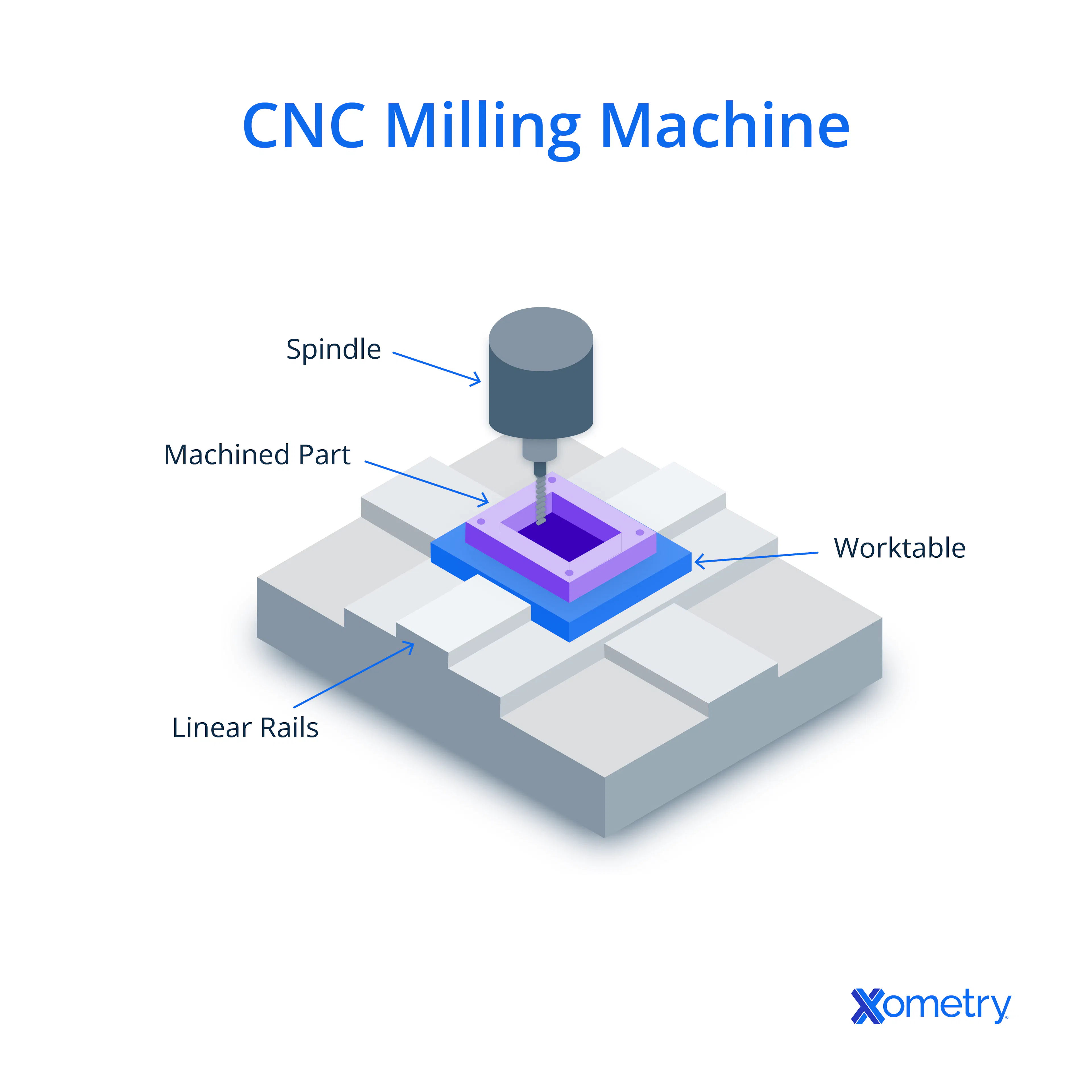
- Spindle: Rotates the cutting tool at controlled speeds for material removal. The component is driven by a motor via belts or gears. High-quality bearings ensure the spindle remains stable during high-speed rotation.
- Worktable: Holds and positions the workpiece during the machining process. The table moves in the X and Y directions to guide the material. Clamping mechanisms secure the part to prevent movement during the operation.
- Column: Provides the primary structural support and rigidity for the machine. The component houses the driving mechanism and supports the spindle head. The heavy frame minimizes vibrations that affect the cutting accuracy.
- Knee/Bed: The knee (in knee-type machines) adjusts vertical positioning, while bed-type machines use a fixed table and moving spindle.
- Control System: Guides the tool and table movement through manual or automated inputs. The system manages the spindle speed and feed rate for the operation. Precision depends on the responsiveness of the control interface.
What Does a Milling Machine Diagram Show?
A milling machine diagram shows the internal and external components and their relationships, highlighting the spindle, worktable, column, and knee. It identifies the motor and drive system locations and illustrates the movement of the X, Y, and Z axes to help operators understand the machine. Feed mechanisms and control handles are clearly labelled for easy identification.
The diagram aids machinists in setting up the workpiece and tool, and assists maintenance teams in locating parts for repair or lubrication. It visualizes the relationship between the tool and workpiece, including coolant lines and safety guards. The diagram provides an overview of the machine architecture, essential for safe and accurate operation. It is a reference for milling tasks and supports the training of new operators, improving setup reliability.
Does a Milling Machine Diagram Include the Spindle and Worktable?
Yes, a milling machine diagram includes the spindle and worktable, which are the primary components. The spindle holds and rotates the cutting tool, while the worktable secures and moves the workpiece. The diagram shows their spatial relationship and how the table moves relative to the spindle. It depicts controls for adjusting their positions. Understanding these parts is crucial for setting up milling operations. The diagram provides a clear view of how the tool interacts with the material and helps troubleshoot movement or alignment issues. Safety features near the components are typically shown. The diagram is important for machine shop education, as understanding machine layout supports proper setup and operation.
Milling is a fundamental machining process that serves as the backbone of material removal in manufacturing. Its primary strength lies in efficiently generating part geometry while maintaining acceptable precision across a wide range of materials. The process is highly versatile and scales from manual setups to fully automated CNC systems. However, its reliance on mechanical cutting introduces inherent limitations such as tool wear, heat generation, and cutting forces that affect accuracy and tool life. As a result, milling is best suited for bulk material removal and external feature creation rather than highly intricate or delicate geometries. In practice, its value is defined not just by capability, but by where it fits in the overall manufacturing sequence. When applied within these boundaries, milling remains one of the most efficient and dependable processes in precision engineering.
What is a Milling Cutter?
A milling cutter is a rotating multi-edge tool used for subtractive material removal. The milling cutter has sharp teeth to shave off chips as the cutter spins, with each tooth acting as a separate cutting edge for high-speed operation. The cutter is mounted on the spindle and moved across the workpiece surface. Milling cutters come in various shapes (cylindrical, conical, spherical), and the material (carbide, high-speed steel, ceramics) depends on the workpiece hardness. The number of teeth affects surface finish and feed rate. The cutter performs tasks such as slotting, facing, and profiling; drilling is typically performed by drills, though milling can create holes via interpolation. Its tooth geometry determines the type of chip produced. High-quality cutters resist heat and wear, and their sharpness and accuracy are crucial for precision machining. The cutter is a consumable part, requiring replacement or sharpening. Efficiency and reliability are key to maintaining production standards.
How Does a Milling Cutter Perform Cutting Operations?
A milling cutter performs cutting operations by rotating at high speeds, engaging the material with multiple teeth. The spindle, driven by the motor, spins the tool while the workpiece moves into its path. Each tooth shears a small amount of material, generating heat and chips, which are evacuated from the cutting zone.
The rotation speed and feed rate determine chip thickness, and cutting can occur in the same direction as the feed (climb milling) or against it (conventional milling). Sharp tool edges ensure clean, precise material removal, with coolant applied to protect the tool and improve surface finish. The tool geometry defines the final shape of the feature, and machine stability prevents tool vibration during operation. The process continues until the desired dimensions are achieved, with accuracy dependent on the interaction between the cutter and material. The mechanical force enables the shaping of hard metals.
Are Milling Cutters Available in Different Shapes and Sizes?
Yes, milling cutters are available in different shapes and sizes to suit different machining needs. End mills (flat, ball nose, bull nose) are used for internal pockets and contours, while face mills, with larger diameters, clear material from flat surfaces. Slotting cutters create narrow grooves or keyways, and specialized cutters (t-slot, dovetail, woodruff) handle unique shaping tasks. The tool's diameter determines the size of the features it can create, with length variations offering deep reach or high rigidity for shallow cuts. Small-diameter tools are used for intricate details, while large tools are preferred for rapid material removal. Material coatings (TiN, TiAlN) enhance cutter durability. Tool selection depends on part geometry, material, and machining conditions; milling machines are versatile but not suitable for all machining tasks.
What Are the Main Parts of a CNC Machine Used in Milling?
The main parts of a CNC milling machine are listed below.
- Spindle: Rotates the cutting tool at controlled speeds for material removal. The component is the heart of the cutting action. High-precision bearings ensure stability during the rotation of the CNC Machine.
- Worktable: Holds and positions the workpiece along the X and Y axes. The table moves precisely according to the computer instructions. Fixtures are used to secure the part during high-speed operations.
- Column and Base: Provide the structural support and rigidity for the machine. The heavy frame dampens vibrations that could affect the surface finish. The base supports the entire weight of the equipment.
- Axis Drive Motors: Move the machine components along the X, Y, and Z axes. These motors receive signals from the controller for exact positioning. High-resolution encoders monitor the movement for accuracy.
- CNC Controller (Control Panel): Interprets the G-code and manages all machine operations. The interface allows the operator to monitor the process and make adjustments. The computer ensures the machine follows the pre-programmed toolpath.
- Automatic Tool Changer (ATC): Automatically switches cutting tools between different operations. The system increases efficiency by reducing the need for manual tool changes. A magazine holds various tools for the machining cycle.
How Do CNC Components Work Together in a Milling Machine?
CNC components work together through a central control system to execute a programmed toolpath. The controller processes digital code and sends signals to the axis drive motors, moving the worktable and spindle head to the exact coordinates. It adjusts the spindle speed for the specific cutting tool, and the tool changer selects and installs the required cutter.
Sensors provide real-time feedback to ensure accuracy, while the cooling system activates during cutting to manage temperature. The workpiece remains securely held, and the tool removes material. The coordination of movement and rotation enables accurate machining when proper setup, tooling, and parameters are applied. Automation enables continuous production with minimal human intervention, though operator oversight is still required. Reliability relies on the synchronization of all mechanical and electronic parts.
Do CNC Milling Machines Include a Spindle and Control Panel?
Yes, Computer Numerical Control (CNC) milling machines include a spindle and control panel as core components. The spindle provides rotational force for the cutting tools to remove material, while the control panel allows the operator to load programs and monitor the machine. The computer inside the panel interprets the G-code and directs the spindle’s actions, ensuring precision. These components work together to ensure accuracy, with spindle speed controlled through software settings on the panel. The control panel also displays diagnostic information and operational status. The components are essential for CNC milling, enabling controlled machining; high precision depends on overall system performance and process conditions.
How is CNC Programming Used in Milling Operations?
Computer Numerical Control (CNC) programming defines the toolpaths and cutting parameters to machine a part automatically. The process starts with a digital model in computer-aided design software, which is converted into instructions by computer-aided manufacturing software. The program controls the movement of the spindle and worktable, along with spindle speed, feed rate, and tool changes.
The program is uploaded to the machine controller for execution, ensuring each part is identical to the design. Simulations prevent tool collisions and errors, while the code optimizes material removal efficiency. Precision is achieved by following exact coordinates, allowing complex geometries that are impossible to machine manually. The method’s repeatability and accuracy make it the standard for modern industrial CNC programming.
What Role Does G-Code Play in CNC Milling?
G-code is the standardized programming language used to control Computer Numerical Control (CNC) milling machine movements. G-code consists of alphanumeric commands that specify tool movement, position, and feed rate (e.g., G01 linear interpolation, G02 circular interpolation). G-code also controls auxiliary functions like coolant and spindle start.
Each line of code represents a specific action, with the controller converting it into electrical signals for the motors. Proper G-code ensures high accuracy and speed, while errors can lead to tool breakage or damaged workpieces. Machinists may edit the code to optimize the process. Minor variations exist across CNC platforms, though the language remains universal. Accuracy in G-code is crucial for maintaining tight tolerances and automating complex manufacturing tasks.
Does CNC Milling Require Programmed Toolpaths for Accuracy?
Yes, CNC milling relies on programmed toolpaths to achieve the high accuracy required in modern manufacturing. The toolpath defines the exact route the cutting tool follows, ensuring it avoids obstacles and stays within dimensions. Without a program, the machine has no instructions for shaping the part.
The software maintains accuracy through precise coordinates and compensates for tool diameter and length. Programmed paths enable efficient creation of complex 3D shapes that are difficult or impractical to achieve manually. Movements are calculated to the thousandth of an inch for consistency, with the same program used for each part in a production run. Automation eliminates variability from manual adjustments, and the reliability of the process depends on the programming quality. Engineers use toolpaths to optimize operation time, with precision as the primary goal.
How Does Milling Differ from Grinding Machines?
Milling differs from grinding machines in terms of material removal methods and surface finish quality. Milling uses a rotating cutter with distinct teeth to remove large chips, making it faster for bulk material removal and rough shaping. Grinding, on the other hand, uses an abrasive wheel to shave off small particles, providing a finer surface finish with tighter tolerances. Milling creates distinct surface textures, while grinding produces smoother surfaces with higher precision. Milling tools are multi-point cutters (end mills, face mills), while grinding wheels are made of abrasive materials like aluminum oxide or silicon carbide. Milling is often used for shaping, while grinding machine is commonly used for finishing and precision work, especially on hardened materials.
What Are the Functional Differences Between Milling and Grinding?
The functional differences between milling and grinding lie in material removal rate and surface quality. Milling machines are designed for high-speed cutting, shaping part geometry and creating features (slots, holes, and pockets). Grinding focuses on surface refinement and precise final dimensions, with a much lower material removal rate.
Milling tools have a fixed number of cutting edges, while grinding wheels feature thousands of abrasive grains acting as tiny cutting points. Milling is effective for a wide range of materials, including hardened steels; grinding is commonly used for hard materials and finishing operations. The higher heat generated in grinding requires more effective cooling systems. Milling produces a rough surface requiring further processing, while grinding achieves a mirror-like finish and precise flatness. The choice between the two depends on the stage of the manufacturing process.
Is Milling Typically Used for Material Removal Rather Than Surface Finishing?
Yes, milling is typically used for material removal rather than surface finishing. The process shapes a raw block of material into a part, with high-speed cutters removing large amounts of material quickly. It defines the part's primary features and dimensions, with roughing and semi-finishing tasks being common.
Finishing passes improve the surface, though grinding achieves finer results. Milling leaves visible tool marks on the surface, requiring grinding or polishing for a smoother finish. The speed of milling makes it efficient for bulk shaping, focusing on geometric accuracy and volume removal. Milling operations aim to reach the target shape as quickly as possible, with high reliability for creating the structural form of the part. It remains the first choice in the early stages of fabrication.
How Does Milling Compare to Electrical Discharge Machining?
Milling and Electrical Discharge Machining (EDM) differ in material removal methods and the types of materials they handle. Milling uses physical contact and a mechanical cutting tool to remove material as chips, making it faster for removing large volumes from softer metals. EDM uses electrical sparks to erode material without contact, making it ideal for extremely hard materials that would wear out milling tools.
Milling requires the tool to be harder than the workpiece, while EDM works on any conductive material regardless of hardness. Milling applies mechanical force, which can deform thin parts, whereas EDM applies no mechanical force, preventing deformation. Milling is used for general shaping, while EDM is preferred for complex internal cavities. The Electrical Discharge Machining produces a characteristic surface finish that may require secondary finishing depending on application requirements.
What Are the Advantages of EDM Compared to Milling?
The advantages of Electrical Discharge Machining (EDM) has advantages such as machining complex shapes in hard materials, its limitations include slower material removal rates and the requirement for electrical conductivity. The advantages lie in machining complex shapes in hardened materials and creating sharp internal corners that milling cutters cannot achieve. EDM applies no mechanical stress to the workpiece, making it ideal for delicate, thin-walled components.
The process excels in producing molds and dies with intricate details, handling hardened tool steels and exotic alloys (tungsten carbide) with ease. The absence of physical contact eliminates tool deflection, and EDM provides a consistent surface finish, even in complex geometries and deep cavities where milling tools might vibrate. EDM is well-suited for small holes and fine features; it may be used as a primary or secondary process depending on application. The choice between EDM and milling depends on material hardness and part complexity.
Does EDM Remove Material Without Contact Like Milling Does?
Yes, Electrical Discharge Machining (EDM) removes material without contact, unlike milling, which uses a physical cutter. The process uses electrical discharges between an electrode and the workpiece to melt and vaporize the material, with dielectric fluid flushing away the particles. EDM has no mechanical contact, so there is no frictional tool wear, but electrode wear still occurs; deformation is minimized due to absence of cutting forces.
Milling relies on the physical strength of the cutter to shear material, while EDM uses electrical energy to erode material at a molecular level. EDM offers high precision and can access complex or hard-to-reach features, though accessibility depends on electrode or wire geometry. The absence of contact makes it ideal for fragile components, offering high accuracy without tool chatter or vibration. EDM remains a staple for specialized tools and die making.
How Does Milling Compare to Swiss Machining?
Milling is compared to Swiss Machining by how the workpiece is supported and the type of parts produced. The workpiece is clamped to a stationary or moving table, while Swiss machining uses a guide bush to support the workpiece near the cutting tool. Swiss machining is ideal for long, slender, small-diameter parts, whereas milling is better suited for larger parts and broader geometries (rectangular blocks and plates).
Swiss machines are lathes with milling capabilities, providing high concentricity and precision on small components, under 1.25 inches in diameter. Milling machines move the tool or table across a wide area, while Swiss machines move the material through the headstock. Swiss machining excels in the high-speed production of small parts, while milling can handle much heavier workpieces(weighing hundreds of pounds).
Which Parts are Better Suited for Swiss Machining than Milling?
Yes, the parts that are better suited for Swiss Machining than milling are the guide bush support, which prevents bending during cutting, providing high concentricity that is difficult to achieve with a standard mill. Swiss machines perform turning and milling operations in a single setup, reducing production time. The method excels in high-volume production of small precision parts, making it essential for industries (medical and electronics). Milling is better for wider parts or with a low length-to-diameter ratio. Swiss machining applies cutting force close to the support point, ensuring reliability and precision for small parts, with the choice of method depending on part dimensions and required tolerance.
Is Swiss Machining More Suitable for Small Diameter Precision Parts?
Yes, Swiss machining is more suitable for small-diameter precision parts, due to the unique guide bush support that significantly reduces vibration and deflection. The design allows the material to be machined close to the support point, achieving tighter tolerances than standard machining methods. Swiss lathes specialize in parts 32 mm or less and perform multiple operations (drilling, threading, milling) simultaneously.
The process ensures consistent accuracy even for slender components. Swiss machining is used for high-precision instruments and connectors, with automated systems allowing lights-out manufacturing. Swiss machines provide better surface finishes on small cylindrical surfaces, with the guide bush's stability being key to its precision. The reliability in producing tiny components makes Swiss machining important in the precision manufacturing industry.
How Does Milling Handle Superalloys Like Inconel®?
Milling handles superalloys like Inconel® by using specialized tooling and controlled cutting parameters. The materials that are known for high strength and heat resistance, are difficult to machine with standard high-speed steel tools.Carbide or ceramic cutters are used to withstand extreme conditions. The process requires slower cutting speeds to avoid excessive heat buildup, and high-pressure coolant is necessary to protect the tool and evacuate chips. Tool wear is inevitable, and the machine must be rigid to prevent vibration during aggressive cutting. Strategic toolpaths help manage heat and prolong tool life. Engineers prefer the method for aerospace and gas turbine components, maintaining accuracy by monitoring tool wear and making adjustments. The material properties of Inconel Alloy require a careful machining approach.
What Tools and Settings Are Required to Machine Superalloys?
Machining superalloys requires high-performance tools and precise settings to manage material hardness. Carbide tools with coatings of Aluminum titanium nitride and Titanium aluminum nitride coatings (AlTiN or TiAlN) are commonly used for heat resistance and friction reduction. Ceramic tools are also employed for high-speed roughing of nickel-based alloys.
Spindle speeds are lower than for standard steel to minimize heat, and feed rates must be consistent to avoid work hardening. High-pressure coolant systems assist with chip evacuation and temperature control. The machine must provide high torque and rigidity to handle cutting forces. Toolpaths often use controlled depth of cut and engagement depending on strategy; in superalloys, moderate engagement and avoiding dwell are critical, and tool geometry (including rake angle) is optimized to balance strength and cutting efficiency. Regular tool inspections are necessary for part quality, and machining technology continues to evolve with improved coatings. Reliability depends on the proper combination of tool and machine settings for machining superalloy material.
Do Superalloys Require Harder Cutting Tools Than Standard Steel?
Yes, Superalloys require harder cutting tools than standard steel due to their extreme heat and wear resistance. Superalloys ( Inconel® and Hastelloy®) quickly dull high-speed steel and basic carbide tools due to their high nickel and cobalt content, while standard steel undergoes machining effectively with those tools. Carbide tools designed for the alloys feature advanced grain structures for toughness, and coated tools provide a thermal barrier between the chip and the cutter. Ceramic cutters, which maintain hardness at high temperatures, are also used.
The tool must remain harder than the material at red-hot temperatures. Using the wrong tool causes rapid failure and damaged parts. Specialized tools cost more than standard ones, yet precision machining of superalloys depends on tool integrity and durability. Manufacturers invest in high-quality tooling for challenging applications, and the process remains complex but achievable with the right equipment applied to superalloys and Steel metal.
What Safety Precautions Should Be Taken While Operating a Milling Machine?
The safety precautions that should be taken while operating a Milling machine are the steps listed below.
- Wear safety glasses. Protect the eyes from flying metal chips and coolant spray. The glasses must have side shields for maximum protection. High-velocity chips can cause permanent eye damage during the operation.
- Secure the workpiece properly. Ensure the part is firmly clamped in a vice or on the table. A loose workpiece can be thrown from the machine at high speeds. Stability prevents tool breakage and potential injury to the operator.
- Keep your hands away from the rotating cutter. Never reach into the machining area while the spindle is turning. The sharp teeth of the cutter cause severe lacerations instantly. Wait for the tool to stop completely before making any adjustments.
- Remove loose clothing/jewelry. Avoid wearing anything that could get caught in the rotating spindle. Loose sleeves, ties, or necklaces are major safety hazards. Keep long hair tied back and away from the moving parts.
- Use correct speeds and feeds. Prevent pushing the machine beyond its designed limits. Incorrect settings lead to tool failure and flying debris. Following the recommended parameters ensures a safe and stable machining process.
What Steps Ensure Operator and Machine Safety During Milling?
The steps that ensure operator and machine safety during milling are listed below.
- Inspect the machine before use. Check for loose bolts, damaged guards, and proper lubrication. A well-maintained machine is less likely to fail unexpectedly. The inspection ensures all safety features are functional.
- Clamp the workpiece firmly. Use the correct fixtures and tighten all clamps securely. The force of the rotating cutter is on an improperly secured part. Secure clamping is the foundation of a safe operation.
- Check tool tightness. Ensure the milling cutter is properly seated in the collet or tool holder. A loose tool can be ejected from the spindle during high-speed rotation. Proper installation prevents tool damage and accidents.
- Use guards and coolant properly. Keep all machine guards in place to contain chips and spray. The coolant should be directed at the cutting zone to prevent fire and smoke. Guards act as a physical barrier between the operator and the hazard.
- Stop the machine before adjustments: Turn off the spindle and wait for it to stop before measuring or moving the part. Making changes while the tool is moving is the leading cause of shop injuries. The practice ensures the operator remains in control of the situation.
Is Wearing Protective Gear Mandatory While Operating a Milling Machine?
Yes, wearing protective gear is mandatory when operating a milling machine to ensure safety. Safety glasses with side shields protect the eyes from high-speed metal chips. Hearing protection is recommended or required depending on noise levels and regulations; steel-toed boots protect against falling objects and sharp debris. Gloves should not be worn while the machine is running to avoid entanglement in the spindle. Protective gear shields the body from flying debris and accidental contact with moving parts. Machine shops enforce strict safety equipment policies, reducing the risk of long-term health issues (hearing loss). Personal safety is everyone's responsibility, with safety gear providing essential defence in a hazardous environment. Health and safety take priority over accuracy and productivity, with reliability in the shop starting with a commitment to safety.
How Xometry Can Help
Xometry works with more than 5,000 manufacturing partners, so whatever material or service you need, including CNC milling, we’ll be happy to help. You can either reach out to one of our reps, or get started straight away by uploading your designs to the Xometry Instant Quoting Engine®.
Copyright and Trademark Notice
- Delrin® and Kevlar® are registered trademarks of DuPont.
Disclaimer
The content appearing on this webpage is for informational purposes only. Xometry makes no representation or warranty of any kind, be it expressed or implied, as to the accuracy, completeness, or validity of the information. Any performance parameters, geometric tolerances, specific design features, quality and types of materials, or processes should not be inferred to represent what will be delivered by third-party suppliers or manufacturers through Xometry’s network. Buyers seeking quotes for parts are responsible for defining the specific requirements for those parts. Please refer to our terms and conditions for more information.