
Ceramics: Definition, Properties, Types, and Applications


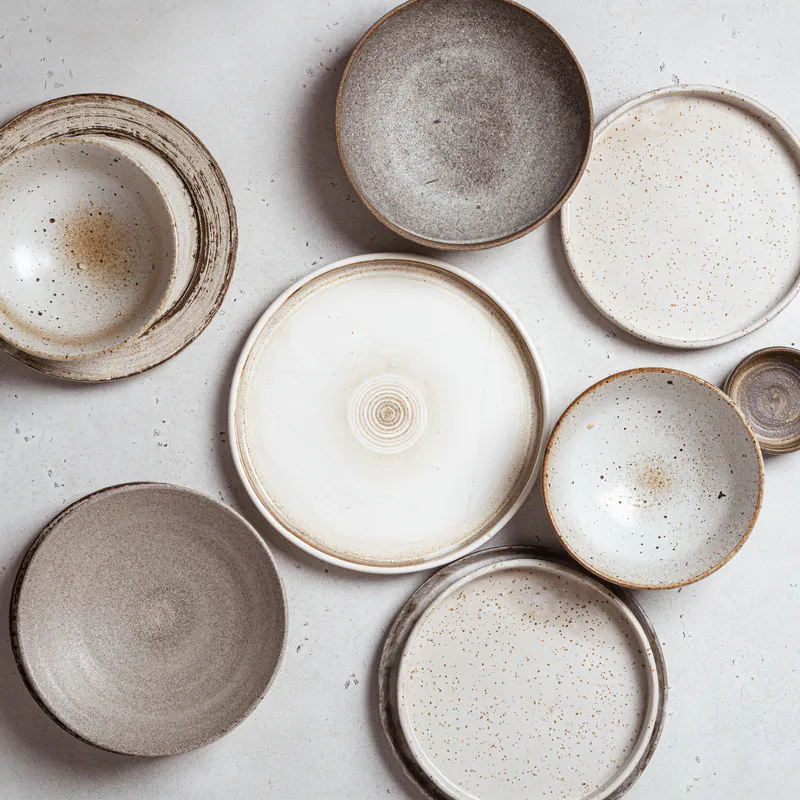
You are most likely familiar with the term “ceramics” but this class of material goes beyond pottery. In fact, ceramics are widely used to make components in the aerospace industry thanks to their many benefits. These include durability, strength, hardness, wear resistance, and electrical and thermal insulation. They also offer chemical stability.
Read on to find out more about exactly what ceramics are, the different types available, their properties, and how they’re being used in aerospace and 3D printing.
What Are Ceramics?
The term, “ceramic materials,” is a wide-ranging category largely defined by a lack of organic substances (those based around carbon-hydrogen bonds) and metallic elements. Absent those components, ceramics may be composed of: clay, minerals, oxides, and other compounds. Ceramics are basically what is left over after organic and metallic materials have been removed. Common ceramics are tiles, bricks, plates, glass, and toilets.
Ceramics are a refractory material, which means they are durable and able to withstand high temperatures. They also resist high pressures and most chemical compounds and are generally poor electrical conductors. Most ceramics are non-magnetic. Some ceramics shatter easily, while others are very tough.
There are two ceramic categories—traditional and modern. Traditional ceramics are things like pottery, and modern ceramics are a more advanced material category that are specially engineered to have specific properties. Many, for example, are meant to be hard and durable. Ceramics are typically shaped at moderate temperatures and then heated or “fired” at high temperatures to create hard, durable materials that resist heat, wear, and corrosion. The material is considered to be ceramic once it is no longer soluble in water even if heated.
It is important here to differentiate between water solubility and porosity. Some ceramics are still porous, meaning that they will still absorb water, but they are not water-soluble. Ceramics can be found in a wide variety of products and applications including tiles, bricks, engineering ceramics used in electronic devices, and aerospace components. We’ll talk a bit more about the two different ceramic types a little further down.
Is Ceramics the Same as Pottery?
It’s easy to get the two confused, but the answer is no; ceramics are not the same as pottery. Although the terms are often used interchangeably, pottery is simply a subdivision of “ceramics”. The term “ceramics” is the rather broad umbrella term for many different materials and products made from non-metallic and inorganic substances, like bricks and cement.
Common ceramic pottery items include mugs, cups, vases, and bowls, or any type of functional container made of clay. You can also find ceramic sculptures and other artistic designs in pottery. Pottery is actually thought to be the oldest form of ceramics, which is likely why it is referred to as “traditional ceramics”.
What Are Ceramics Made Of?
Ceramics are made from many different substances and are usually a mix of clay, water, powders, and earthen elements. The materials and ratios vary depending on the ceramic product being made and what characteristics it’s supposed to have. For example, some are made from pure clay, while others could also include feldspar, silica, or other additives to enhance their properties.
In general, to make ceramics, the materials are combined, and then molded into the desired shape. They are then fired in a kiln or other special piece of equipment for completion. Advanced ceramics intended for specialized applications may be made from more exotic materials such as tungsten carbide, or zirconia.
What Are the Properties of Ceramics?
The properties of ceramics, like those of any material, depend on the types of atoms involved, the bonds between them, and their arrangement. This is referred to as the atomic structure of a material and is what will determine its characteristics. Ceramic materials tend to be:
- Harder and more brittle than metals
- Wear-resistant
- Refractory
- Good thermal and electrical insulators
- Nonmagnetic
- Oxidation-resistant
- Chemically stable
Let’s consider the mechanical and chemical properties of ceramics in more detail below:
What Are the Mechanical Properties of Ceramics?
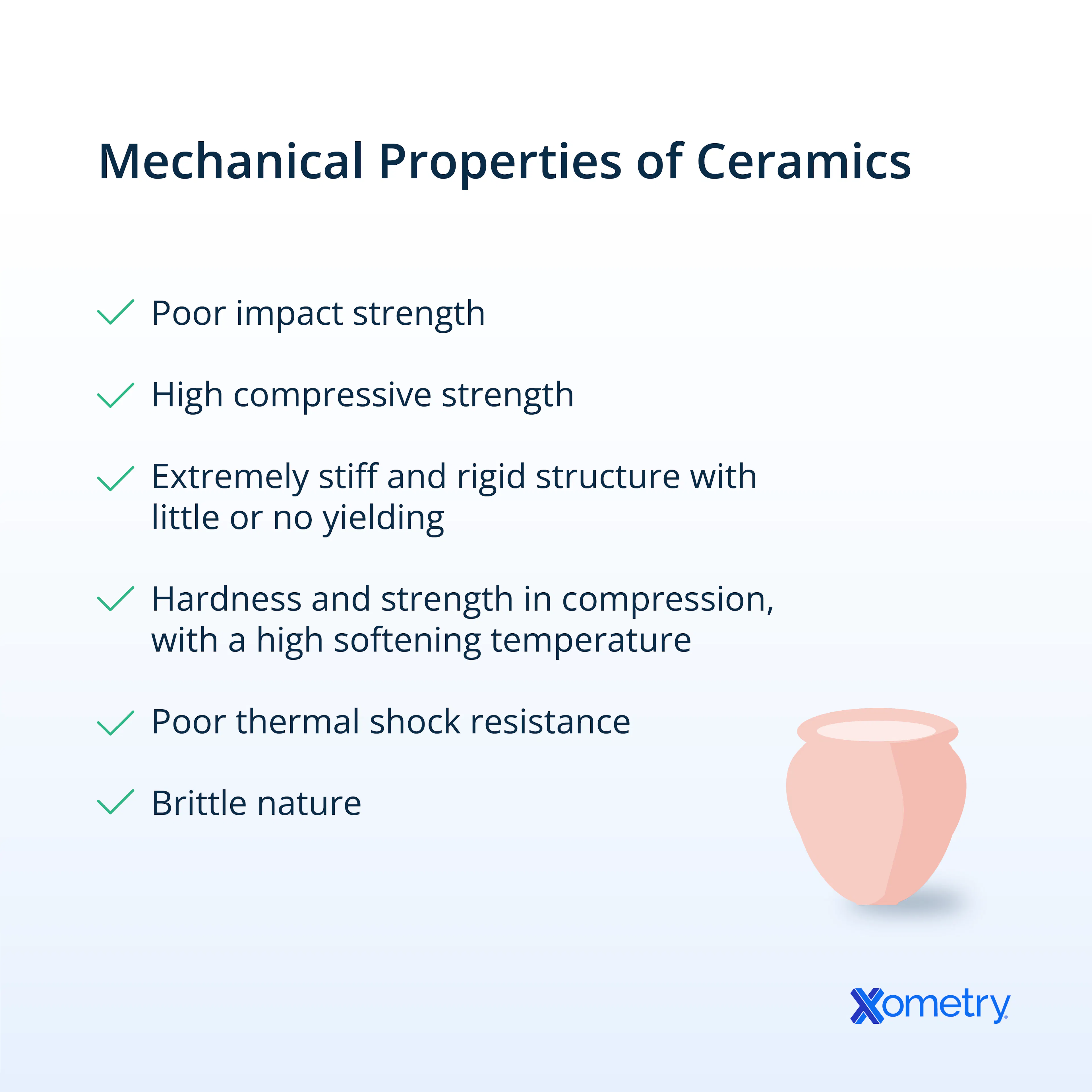
The mechanical properties of ceramics include:
- Poor impact strength
- High compressive strength
- Extremely stiff and rigid structure with little or no yielding
- The presence of microcracks can cause local stress concentrations and brittle fracture
- Hardness and strength in compression, with a high softening temperature
- Poor thermal shock resistance
- Brittle nature
Shane Felton, a Manager, Solutions Engineering here at Xometry said, "There are many types of advanced ceramic materials available depending on the mechanical properties required for the part in question. First, pick the best manufacturing process and material grade for your application - typically, this will be either 3D Printing or CNC Machining. If you choose a material that needs to be machined, ensure that the material is readily available in the size required to make the part. If you choose a carbide material or another advanced ceramic, keep in mind that these materials are more difficult to machine than most materials, and EDM is commonly used. So, designing the part to be Wire EDM friendly can be key."
"There are many types of advanced ceramic materials available depending on the mechanical properties required for the part in question. First, pick the best manufacturing process and material grade for your application - typically, this will be either 3D Printing or CNC Machining."
What Are the Chemical Properties of Ceramics?
Compared to most engineering materials, most ceramics are very chemically stable. They inherently resist chemical reactions and corrosion. Ceramics are also generally inert and do not react with acids or bases. Having said that, the chemical properties of ceramics can vary depending on their type and composition.
For instance, some may be prone to corrosion or degradation under certain conditions, while others can survive a chemical attack. There are also ceramics with unusual chemical properties such as the ability to conduct electricity or act as catalysts. The chemical behavior of ceramics can be summarized as follows:
- Mostly resistant to chemical attacks (i.e., by gasses, liquids, and even high-temperature melts)
- Generally inert and non-reactive with acids or bases.
What Are the Different Types of Ceramics?
As briefly touched upon, ceramics tend to fall into two categories—traditional and advanced. Traditional ceramics are made from natural materials like feldspar, quartz, and clay, in a wet molding process. Each of these ceramics is known for its ability to serve specific purposes, such as permeability, magnetism, insulation, and conductivity. Their structure depends on the clay’s composition. This means that they’re not as perfectly structured as advanced ceramics which have a uniform microstructure. Traditional ceramics are mainly used in daily household items, such as jugs, vases, pots, planters, kitchen and tableware, as well as building materials.
Now advanced ceramics are a whole different ballgame as they are specially designed and engineered for high-performance use so they’re made to be hard-wearing, strong, extremely tough, and able to resist heat and chemicals. They’re usually made from a mix of high-purity synthetic powders like aluminum oxide, silicon carbide, and silicon nitride. To create the final product, the materials are processed using specialized techniques to give them their durable properties.
There are many different materials and ceramic types that fall under the traditional and advanced categories. We’ll discuss some of them below, referring to traditional ceramics as “pottery” while we compare them to advanced ceramics.
Advanced Ceramics
Some common types of advanced ceramics are listed below:
1. Silica
Silica, or SiO2, is renowned for its impressive thermal shock resistance and leachability. It is a popular choice for aerospace and energy applications for the production of investment casting shells and cores.
2. Tungsten Carbide
Tungsten carbide is known for its ability to maintain its properties at high temperatures. The material Tungsten carbide often gets mixed with high percentages of a metal binder, such as cobalt or nickel, which is used as a second metallic phase to form materials known as "cermets." Pure tungsten carbide can also be produced as an advanced technical ceramic using a high-temperature hot isostatic pressing process. Thanks to its hardness and wear resistance, this material is used to make products that need to be extra strong, like cutting tools, and abrasive water jet nozzles. However, its weight can limit its use in certain applications.
"Xometry provides ceramic parts to customers quite often through 3D Printing (SLA Accura Bluestone, SLA Somos perFORM) or CNC Machining. Typically, we CNC machine “easy-to-machine” unfired or semi-fired ceramics like Macor for customers needing parts with excellent thermal insulation properties and high hardness. We also regularly use Wire EDM on advanced ceramics like Tungsten Carbide."
3. Fire Bricks
Fire bricks fall under the category of “refractory materials” meaning that they are resistant to both extremely high temperatures and chemical attacks, and won’t crack or break down when exposed to either. Their low thermal conductivity makes them naturally energy-efficient, which is why they are the preferred go-to for lining furnaces, fireboxes, fireplaces, and kilns, as well as other applications where resistance and durability is important. Fire bricks are most often made from a mixture of clay and other materials, and are used in lots of industrial applications, like steelmaking, glassmaking, and ceramics.
4. Bone China
Also known as fine china (the type you’ll find in a fancy restaurant), bone china is a porcelain variety famed for its strength, chip resistance, and translucency. It was first made in the 1800s by an English ceramicist, Josiah Spode. This type of ceramic is made from bone ash, kaolin, and feldspathic material. As it’s highly durable, bone china can be molded into thinner shapes than porcelain can. It goes through several changes during production, but the differences in the material properties give it its final transparent look. The final product is elegant which, combined with its durability, makes it a common material for fine dinnerware, ornaments, and other decorative objects.
5. Silicon Carbide (SiC)
Silicon carbide, made from silicon and carbon atoms, is another advanced ceramic material with high chemical- and wear resistance, as well as great thermal conductivity. These properties make it ideal for use in thermal processing applications and advanced ceramics, like cutting tools, abrasives, and semiconductor devices. The process of making silicon carbide (or SiC) involves heating a mixture of sand (silicon dioxide) and petroleum coke (carbon) at a very high temperature.
6. Titanium Carbide
Used for cutting tools, wear-resistant coatings, and other applications that require extreme strength and hardness, titanium carbide is a type of advanced ceramic composed of titanium and carbon atoms. It’s usually made by heating a mixture of titanium dioxide and carbon at high temperatures. Titanium carbide is known for having stable properties even at high temperatures and in harsh environments.
7. Glass Ceramics
Glass ceramics are composite materials made by mixing tiny crystals into glass. They’re made slightly differently than the other advanced ceramics on our list; glass is heated to a high temperature and then quickly cooled down, giving it a crystalline aesthetic. This unique combination of amorphous and crystalline states makes for customizable properties. Many varieties are especially known for their high strength, toughness, and resistance to thermal shock.
They were initially developed for the mirrors and mounts of astronomical telescopes. Glass ceramics have gained wider popularity, though, and are now found in everyday products such as cooktops, cookware, bakeware, and high-performance reflectors for digital projectors.
8. Porcelain
Porcelain is made from a fine white clay called kaolin, which is known for its fine particle size and high plasticity. Typically white or translucent, porcelain is hard, strong, and durable. To make porcelain, the clay mixture has to be fired at high temperatures of around 1200 to 1450 °C, making the clay non-porous. Porcelain is often used for decorative or fine art objects and practical items such as dinnerware, electrical insulators, and dental implants.
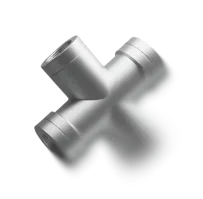
"The main benefits of ceramics over metals and plastics are the extraordinary combination of great thermal / electrical insulation properties with high hardness and wear resistance."
Pottery Ceramics
Pottery ceramics, otherwise referred to as traditional ceramics, can be divided into three categories—porcelain, stoneware, and earthenware.
1. Porcelain
Porcelain is made from a specific type of clay called kaolin, which is known for its fine particle size and high plasticity. Porcelain is typically white or translucent in appearance. It is known for its hardness, strength, and durability. It is fired at a high temperature, usually between 1200 and 1450 °C, which causes the clay to vitrify and become non-porous. Porcelain is often used for decorative or fine art objects and practical items such as dinnerware, electrical insulators, and dental implants.
2. Stoneware
Stoneware ceramic materials are made from a mixture of clay and other materials such as feldspar, quartz, and bone ash. It is typically fired at a high temperature(1200-1300 °C), which causes the clay to become vitrified and non-porous. Stoneware is known for its strength, durability, and resistance to chipping and scratching, and is often used for practical items such as dinnerware, bakeware, and pottery.
3. Earthenware
Earthenware is made from clay and fired at a lower temperature than other types of ceramics — typically below 1180 °C. This results in a porous material that is less durable than stoneware or porcelain, but which has a unique, rustic appearance. Earthenware is often used for decorative pottery, vases, and figurines, as well as for practical items such as flower pots and cookware. It can be glazed or left unglazed and is often decorated with colored slips, underglazes, or painted designs.
What Are the Different Advanced Applications of Ceramics?
Advanced ceramics are used in various industries for many different applications. Just some of them are:
- Aerospace: Many high-temperature aerospace components, including turbine blades, heat shields, and nose cones, are made using advanced ceramics. Until recently, conventional manufacturing has been used to shape these parts, but a much easier method is getting increasingly popular—3D printing.
- Biomedical: Ceramics show up in medical implants due to their biocompatibility, strength, and wear resistance.
- Electronics: Electronic devices receive ceramic components because of the material’s electrical insulation properties and ability to dissipate heat.
- Energy: Thanks to their thermal stability and heat resistance, ceramic materials are being used in various energy applications, such as fuel cells, solar panels, and thermal insulation.
How Is 3D Printing Being Applied to Create Aerospace Parts Made from Ceramics?
3D printing presents a potential way to create complex and detailed parts that cannot be achieved using traditional machining or molding techniques. There are several 3D printing processes available for ceramics, including stereolithography (SLA), selective laser sintering (SLS), material jetting, laminated object manufacturing (LOM), and fused deposition modeling (FDM). Each process requires a different form of ceramic feedstock. For example, SLA printers use ceramic slurry or paste as feedstock, which is a mixture of photosensitive resins and ceramic powder. Ceramic components are built up by successive layers using a laser to polymerize the paste, after which the parts are subjected to heat treatment for debinding and densification.
Other related technologies that use ceramic pastes or slurries include direct light printing (DLP) and lithography-based ceramic manufacturing (LCM) technology. A ceramic powder can also be used in material jetting printers, while solid ceramic filament can be used for LOM and FDM. Of these processes, stereolithography or related photopolymerization techniques are the most common because they can achieve smooth surface finishes. For more information, see our How Does 3D Printing Work guide.
What Are the Advantages of 3D Printing to Create Aerospace Parts from Ceramics?
Printing 3D aerospace parts has some distinct advantages over making them via conventional manufacturing methods:
- Design Flexibility and Innovation: One of the key benefits of additive manufacturing is the ability to create complex parts, geometric shapes, and patterns. This is more critical for ceramic materials than others because these ceramics are more difficult to shape.
- Time and Cost Savings: Production using additive manufacturing is often cheaper and requires less lead time than other methods.
- Replacement Parts with Better Properties: 3D-printed ceramic parts are now being used to replace polymer or metal components. In some cases, the materials are selected not for their properties, but because they are easier to shape using a printer.
- Material Availability and Environmental Impact: Ceramic materials are readily available, can be locally sourced, and are environmentally friendly.
What Are Examples of 3D Printed Materials Made from Ceramics for Aerospace?
A few 3D-printed ceramic materials show up more often than others in aerospace components. Here are some of the most common:
- Silica: Silica is known for its remarkable thermal shock resistance and leachability, making it a popular choice for the investment casting of aerospace shells and cores.
- Alumina: This is a ceramic material with high stiffness and strength, excellent wear resistance, and good chemical resistance. It is used in high-temperature electrical insulation, engine components, and cutting tools.
- Silicon Nitride: This ceramic material has excellent thermal shock resistance, high strength, and good toughness. Turbine blades, cutting tools, and wear-resistant parts get made from silicon nitride.
- Zirconia: This is a ceramic material with high strength, toughness, and wear resistance. It is used in cutting tools, thermal barrier coatings, and engine components.
- Glass-ceramics: These are formed by the controlled crystallization of glasses. They have good mechanical properties, excellent thermal stability, and low thermal expansion. They are used in applications such as optical components and high-temperature sensors.
Are 3D Printed Ceramics tested for Ductility?
No, 3D-printed ceramic parts are not usually tested for ductility. Ceramics are non-ductile in general and therefore are not normally selected when a ductile 3D-printed part is required.
Are 3D Printed Ceramics tested for Brittleness?
Yes, 3D-printed ceramics are usually tested for brittleness. Ceramics are known for being brittle, so printed parts need testing so engineers know they will meet their strength requirements. These tests should be performed on the part itself, as the design of the part, as well as printing and material parameters all play a role in the overall brittleness.
What Are the Benefits of 3D Printed Ceramics Over Metals?
3D-printed ceramics are preferable to metals in several ways, including:
- High-Temperature Resistance: Unlike metals, ceramics can withstand high temperatures without melting, or losing their strength and shape.
- Lightweight: Making them perfect for use in aviation, ceramics are generally lighter than metals (per unit volume).
- Corrosion Resistance: Many metals have the tendency to oxidize quickly, but ceramics are highly resistant to corrosion.
For more information on the properties and uses of semimetals, you might want to read our What Are Metalloids guide.
What Are the Advantages of 3D Printed Ceramics Compared to Plastics?
3D printed ceramic parts are better than plastics in many ways. Here are just a few:
- Higher Temperature Resistance: Ceramics can withstand much higher temperatures than plastics. Even polyimides, which are considered to have the strongest resistance to heat among plastics, will start to melt around the 400°C mark. This pales in comparison to ceramics’ 1200°C to 2800°C.
- Greater Strength and Durability: Ceramics are, in general, much stronger and more durable than plastics.
- Better Chemical Resistance: Ceramics are less likely to react with chemicals than plastics are.
- Longer Lifespan: All the above factors combined make ceramic a more durable material, with a longer life than plastic.
Summary
We hope you enjoyed our article on the different types, properties, and benefits of both traditional and advanced ceramics, and how they’re used in industry—particularly in aerospace. To learn more about ceramics, please feel free to contact a Xometry representative.
Xometry provides a wide range of manufacturing capabilities and other value-added services for all of your prototyping and production needs. Visit our website to learn more or to request a free, no-obligation quote.
Disclaimer
The content appearing on this webpage is for informational purposes only. Xometry makes no representation or warranty of any kind, be it expressed or implied, as to the accuracy, completeness, or validity of the information. Any performance parameters, geometric tolerances, specific design features, quality and types of materials, or processes should not be inferred to represent what will be delivered by third-party suppliers or manufacturers through Xometry’s network. Buyers seeking quotes for parts are responsible for defining the specific requirements for those parts. Please refer to our terms and conditions for more information.