Polycarbonate 3D Printing: Definition, Purpose, How It Works, Advantages, and Examples


Polycarbonate is a plastic that—more specifically—falls under the thermoplastic category, meaning it’s pretty fantastic at melting down and hardening over and over again. Interestingly enough, this makes for a material that’s well equipped to go through the 3D printing process. Not only that, but it’s renowned for being durable and having a decent heat tolerance and chemical resistance.
If polycarbonate has caught your attention as a potential candidate for whatever types of products you’re creating with additive manufacturing, we have created a helpful explainer below that goes through exactly what this process entails and what its benefits (and limitations) are.
What is Polycarbonate 3D Printing?
Polycarbonate, or PC for short, is the material that’s used in this style of printing, and it’s usually a go-to choice for fused deposition modeling (FDM) printing systems, which layer up the material to build up several layers until your shape is finished.
The reason why polycarbonate has earned its spot in the 3D printing world is because of its useful characteristics that make it easy to work with and functional once the 3D object is printed out. It has a tensile strength of 70 MPa and a yield strength of 63 MPa—which, for context, is far higher than concrete. It also holds onto its structural integrity at high heats (up to 150 ℃). Understandably, these impressive feats have made it a staple of many industries, including aerospace and medical fields, but we’ll delve into applications later.
What Is Polycarbonate 3D Printing Also Known As?
Polycarbonate 3D printing is also commonly referred to as PC 3D printing or PC filament 3D printing.
What Is the Purpose of Polycarbonate 3D Printing in Manufacturing?
The purpose of polycarbonate 3D printing in manufacturing is to harness the exceptional mechanical properties and thermal stability of PC through additive manufacturing techniques. Polycarbonate 3D printing allows for the creation of intricate geometries and complex internal structures that might be challenging or impossible to achieve through traditional manufacturing methods. This is particularly valuable for producing components with internal channels, lattice structures, or intricate designs that serve specific functions. Additionally, the additive nature of 3D printing enables rapid customization and the production of low-volume batches without significant setup costs. Finally, 3D printing PC allows for the quick iteration of designs with the same material that will be used for the final product. This helps in fine-tuning designs and assessing performance without the need for transitioning between different materials and manufacturing techniques.
What Are the Industries That Use Polycarbonate 3D Printing?
Polycarbonate finds application in a wide range of industries. The main industries that use polycarbonate include: aerospace, automotive, consumer goods, electrical devices and electronics, and medical devices. For example, polycarbonate proves to be an appropriate choice for applications within the electrical and automotive sectors due to its remarkable flame retardancy, heat resistance, light weight, and insulating properties. These applications encompass electrical housings, light fixtures, and even headlights in vehicles. Polycarbonate's transparent and shatter-resistant nature also makes it an excellent fit for protective equipment. This is specifically important in the safety and construction fields, where it is used in safety goggles and window materials.
How Does Polycarbonate 3D Printing Work?
If you’re curious about what the polycarbonate 3D printing process involves, we’ve broken down a general step by step below.
- For starters, you’ll need to design the 3D model you want to print through a computer-aided software program. This is what the printer will use as instructions so it can print exactly the dimensions, details, and shape you want.
- Then the preprocessing will start, which involves scaling, orienting, and positioning the model and ensuring that it’s correct and ready to be materialized with the help of a printer.
- Next, you’ll need to program the printer and get it prepped for its upcoming job. This can involve a variety of different tasks and jobs, including leveling the print bed, cleaning the nozzle, and setting the right parameters. In doing so, you’re making sure the print comes out successfully and won’t warp on the print bed—which polycarbonate is sometimes known to do.
- Once these steps are complete, the printing can finally begin. The nozzle or extruder will heat up the polycarbonate filament inside and then, following your 3D model, it’ll start moving around the print bed, depositing layers of the molten PC, which will fuse together and create your build.
- The last step has to do with post-processing and finishing, but will depend on the specific product that’s being printed and how much cleaning, sanding, and painting are needed. The bigger and more complex the build, the longer it may take to fully finish a print.
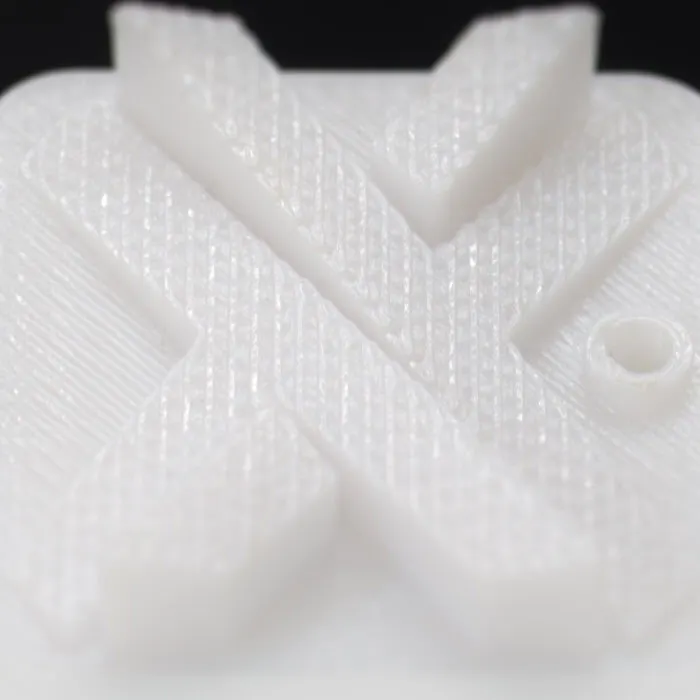
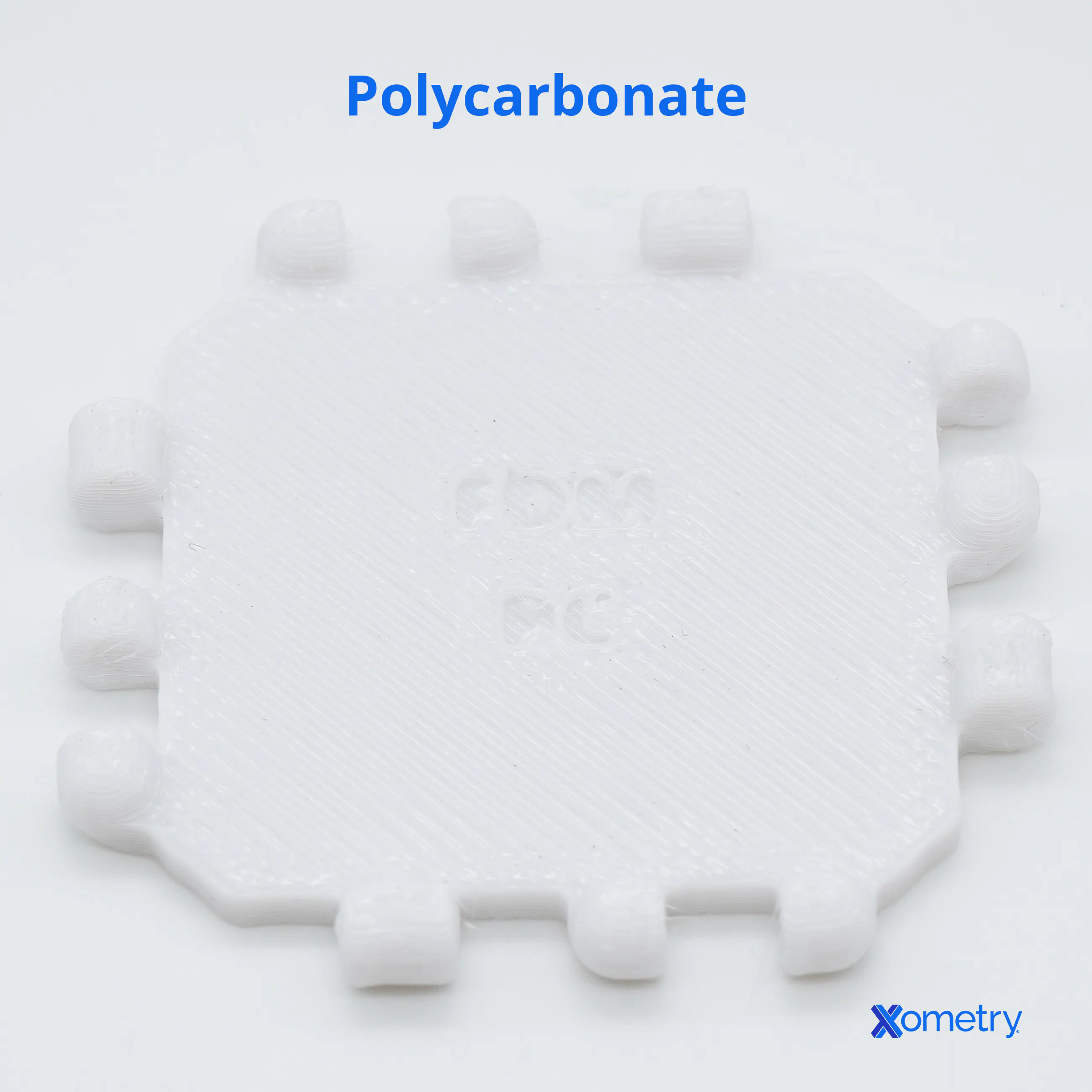
In the picture below, you can see an example of our Xometry logo that’s been 3D printed with polycarbonate.
What Is the Step-by-Step Process for Polycarbonate 3D Printing?
Polycarbonate 3D printing typically involves several key steps:
1. Design
The process begins with creating a digital 3D model of the desired object using computer-aided design (CAD) software. This model serves as the blueprint for the subsequent printing process, defining the shape, dimensions, and internal structures of the object. The 3D model is then divided into thin horizontal layers using slicing software. Each layer's specifications are generated, including the path the printer's nozzle will follow to deposit the material accurately.
2. Preprocessing
Once the design is complete, the 3D model is prepared for printing. This involves tasks like scaling, orienting, and positioning the model within the build volume. Additionally, support structures may be generated to provide stability for overhangs and intricate features during printing.
3. Printer Setup
Before printing, the 3D printer must be calibrated and prepared. This involves a series of essential steps to ensure optimal printing conditions. Firstly, it's crucial to confirm that the print bed is perfectly level. This step is particularly critical when working with materials that can be sensitive to bed adhesion, like polycarbonate. Polycarbonate's tendency to warp during printing can lead to challenges in maintaining consistent layer adhesion.
In addition to bed leveling, it's important to ensure that the nozzle is clean and free from any residue that could affect the extrusion process. Proper nozzle maintenance is essential for achieving accurate and high-quality prints. Furthermore, selecting the appropriate printing parameters is essential. For polycarbonate, in particular, precise temperature settings are crucial for both the extruder and the build chamber. Polycarbonate's relatively high glass transition temperature requires careful temperature management to prevent warping and ensure proper layer bonding.
4. Printing
The actual printing process begins with the 3D printer's extruder or nozzle heating the polycarbonate filament to its melting point. The nozzle then moves to the printing positions defined by the machine instructions, depositing the molten material layer by layer onto the print bed. As each layer is deposited, the molten polycarbonate fuses with the previously deposited layers, creating a strong bond between them. This layer-by-layer approach leads to the gradual construction of the final object.
Once all layers are printed, the object is allowed to cool and solidify completely. This can take varying amounts of time depending on the complexity and size of the print. Additional mechanisms may be employed to regulate temperature, including the use of fans or even a heated build chamber, in order to uphold the ideal printing conditions.
5. Post-Processing
Once printing and cooling are complete, the object is removed from the build plate. Post-processing might involve removing excess support material, cleaning the part, and addressing any imperfections on the surface. This will depend on the complexity of the design and the presence of support structures.
6. Finishing
Finishing steps may be necessary to achieve the desired appearance and functionality. This can include sanding to smooth surfaces, painting or coating for aesthetics, and adding any required assembly components.
What Are the Materials That Can Be Used in Polycarbonate 3D Printing?
You can, of course, just use regular polycarbonate for 3D printing, but there are a few other blends that might come in handy to know about as they offer different properties.
1. Polycarbonate
This pure form of PC is a top pick because of how strong it is and how much resistance it provides against heat, impact, and abrasion.
2. Polycarbonate/ABS Blends
Acrylonitrile butadiene styrene—or ABS—is another popular 3D printing filament, but you can find it mixed with polycarbonate, too. The result is a printable material that’s not too expensive and still has a decent amount of strength.
3. Polycarbonate/Carbon Fiber Composites
If you like the heat resistance of PC, but are looking for a little more strength and stiffness, you’ll want to consider this filament, which mixes polycarbonate’s thermoplastic characteristics with those of carbon fiber composites.
4. Polycarbonate/Fire-Retardant Blends
In instances where you build will be subject to flames, fire, or extreme heat, you might need more heat resistance than usual and a material that won’t go up in flames. The best filament for that is a polycarbonate that’s boosted with the help of fire-retardant additives.
5. Polycarbonate/Polyethylene Glycol Blends
Warping can be an issue with polycarbonate, but to prevent this, you can use a filament that has a mixture of PC and PEG. The most common use cases tend to be designs that have intricate details or geometries that are likely to become misshapen.

"When choosing polycarbonate materials for 3D printing, I focus on several factors."
Our very own Colton Bamford, an Additive Production Manager here at Xometry said, "When choosing polycarbonate materials for 3D printing, I focus on several factors. First, its high impact strength and durability make it ideal for tool-making and creating functional prototypes. Dimensional stability ensures the printed parts retain their shape and precision, which is crucial for manufacturing tools. Heat resistance and compression strength are important for applications such as metal-forming dies or validating tool designs before full-scale production. Finally, the cost-effectiveness of polycarbonate compared to other high-performance materials makes it a practical choice for low-volume end-use parts."
How Long Does It Take for Polycarbonate 3D Printing To Finish?
The time required to complete a polycarbonate 3D printing project can vary significantly based on a range of factors, including: the size and complexity of the object being printed, the layer height, print speed, density of infill, the 3D printer used, and the material’s unique requirements. As a general guideline, smaller and less complex objects may be completed within a few hours, while larger and more intricate designs could take several days. Many slicing software tools provide users with a rough "time to print" estimate based on the settings chosen, though this estimate should be viewed as an approximation rather than an absolute certainty.
How Much Does Polycarbonate 3D Printing Cost?
The cost of polycarbonate 3D printing is influenced by a range of variables, making its cost quite variable. The printing filament is a significant component of the total cost. Polycarbonate filament is expensive compared to other 3D printing materials. You can expect to pay around $30-$60 per spool of PC filament. Labor costs will include tasks such as printer setup, post-processing, and troubleshooting. Additional expenses stem from software and design tools, as well as finishing steps such as sanding, painting, or applying coatings.
Given all these factors, pinning down an exact cost for polycarbonate 3D printing without specific project details is challenging. A comprehensive cost assessment demands considering printer maintenance, energy consumption, labor, and supplementary processes.
Is Polycarbonate 3D Printing Expensive Compared to Die Casting?
It depends. Polycarbonate 3D printing can be more cost-effective for low-volume production runs, prototypes, and complex designs. It's advantageous for its design flexibility and rapid prototyping capabilities. Die casting, on the other hand, is more suitable for high-volume production due to lower material costs for bulk materials and the efficiency of batch processing.
What Are the Advantages of Polycarbonate 3D Printing?
Outside of its superb mechanical properties, polycarbonate makes a few other cases for why it’s such a good material to 3D print:
- PC products can be made to have a clarity and transparency that many other filaments can’t provide.
- It’s great when put up against high temperatures, chemicals, oils, and solvents.
- Polycarbonate is a useful electrical insulator.
- Compared to other materials, polycarbonate is pretty lightweight.
- You can also recycle PC.
What Are the Disadvantages of Polycarbonate 3D Printing?
There are also a few negatives to note when working with polycarbonate:
- It can have a higher cost than other filaments (but blends like PC/ABS can be more affordable).
- Polycarbonate has the tendency to absorb moisture from its surroundings, so it needs to be stored properly.
- Because of its heat resistance, polycarbonate needs to be used within a printer that can reach temperatures of at least 290 ℃ in order for it to successfully melt and funnel out.
- Polycarbonate tends to warp more than other materials, and without good temperature control, it may not adhere to the print bed very well.
- A lot of polycarbonate materials have BPA, which can be released during printing, so be sure to wear protective equipment like masks and work in a well ventilated room.
What Are Examples of Polycarbonate 3D Printing Products?
There are so many uses for polycarbonate 3D printed products, hence why the aerospace, automotive, medical, consumer and electronic industries all use them. We’ve listed out a few examples of items that can be produced this way:
- Light fixtures
- Vehicle headlights
- Safety goggles
- Window panes
- Carabiners
- Bike helmets
- Lenses for glasses
- Surgical guides
Frequently Asked Questions About Polycarbonate 3D Printing
How Xometry Can Help
Whether you’re interested in polycarbonate 3D printing or plastic 3D printing, our services at Xometry have you covered. Outside of plastic, we have a long list of other additive manufacturing capabilities that you can get an instant quote for, including selective laser sintering, carbon DLS, metal 3D printing, and plenty more.
Disclaimer
The content appearing on this webpage is for informational purposes only. Xometry makes no representation or warranty of any kind, be it expressed or implied, as to the accuracy, completeness, or validity of the information. Any performance parameters, geometric tolerances, specific design features, quality and types of materials, or processes should not be inferred to represent what will be delivered by third-party suppliers or manufacturers through Xometry’s network. Buyers seeking quotes for parts are responsible for defining the specific requirements for those parts. Please refer to our terms and conditions for more information.