SLS vs. SLA: Differences and Comparison


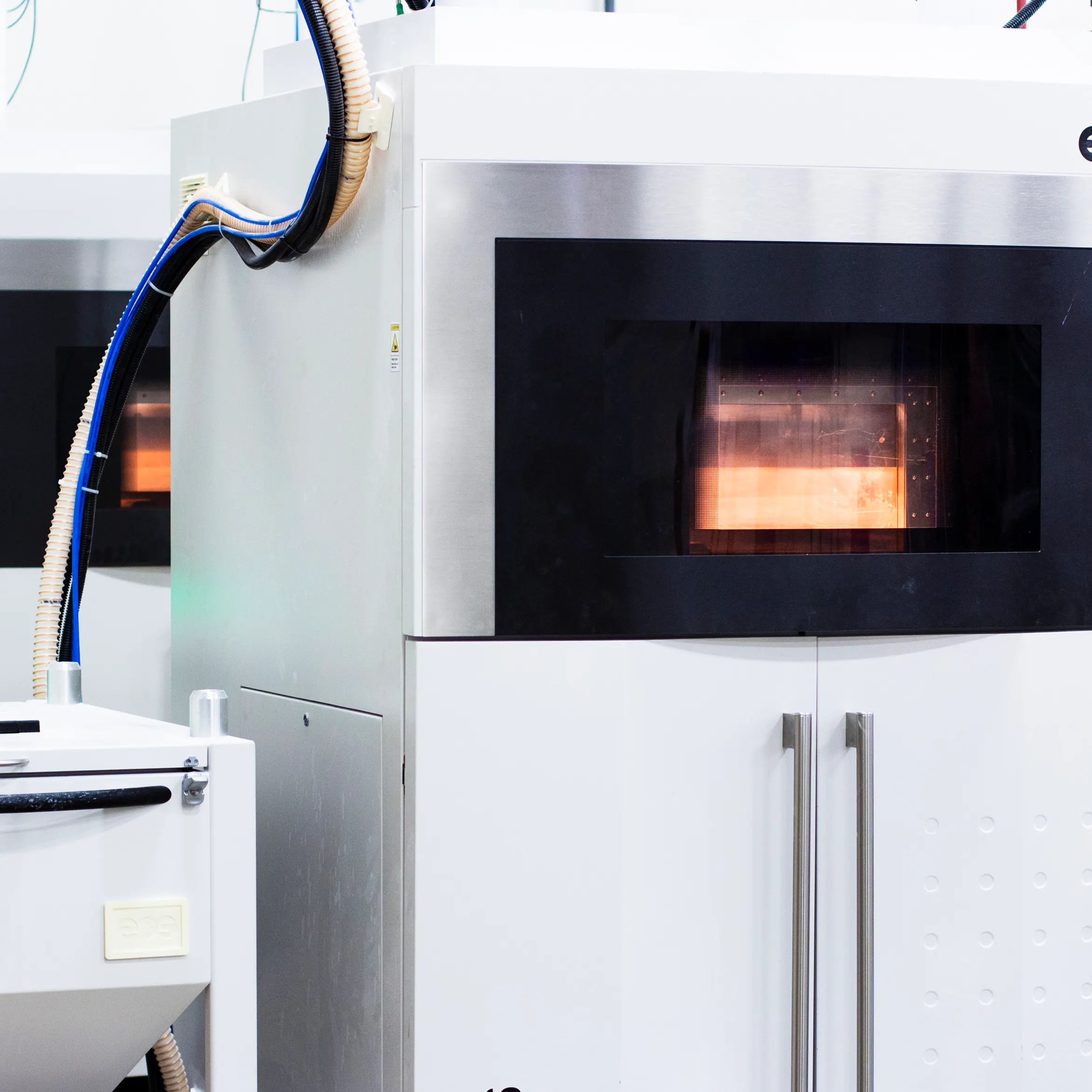
SLS and SLA do have a few similarities; they’re both 3D printing methods, and they both use lasers. But the way they work, how much they cost, and their capabilities differ quite a bit. If you’re not familiar with either (or both) of these options, read on to learn all about them, how they work, and the ways in which they are different.
SLS Definition and Comparison to SLA
SLS (selective laser sintering) is a type of 3D printing invented in the ‘80s by Drs. Deckard and Beaman at Austin’s University of Texas. An SLS 3D printer makes solid parts by fusing powdered particles (like plastic, metal, glass, or ceramic) together with a powerful laser. While most SLS machines use nylon- or polymer-based materials, more high-end machines can work with materials with higher melting points. You can see how this machine is made up in the below image.
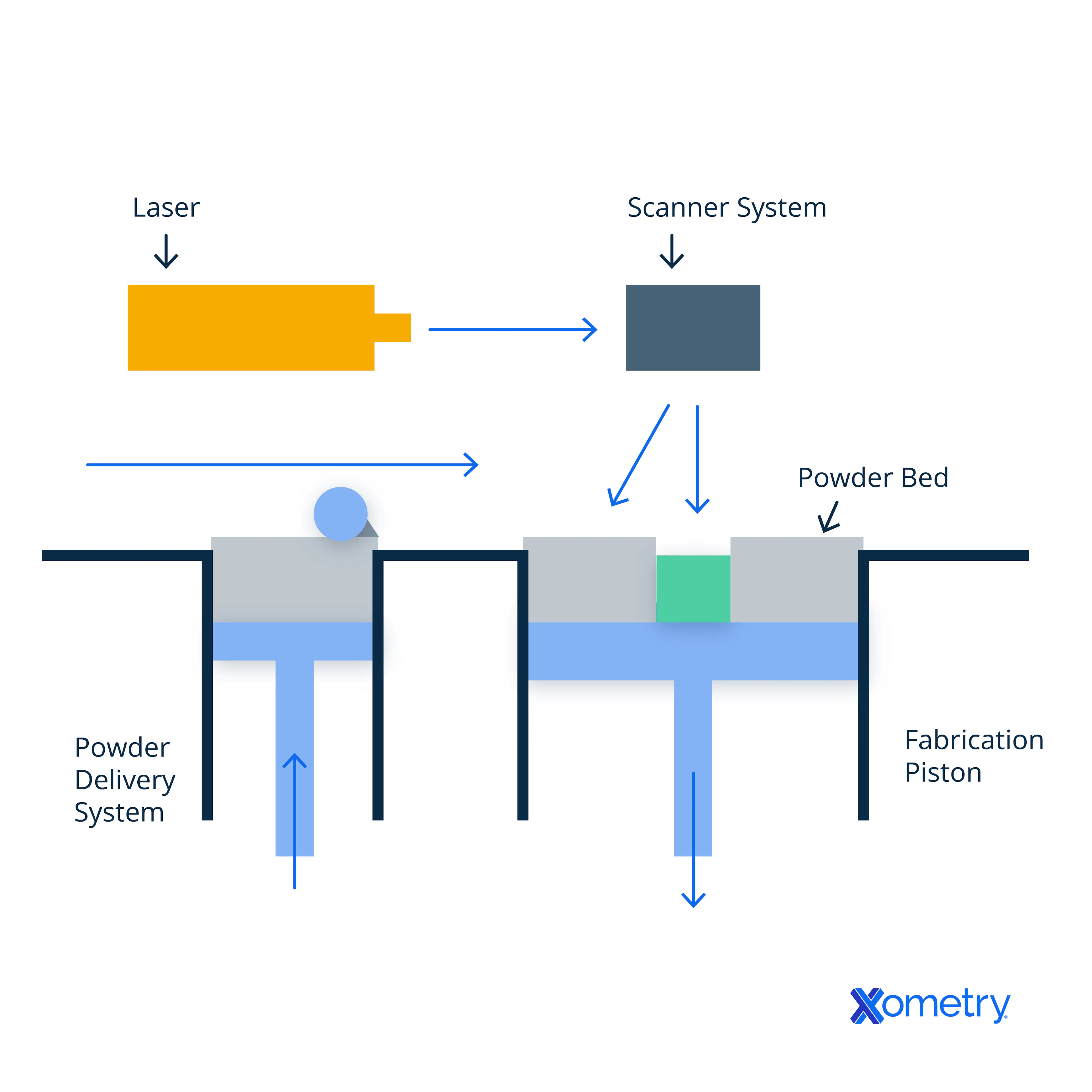
An SLS printer takes a digital design made on a computer and turns it into a physical model by first breaking it into 2D slices and then tracing them out individually. It then bonds the powder when necessary. It will then add more powder after each layer and the whole process repeats. Parts made with these printers are known for being tough, with great mechanical properties, but since the machine needs to be completely shielded and closed up during printing, you likely won’t be able to see your print until it’s finished. Here’s an example of an SLS-made part:
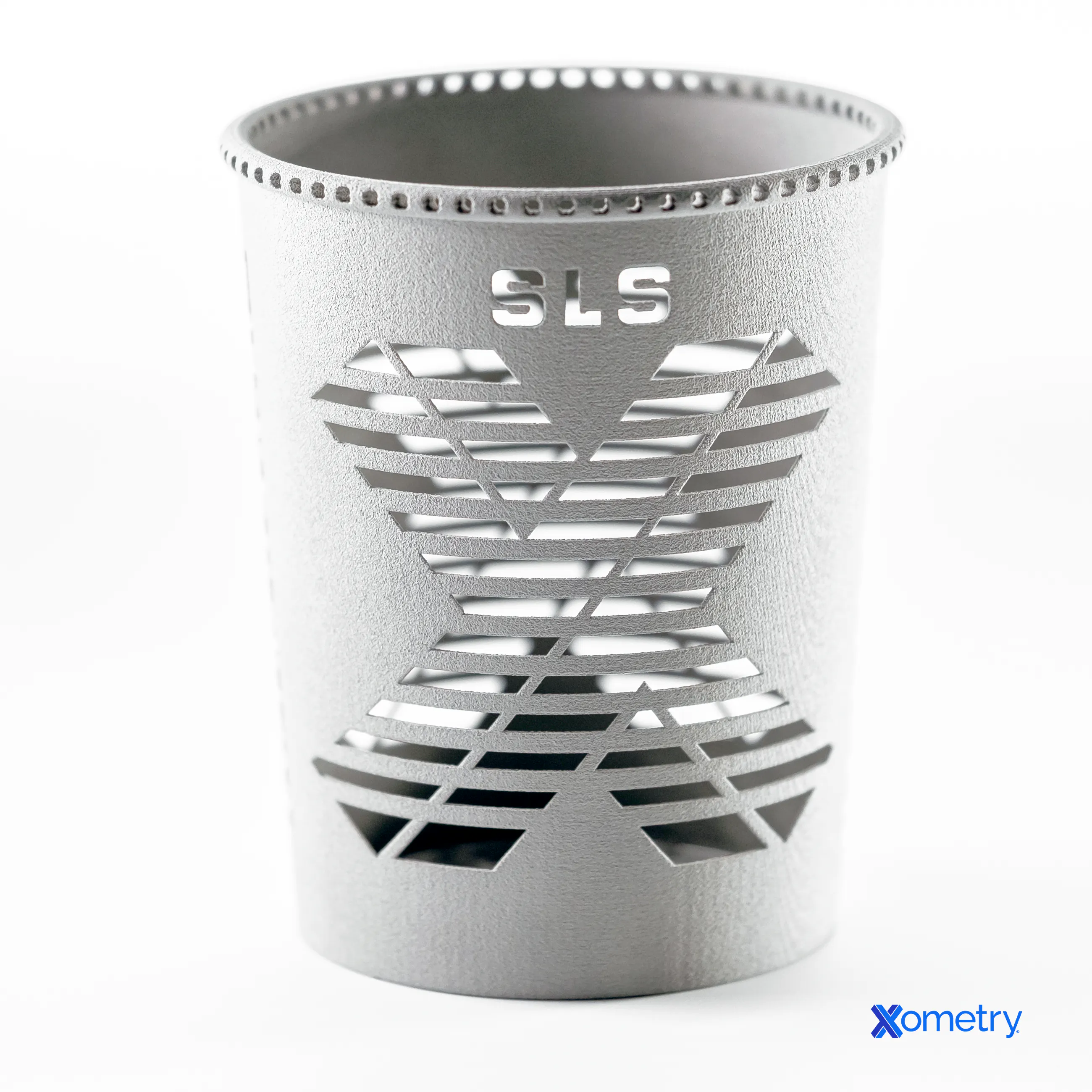
Another advantage SLS offers is that you don’t need any support structures during printing—the surrounding powder can actually provide support for any overhanging parts. A lot of our customers use it for their time-sensitive projects as it’s very quick. If you’re interested in buying one of these printers for your business, prepare to make a substantial investment. SLS machines are not only expensive to buy, but they also use up a lot of electricity, racking up those utility bills. You’ll also want to make sure you’ve got enough space in your office or lab for them as they’re on the bulky side.
What are the Advantages of SLS Compared to SLA?
There are advantages to using SLS vs. SLA. Some are listed below:
- SLS parts need no support structures during production while SLA parts do. The surrounding powder serves to support overhanging components during the building process. SLA parts need to be designed with supporting structures or built in such a way that makes the parts self-supporting.
- The SLS production process is faster than SLA. That makes it handy for rapid prototyping activities.
- The parts produced via SLS are tougher than those of SLA, so they’re more often used as functional parts.
What are the Disadvantages of SLS Compared to SLA?
Though SLS is very capable, it still has its disadvantages. These include:
- SLS machines are more expensive than SLA machines.
- The SLS laser demands a lot of electricity. This means the print needs to be completely enclosed and shielded. The laser beam in SLA uses less power; users can view the print while it is enclosed behind plastic or tinted glass.
- SLS machines are bulkier. They typically fill an entire laboratory workbench. In contrast, SLA machines are often designed as desktop devices.
SLA Definition and Comparison to SLS
SLA, an abbreviation for stereolithography, is also a form of 3D printing that’s considered the oldest around. Invented in 1986 by 3D Systems’ founder Chuck Hall, SLA builds parts in a more peculiar way… upside down. It uses a type of laser, but this time it’s an ultraviolet laser that cures photosensitive resin into whichever shape you’ve chosen. While it prints, the build plate is always in contact with the resin tank. The laser points at specific parts until they’ve solidified, and then the plate raises out of the reservoir so the next layer can be cured. As this happens, each layer fuses with the one prior, and the whole process almost looks like the part is rising out of the liquid. You can see how these printers work in the following image:

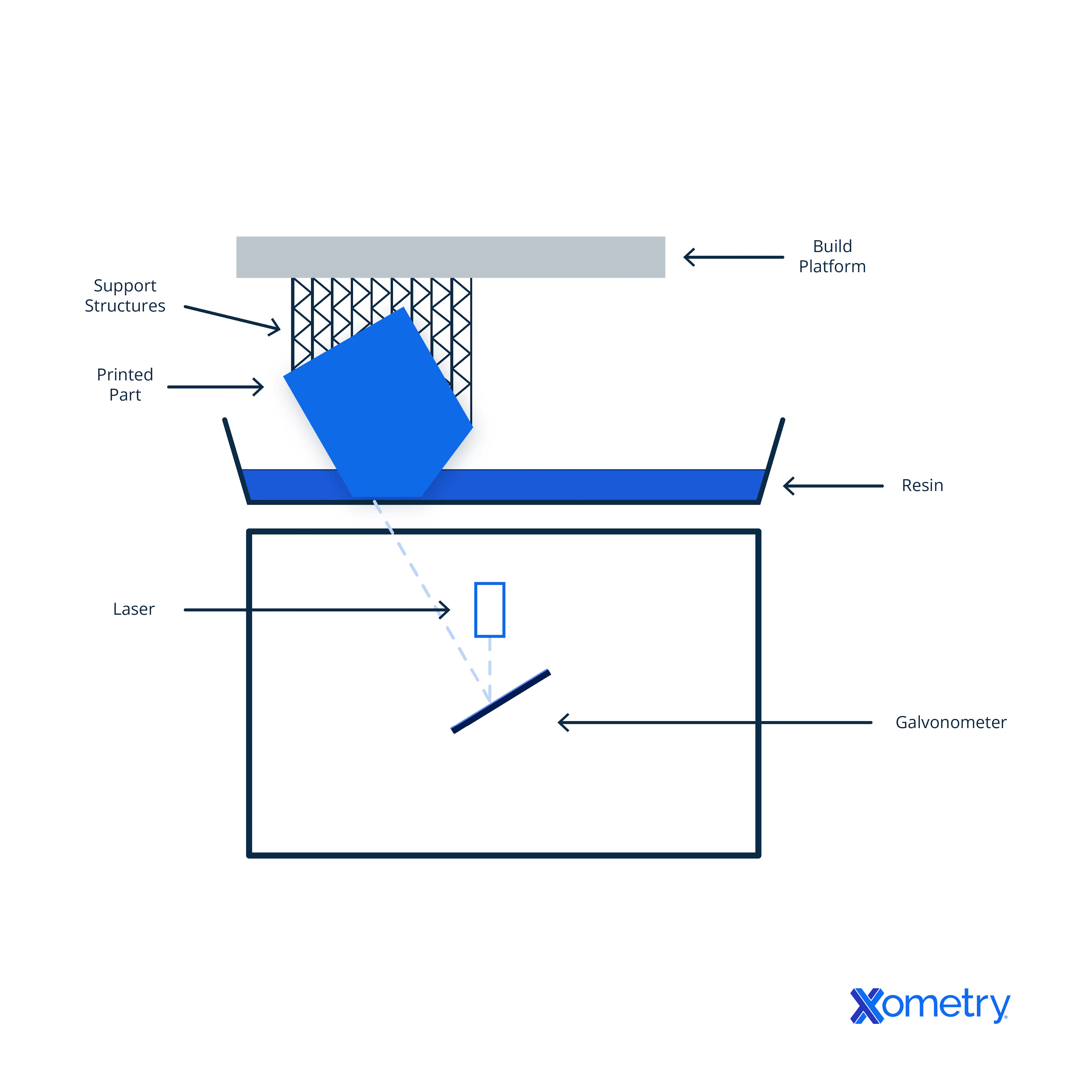
Around six years after it was initially introduced, the printer got a big upgrade that made it capable of printing more complex parts and much more quickly. It’s still used today, especially when tight tolerances are needed. SLA printers can make parts with great resolution and surface finishes (like injection-molded parts), and they’re much smaller than SLS machines and can fit on an average desk. Their small size does mean that they’re not able to print larger parts like an SLS printer.
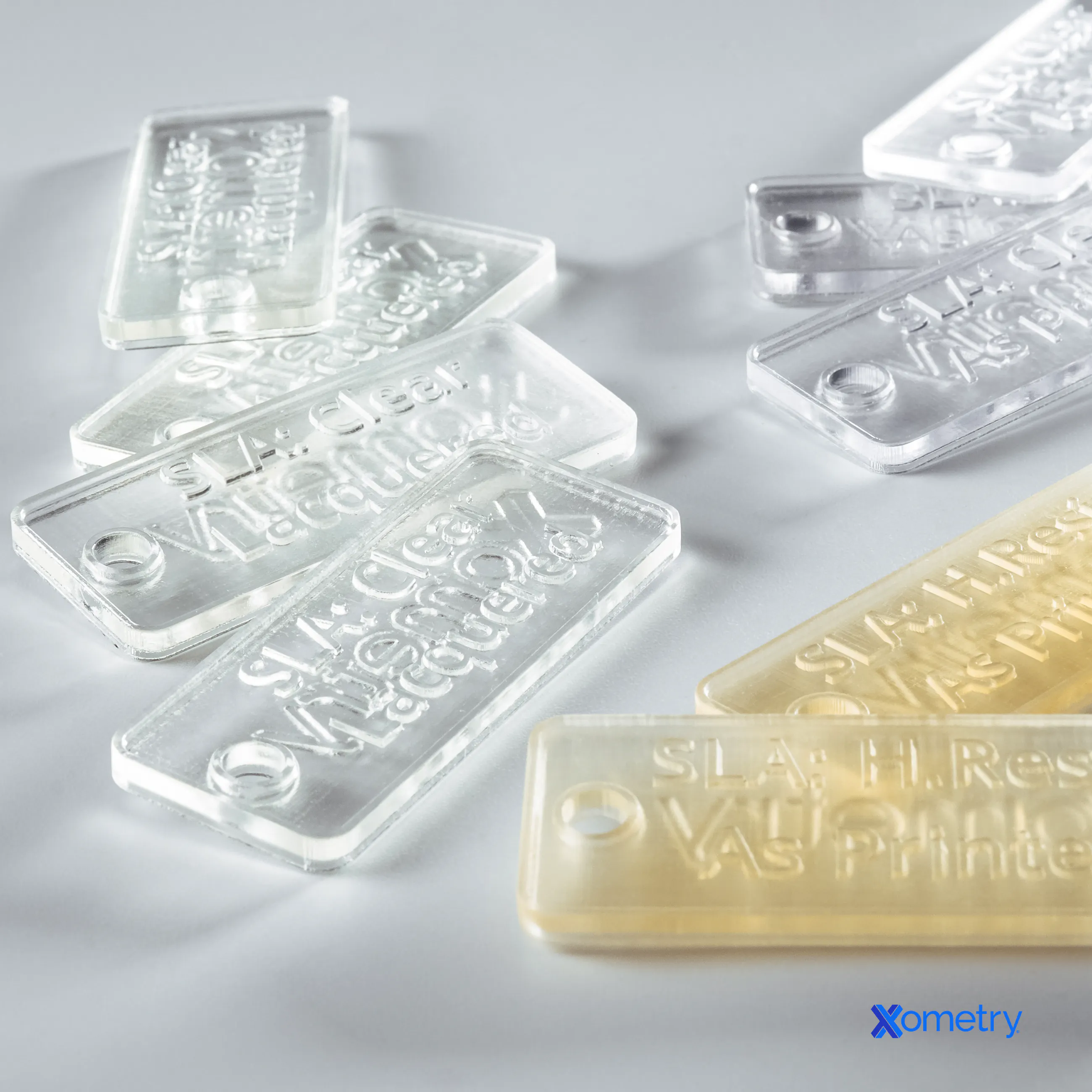
Also, the resin used isn’t environmentally friendly, and the fumes can be quite nasty (remember to wear gloves and all the necessary PPE). Some polymer powders like nylon, though, aren’t too bad unless you have specific allergies. Finally, SLA parts are not as strong as SLA parts. That’s why they’re better for proofs of concept or experiments. The following picture shows some SLA 3D printed tags we made here at Xometry:
What are the Advantages of SLA Compared to SLS?
SLA’s advantages compared to SLS are:
- SLA systems provide greater resolution than their SLS counterparts.
- SLA produces parts with better surface finishes than SLS. Its parts are comparable to injection-molded parts.
- SLA machines are less bulky than SLS. For this reason, they can serve as desktop devices.
What are the Disadvantages of SLA Compared to SLS?
Listed below are the disadvantages of SLS compared to SLS:
- SLA cannot print parts as large as those of SLS.
- The resin in SLA is not environmentally friendly. The resins produce unpleasant fumes and require one to wear gloves when handling them. On the other hand, SLS uses polymer powder such as nylon which is not particularly harmful except to people with specific allergies.
- SLA produces weaker parts compared to SLS. They are best used as proofs of concept or for experimental use.
"SLS and SLA are both laser-based processes building a part layer by layer, but that is about where the similarity ends. SLS uses a laser to melt powdered thermoplastics, while SLA uses a laser to photoset a thermoset resin. The main factors in SLA lead time are curing and support material removal, neither of which are required for SLS. Parts must be cured in a light chamber or oven to reach full stiffness, and support material must be removed using a variety of tools."
Comparison of SLS and SLA
In the following table, we list some further attributes of the two methods and compare them:
| Attribute | SLS | SLA |
|---|---|---|
| Attribute Sensitivity to UV light | SLS No | SLA Yes |
| Attribute It makes rough surface finishes | SLS Yes | SLA No |
| Attribute It’s limited regarding material compatibility | SLS Yes | SLA No |
| Attribute The process is quick | SLS Yes | SLA No |
SLS vs. SLA Comparison
The polymer resin used in SLA is sensitive to UV light. As such, it should be kept away from sunlight or any other source of light that contains UV radiation. SLS products do not have this shortcoming, and nor do they need supporting structures during manufacturing. The unfused powder particles are sufficient to provide support.
SLS vs. SLA: Technology Comparison
The high-powered laser in SLS is completely enclosed, giving operators no view of the print. SLA laser output is significantly lower in power and requires only tinted glass or a plastic enclosure to prevent the UV light from escaping.
SLS vs. SLA: Material Comparison
The polymer powder in SLS is easy to handle but users must wear gloves while handling SLA parts. The resin used in the production process is slightly harmful. Some commercially available production materials used in SLS include: polyaryletherketones, thermoplastic elastomers, polystyrenes, and nylon. SLA materials include but are not limited to: epoxy photopolymer, acrylic photopolymer, and some others with polypropylene-like and ABS-like properties.
SLS vs. SLA: Product Applications Comparison
SLS produces parts that are tougher than those of SLA. This makes them better options for mechanical or end-use applications.
SLS vs. SLA: Print Volume Comparison
Thanks to its size and the sintering time, SLS prints faster than SLA both on large- and small-scale models. In addition to this, SLS requires no supporting structures during the building process.
SLS vs. SLA: Cost Comparison
SLS devices are generally more expensive than SLA devices. In both cases, the cost is compounded over time since materials such as resin or powder have to be purchased regularly. SLS machines can be purchased for as little as $10,000 or as much as $650,000. The cost depends on the maximum build volume, minimum layer thickness, print speed, laser type, and the build materials it can accept. SLA machines, on the other hand, usually fall in the range of $3,750 to $5,000, depending on the size. They can be classified into four different types: DIY, advanced hobbyist, professional and performance, and business and industrial.
What are the Mutual Alternatives to the SLS and SLA?
Of course. The mutual alternative to both would probably be MJF—or multi-jet fusion. It can be used to make functional prototypes, proofs of concept, and end-use parts and doesn’t need a high-powered laser to do so.
What are the Similarities Between SLS and SLA?
SLS and SLA share some basic similarities:
- Both technologies employ lasers to fuse material.
- Both require post-processing. SLS parts have to be cleaned to remove excess powder and may need extra work to match surface-quality specifications. Similarly, SLA parts have to be cleaned to get rid of uncured resin.
What are the Other Comparisons for SLS Besides SLA?
Listed below are the 3D printing technologies that can also be compared to SLS:
Here are some specific SLS alternatives:
- SLM (selective laser melting) uses metallic powder rather than polymer. To learn more, see our full guide on SLS vs. SLM.
- EMB (electron beam melting) melts and prints metal parts under a vacuum with an electron beam.
- FDM (fused deposition modeling) uses a heated nozzle to melt and create layers of filament material.
What are the Other Comparisons for SLA Besides SLS?
Listed below are the 3D printing technologies that can also be compared to SLA:
- MJ (material jetting) machines use an inkjet-like print head that sprays liquid photopolymer in the pattern of the cross-section of the part. After the spraying, a UV light is used to cure the polymer.
- DLP (digital light processing) printers expose only parts of photopolymer resin to UV light to cure them. Unlike SLA, though, DLP printers use a projector light and thousands of tiny mirrors to direct it to or away from the print bed. To learn more, see our full guide on SLA vs. DLP.
Frequently Asked Questions About SLS and SLA
How Xometry Can Help
If you still have questions about SLS, SLA, FDM, or any other type of 3D printing, feel free to reach out to one of our representatives who will be happy to assist. Xometry also offers a vast array of manufacturing services, including CNC machining and laser cutting. Get started today by requesting a free, no-obligation quote.
Disclaimer
The content appearing on this webpage is for informational purposes only. Xometry makes no representation or warranty of any kind, be it expressed or implied, as to the accuracy, completeness, or validity of the information. Any performance parameters, geometric tolerances, specific design features, quality and types of materials, or processes should not be inferred to represent what will be delivered by third-party suppliers or manufacturers through Xometry’s network. Buyers seeking quotes for parts are responsible for defining the specific requirements for those parts. Please refer to our terms and conditions for more information.